

Kirjojen hintavertailu – 12 903 724 kirjaa ja 27 kauppaa

Kirjailija

Martin Vieiro

Kirjat ja teokset yhdessä paikassa: 2 kirjaa, julkaisuja vuodelta 2013, suosituimpiin kuuluu Local Content Requirements – A Global Problem. Vertaile teosten hintoja ja tarkista saatavuus suomalaisista kirjakaupoista.

2 kirjaa

Local Content Requirements – A Global Problem

Local Content Requirements – A Global Problem

Gary Clyde Hufbauer; Jeffrey Schott; Cathleen Cimino–isaacs; Martin Vieiro; Erika Wada

The Peterson Institute for International Economics
2013
nidottu
In the wake of the Great Recession of 2008-09, economists feared that protectionist policies might sweep the world economy, echoing the wave of tariff escalations during the Great Depression of the 1930s. To some surprise, officials were more restrained and largely avoided traditional forms of protection (tariffs and quotas). As a result, economists underestimated the incidence of new protectionism because policymakers increasingly turned to more opaque behind-the-border nontariff barriers (NTBs). Using a combination of statistical analysis and case studies, the authors show that local content requirements (LCRs), a form of NTB, have become increasingly popular. How much was global trade actually reduced on account of LCRs? A conservative estimate might be $93 billion. Case studies featured cover the healthcare sector in Brazil, wind turbines in Canada, the automobile industry in China, solar cells and modules in India, oil and gas in Nigeria, and "Buy American" restrictions on government procurement.
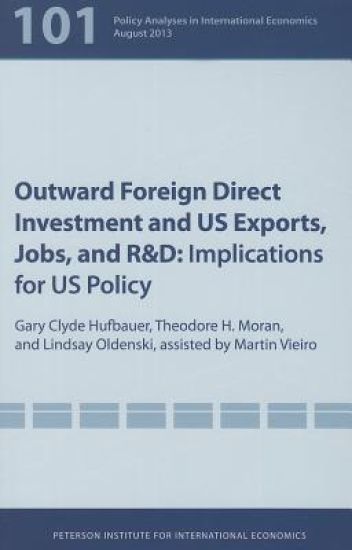
Outward Foreign Direct Investment and US Exports – Implications for US Policy

Outward Foreign Direct Investment and US Exports – Implications for US Policy

Gary Clyde Hufbauer; Theodore Moran; Lindsay Oldenski; Martin Vieiro

The Peterson Institute for International Economics
2013
nidottu
It is not in the US interest to adopt tax and regulatory policies that would discourage global engagement by US multinational corporations (MNCs). Research presented in this book shows that the expansion of foreign affiliates of US MNCs is positively associated with more production, greater employment, higher exports, and more research and development (R&D) in the United States. These findings suggest that less investment abroad by US firms would weaken-not strengthen-the US economy. This analysis by no means implies that there are only winners and no losers from outward investment. Changing patterns of MNC investment, like changing patterns of technology and production more generally, contribute to job losses and dislocations for some workers and to new opportunities for others. To benefit the US economy and US workers most broadly, the United States will want to search for ways to strengthen the appeal of the United States as a base for the operations of international firms. High among the recommendations to accomplish this, the United States should adopt a territorial tax system, like the great majority of developed countries.