Kirjojen hintavertailu – 12 859 819 kirjaa ja 27 kauppaa

Kirjailija

Martti Koskenniemi

Kirjat ja teokset yhdessä paikassa: 8 kirjaa, julkaisuja vuosilta 2001–2023, suosituimpiin kuuluu The Politics of International Law. Vertaile teosten hintoja ja tarkista saatavuus suomalaisista kirjakaupoista.

8 kirjaa

Kirjojen julkaisuvuodet: 2001–2023.

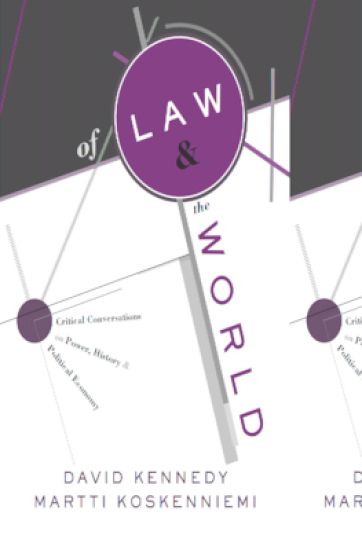
Of Law and the World

Of Law and the World

David Kennedy; Martti Koskenniemi

HARVARD UNIVERSITY PRESS
2023
sidottu

Halvin toimitettuna 46,40 €

A searching dialogue between two leading legal scholars exploring the place of law in global affairs. The modern world is legalized: legal language, institutions, and professionals are everywhere. But what is law’s power in global life? What does all this legality have to do with hegemony, with hierarchy and inequality, and with the diversity of human experience? What is its history and how does that history matter in world affairs? Above all, what does it mean to think “critically” about law and global affairs? In this poignant and iconoclastic book, two leading scholars take us to the heart of the matter, examining law’s relationship with history, power, and political economy. David Kennedy and Martti Koskenniemi have often inspired each other and are both considered “critical” voices in international law, but they have never explored their similarities and differences as deeply as they do here. Of Law and the World takes the form of a conversation, as the authors reflect on the study of international law, the motivations underlying their research, and the payoffs and limitations of their investigations into law’s role in global affairs. They revisit and renew debates about the past and future of the many legalities that shape our world. Erudite, open-minded, and informed by decades of experience and observation, Of Law and the World is an unflinchingly honest confrontation with humanity’s struggle to live together.
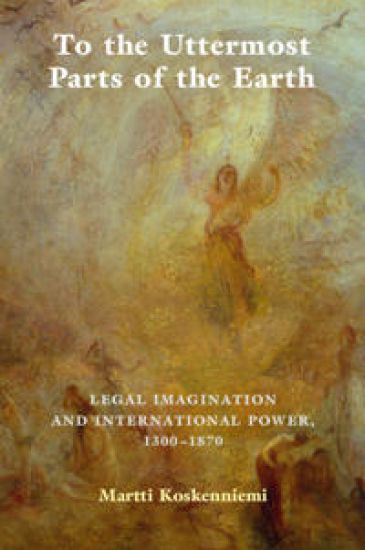
To the Uttermost Parts of the Earth

To the Uttermost Parts of the Earth

Martti Koskenniemi

Cambridge University Press
2021
sidottu
To the Uttermost Parts of the Earth shows the vital role played by legal imagination in the formation of the international order during 1300–1870. It discusses how European statehood arose during early modernity as a locally specific combination of ideas about sovereign power and property rights, and how those ideas expanded to structure the formation of European empires and consolidate modern international relations. By connecting the development of legal thinking with the history of political thought and by showing the gradual rise of economic analysis into predominance, the author argues that legal ideas from different European legal systems - Spanish, French, English and German - have played a prominent role in the history of global power. This history has emerged in imaginative ways to combine public and private power, sovereignty and property. The book will appeal to readers crossing conventional limits between international law, international relations, history of political thought, jurisprudence and legal history.
To the Uttermost Parts of the Earth

To the Uttermost Parts of the Earth

Martti Koskenniemi

Cambridge University Press
2021
pokkari

Halvin toimitettuna 99,50 €

To the Uttermost Parts of the Earth shows the vital role played by legal imagination in the formation of the international order during 1300–1870. It discusses how European statehood arose during early modernity as a locally specific combination of ideas about sovereign power and property rights, and how those ideas expanded to structure the formation of European empires and consolidate modern international relations. By connecting the development of legal thinking with the history of political thought and by showing the gradual rise of economic analysis into predominance, the author argues that legal ideas from different European legal systems - Spanish, French, English and German - have played a prominent role in the history of global power. This history has emerged in imaginative ways to combine public and private power, sovereignty and property. The book will appeal to readers crossing conventional limits between international law, international relations, history of political thought, jurisprudence and legal history.
Is International Law International?

Is International Law International?

Anthea Roberts; Martti Koskenniemi

Oxford University Press Inc
2017
sidottu
This book takes the reader on a sweeping tour of the international legal field to reveal some of the patterns of difference, dominance, and disruption that belie international law's claim to universality. Pulling back the curtain on the "divisible college of international lawyers", Anthea Roberts shows how international lawyers in different states, regions, and geopolitical groupings are often subject to distinct incoming influences and outgoing spheres of influence in ways that reflect and reinforce differences in how they understand and approach international law. These divisions manifest themselves in contemporary controversies, such as debates about Crimea and the South China Sea. Not all approaches to international law are created equal, however. Using case studies and visual representations, the author demonstrates how actors and materials from some states and groups have come to dominate certain transnational flows and forums in ways that make them disproportionately influential in constructing the "international". This point holds true for Western actors, materials, and approaches in general, and for Anglo-American (and sometimes French) ones in particular. However, these patterns are set for disruption. As the world moves past an era of Western dominance and toward greater multipolarity, it is imperative for international lawyers to understand the perspectives and approaches of those coming from diverse backgrounds. By taking readers on a comparative tour of different international law academies and textbooks, the author encourages them to see the world through the eyes of others - an essential skill in this fast changing world of shifting power dynamics and rising nationalism.
The Politics of International Law

The Politics of International Law

Martti Koskenniemi

Hart Publishing
2011
nidottu

Halvin toimitettuna 110,00 €

Today international law is everywhere. Wars are fought and opposed in its name. It is invoked to claim rights and to challenge them, to indict or support political leaders, to distribute resources and to expand or limit the powers of domestic and international institutions. International law is part of the way political (and economic) power is used, critiqued, and sometimes limited. Despite its claim for neutrality and impartiality, it is implicit in what is just, as well as what is unjust in the world. To understand its operation requires shedding its ideological spell and examining it with a cold eye. Who are its winners, and who are its losers? How - if at all - can it be used to make a better or a less unjust world? In this collection of essays Professor Martti Koskenniemi, a well-known practitioner and a leading theorist and historian of international law, examines the recent debates on humanitarian intervention, collective security, protection of human rights and the 'fight against impunity' and reflects on the use of the professional techniques of international law to intervene politically. The essays both illustrate and expand his influential theory of the role of international law in international politics. The book is prefaced with an introduction by Professor Emmanuelle Jouannet (Sorbonne Law School), which locates the texts in the overall thought and work of Martti Koskenniemi.
From Apology to Utopia

From Apology to Utopia

Martti Koskenniemi

Cambridge University Press
2006
sidottu
This book presents a critical view of international law as an argumentative practice that aims to 'depoliticise' international relations. Drawing from a range of materials, Koskenniemi demonstrates how international law becomes vulnerable to the contrasting criticisms of being either an irrelevant moralist Utopia or a manipulable façade for State interests. He examines the conflicts inherent in international law - sources, sovereignty, 'custom' and 'world order' - and shows how legal discourse about such subjects can be described in terms of a small number of argumentative rules. This book was originally published in English in Finland in 1989 and though it quickly became a classic, it has been out of print for some years. In 2006, Cambridge was proud to reissue this seminal text, together with a freshly written Epilogue in which the author both responds to critiques of the original work, and reflects on the effect and significance of his 'deconstructive' approach today.
From Apology to Utopia

From Apology to Utopia

Martti Koskenniemi

Cambridge University Press
2006
pokkari

Halvin toimitettuna 67,20 €

This book presents a critical view of international law as an argumentative practice that aims to 'depoliticise' international relations. Drawing from a range of materials, Koskenniemi demonstrates how international law becomes vulnerable to the contrasting criticisms of being either an irrelevant moralist Utopia or a manipulable façade for State interests. He examines the conflicts inherent in international law - sources, sovereignty, 'custom' and 'world order' - and shows how legal discourse about such subjects can be described in terms of a small number of argumentative rules. This book was originally published in English in Finland in 1989 and though it quickly became a classic, it has been out of print for some years. In 2006, Cambridge was proud to reissue this seminal text, together with a freshly written Epilogue in which the author both responds to critiques of the original work, and reflects on the effect and significance of his 'deconstructive' approach today.
The Gentle Civilizer of Nations

The Gentle Civilizer of Nations

Martti Koskenniemi

Cambridge University Press
2001
sidottu
International law was born from the impulse to ‘civilize’ late nineteenth-century attitudes towards race and society, argues Martti Koskenniemi in this fascinating and highly readable study of the rise and fall of modern international law. In a work of immense intellectual scope, Koskenniemi traces the emergence of a liberal sensibility relating to international matters in the late nineteenth century, and its subsequent decline after the Second World War. He combines legal analysis, historical and political critique and semi-biographical studies of key figures (including Hersch Lauterpacht, Carl Schmitt and Hans Morgenthau); he also considers the role of crucial institutions (such as the Institut de droit international and the League of Nations). His discussion of legal and political realism at American law schools ends in a critique of post–1960 ‘instrumentalism’. Along with the book’s other chapters, this provides a unique reflection on the possibility of critical international law today.