Kirjojen hintavertailu – 12 903 724 kirjaa ja 27 kauppaa

Kirjailija

Mary Dalrymple

Kirjat ja teokset yhdessä paikassa: 5 kirjaa, julkaisuja vuosilta 1993–2019, suosituimpiin kuuluu The Syntax of Anaphoric Binding. Vertaile teosten hintoja ja tarkista saatavuus suomalaisista kirjakaupoista.

5 kirjaa

Kirjojen julkaisuvuodet: 1993–2019.

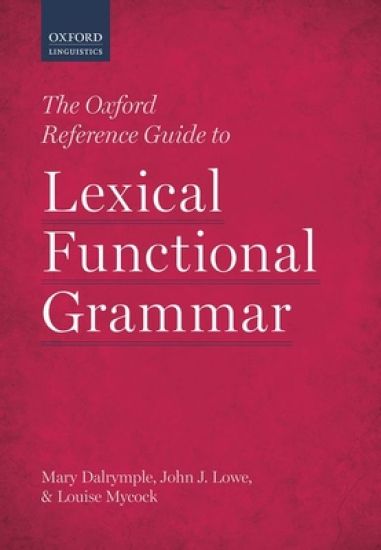
The Oxford Reference Guide to Lexical Functional Grammar

The Oxford Reference Guide to Lexical Functional Grammar

Mary Dalrymple; John J. Lowe; Louise Mycock

Oxford University Press
2019
sidottu
This volume is the most comprehensive reference work to date on Lexical Functional Grammar. The authors provide detailed and extensive coverage of the analysis of syntax, semantics, morphology, prosody, and information structure, and how these aspects of linguistic structure interact in the nontransformational framework of LFG. The book is divided into three parts. The first part examines the syntactic theory and formal architecture of LFG, with detailed explanations and comprehensive illustration, providing an unparalleled introduction to the fundamentals of the theory. Part two explores non-syntactic levels of linguistic structure, including the syntax-semantics interface and semantic representation, argument structure, information structure, prosodic structure, and morphological structure, and how these are related in the projection architecture of LFG. Chapters in the third part illustrate the theory more explicitly by presenting explorations of the syntax and semantics of a range of representative linguistic phenomena: modification, anaphora, control, coordination, and long-distance dependencies. The final chapter discusses LFG-based work not covered elsewhere in the book, as well as new developments in the theory. The volume will be an invaluable reference for graduate and advanced undergraduate students and researchers in a wide range of linguistic sub-fields, including syntax, morphology, semantics, information structure, and prosody, as well as those working in language documentation and description.
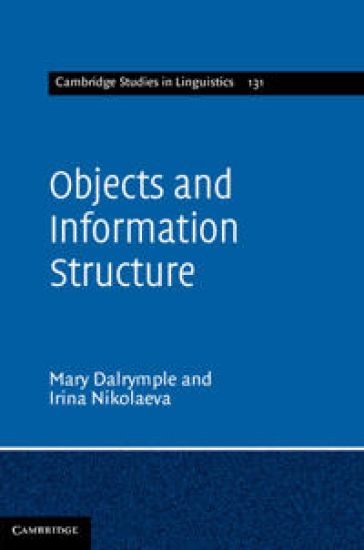
Objects and Information Structure

Objects and Information Structure

Mary Dalrymple; Irina Nikolaeva

Cambridge University Press
2014
pokkari
In many languages, the objects of transitive verbs are either marked by grammatical case or agreement on the verb, or they remain unmarked: this is differential object marking. This book is a cross-linguistic study of how differential object marking is affected by information structure, the structuring of the utterance in accordance with the informational value of its elements and contextual factors. Marked objects tend to be associated with old information or information that the sentence is about, while unmarked objects tend to express new information. The book also sheds light on grammatical patterning in languages with differential object marking: in some languages marked and unmarked objects have identical grammatical properties, whereas in other languages marked objects are more active in syntax. Finally, it provides a theory of the historical changes that lead to the emergence of various patterns of differential object marking.
Objects and Information Structure

Objects and Information Structure

Mary Dalrymple; Irina Nikolaeva

Cambridge University Press
2011
sidottu
In many languages, the objects of transitive verbs are either marked by grammatical case or agreement on the verb, or they remain unmarked: this is differential object marking. This book is a cross-linguistic study of how differential object marking is affected by information structure, the structuring of the utterance in accordance with the informational value of its elements and contextual factors. Marked objects tend to be associated with old information or information that the sentence is about, while unmarked objects tend to express new information. The book also sheds light on grammatical patterning in languages with differential object marking: in some languages marked and unmarked objects have identical grammatical properties, whereas in other languages marked objects are more active in syntax. Finally, it provides a theory of the historical changes that lead to the emergence of various patterns of differential object marking.
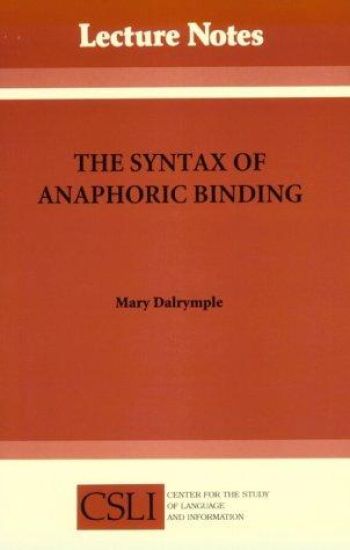
The Syntax of Anaphoric Binding

The Syntax of Anaphoric Binding

Mary Dalrymple

Centre for the Study of Language Information
1993
sidottu
Mary Dalrymple provides a theory of the syntax of anaphoric binding, couched in the framework of Lexical-Functional Grammar. Cross-linguistically, anaphoric elements vary a great deal. One finds long- and short-distance reflexives, sometimes within the same language; pronominals may require local noncoreference or coreference only with nonsubjects. Analyses of the syntax of anaphoric binding which have attempted to fit all languages into the mold of English are inadequate to account for the rich range of syntactic constraints that are attested. How, then, can the cross-linguistic regularities exhibited by anaphoric elements be captured, while at the same time accounting for the diversity that is found? Dalrymple shows that syntactic constraints on anaphoric binding can be expressed in terms of just three grammatical concepts: subject, predicate, and tense. These concepts define a set of complex constraints, combinations of which interact to predict the wide range of universally available syntactic conditions that anaphoric elements obey. Mary Dalrymple is a member of the research staff of the Natural Language Theory and Technology group at the Xerox Palo Alto Research Center.
Syntax of Anaphoric Binding

Syntax of Anaphoric Binding

Mary Dalrymple

Centre for the Study of Language Information
1993
pokkari
Mary Dalrymple provides a theory of the syntax of anaphoric binding, couched in the framework of Lexical-Functional Grammar. Cross-linguistically, anaphoric elements vary a great deal. One finds long- and short-distance reflexives, sometimes within the same language; pronominals may require local noncoreference or coreference only with nonsubjects. Analyses of the syntax of anaphoric binding which have attempted to fit all languages into the mold of English are inadequate to account for the rich range of syntactic constraints that are attested. How, then, can the cross-linguistic regularities exhibited by anaphoric elements be captured, while at the same time accounting for the diversity that is found? Dalrymple shows that syntactic constraints on anaphoric binding can be expressed in terms of just three grammatical concepts: subject, predicate, and tense. These concepts define a set of complex constraints, combinations of which interact to predict the wide range of universally available syntactic conditions that anaphoric elements obey. Mary Dalrymple is a member of the research staff of the Natural Language Theory and Technology group at the Xerox Palo Alto Research Center.