Kirjojen hintavertailu – 12 903 727 kirjaa ja 27 kauppaa

Kirjailija

Mary Ellen O'Connell

Kirjat ja teokset yhdessä paikassa: 6 kirjaa, julkaisuja vuosilta 2008–2020, suosituimpiin kuuluu The Art of Law in the International Community. Vertaile teosten hintoja ja tarkista saatavuus suomalaisista kirjakaupoista.

6 kirjaa

Kirjojen julkaisuvuodet: 2008–2020.

The Art of Law in the International Community

The Art of Law in the International Community

Mary Ellen O'Connell

Cambridge University Press
2020
pokkari
International law evolved to end and prevent armed conflict as much as for any other reason. Yet, the law against war appears weaker today than ever in its long history, evidenced by raging armed conflicts in which people are killed, injured, and forcibly displaced. The environment is devastated, and the planet impoverished. These consequences can be traced to the dominant ideology of realism. In 1946, Hersch Lauterpacht challenged that ideology by contrasting it with the idea of international law, composed of natural law, positive law, and process theory. The Art of Law in the International Community revives his vision, rebuilding the understanding of why international law binds, what its norms require, and how courts are the ideal substitutes for war. The secret to the renewal of international law lies in revitalizing the moral foundation of natural law through drawing on aesthetic philosophy and the arts.
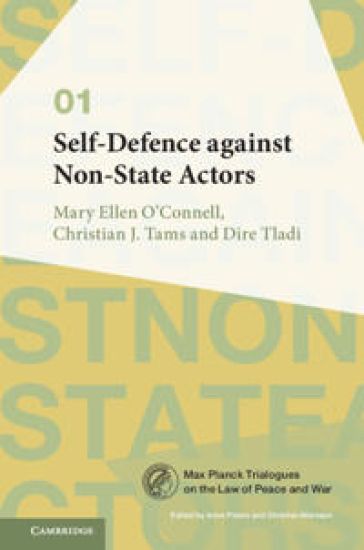
Self-Defence against Non-State Actors: Volume 1

Self-Defence against Non-State Actors: Volume 1

Mary Ellen O'Connell; Christian J. Tams; Dire Tladi

Cambridge University Press
2019
pokkari
In this book, self-defence against non-state actors is examined by three scholars whose geographical, professional, theoretical, and methodological backgrounds and outlooks differ greatly. Their trialogue is framed by an introduction and a conclusion by the series editors. The novel scholarly format accommodates the pluralism and value changes of the current era, a shifting world order and the rise in nationalism and populism. It brings to light the cultural, professional and political pluralism which characterises international legal scholarship and exploits this pluralism as a heuristic device. This multiperspectivism exposes how political factors and intellectual styles influence the scholarly approaches and legal answers and the trialogical structure encourages its participants to decentre their perspectives. By explicitly focussing on the authors' divergence and disagreement, a richer understanding of self-defence against non-state actors is achieved, and the legal challenges and possible ways ahead identified.
Self-Defence against Non-State Actors: Volume 1

Self-Defence against Non-State Actors: Volume 1

Mary Ellen O'Connell; Christian J. Tams; Dire Tladi

Cambridge University Press
2019
sidottu
In this book, self-defence against non-state actors is examined by three scholars whose geographical, professional, theoretical, and methodological backgrounds and outlooks differ greatly. Their trialogue is framed by an introduction and a conclusion by the series editors. The novel scholarly format accommodates the pluralism and value changes of the current era, a shifting world order and the rise in nationalism and populism. It brings to light the cultural, professional and political pluralism which characterises international legal scholarship and exploits this pluralism as a heuristic device. This multiperspectivism exposes how political factors and intellectual styles influence the scholarly approaches and legal answers and the trialogical structure encourages its participants to decentre their perspectives. By explicitly focussing on the authors' divergence and disagreement, a richer understanding of self-defence against non-state actors is achieved, and the legal challenges and possible ways ahead identified.
The Art of Law in the International Community

The Art of Law in the International Community

Mary Ellen O'Connell

Cambridge University Press
2019
sidottu
International law evolved to end and prevent armed conflict as much as for any other reason. Yet, the law against war appears weaker today than ever in its long history, evidenced by raging armed conflicts in which people are killed, injured, and forcibly displaced. The environment is devastated, and the planet impoverished. These consequences can be traced to the dominant ideology of realism. In 1946, Hersch Lauterpacht challenged that ideology by contrasting it with the idea of international law, composed of natural law, positive law, and process theory. The Art of Law in the International Community revives his vision, rebuilding the understanding of why international law binds, what its norms require, and how courts are the ideal substitutes for war. The secret to the renewal of international law lies in revitalizing the moral foundation of natural law through drawing on aesthetic philosophy and the arts.
The Power and Purpose of International Law

The Power and Purpose of International Law

Mary Ellen O'Connell

Oxford University Press Inc
2011
nidottu
The world is poised for another important transition. The United States is dealing with the impact of the Afghan and Iraq wars, the use of torture and secret detention, Guantanamo, climate change, nuclear proliferation, weakened international institutions, and other issues related directly or indirectly to international law. The world needs an accurate account of the important role of international law and The Power and Purpose of International Law seeks to provide it. Mary Ellen O'Connell explains the purpose of international law and the power it has to achieve that purpose. International law supports order in the world and the attainment of humanity's fundamental goals of peace, prosperity, respect for human rights, and protection of the natural environment. These goals can best be realized through international law, which uniquely has the capacity to bind even a superpower of the world. By exploring the roots and history of international law, and by looking at specific events in the history of international law, this book demonstrates the why and the how of international law and its enforcement. It directly confronts the notion that international law is "powerless" and that working within the framework of international law is useless or counter-productive. As the world moves forward, it is critical that both leaders and their citizens understand the true power and purpose of international law and this book creates a valuable resource for them to aid their understanding. It uses a clear, compelling style to convey topical, informative and cutting-edge information to the reader.
The Power and Purpose of International Law

The Power and Purpose of International Law

Mary Ellen O'Connell

Oxford University Press Inc
2008
sidottu
The world is poised for another important transition. The United States will soon have a new president, someone who will have to deal with the impact of the Afghan and Iraq wars, the use of torture and secret detention, Guantanamo, climate change, nuclear proliferation, weakened international institutions, and other issues related directly or indirectly to international law. The next president and the public worldwide need an accurate account of the important role of international law and The Power and Purpose of International Law seeks to provide it. Mary Ellen O'Connell explains the purpose of international law and the power it has to achieve that purpose. International law supports order in the world and the attainment of humanity's fundamental goals of peace, prosperity, respect for human rights, and protection of the natural environment. These goals can best be realized through international law, which uniquely has the capacity to bind even a superpower of the world. By exploring the roots and history of international law, and by looking at specific events in the history of international law, this book demonstrates the why and the how of international law and its enforcement. It directly confronts the notion that international law is "powerless" and that working within the framework of international law is useless or counter-productive. As the world moves forward, it is critical that both leaders and their citizens understand the true power and purpose of international law and this book creates a valuable resource for them to aid their understanding. It uses a clear, compelling style to convey topical, informative and cutting-edge information to the reader.