Kirjojen hintavertailu – 12 859 824 kirjaa ja 27 kauppaa

Kirjailija

Mary Frances Agnello

Kirjat ja teokset yhdessä paikassa: 7 kirjaa, julkaisuja vuosilta 1997–2020, suosituimpiin kuuluu A Postmodern Literacy Policy Analysis. Vertaile teosten hintoja ja tarkista saatavuus suomalaisista kirjakaupoista.

7 kirjaa

Kirjojen julkaisuvuodet: 1997–2020.

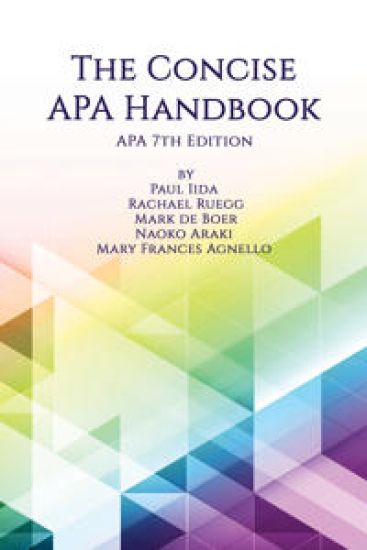
Concise APA Handbook

Concise APA Handbook

Paul Iida; Rachael Ruegg; Mark de Boer; Naoko Araki; Mary Frances Agnello

Information Age Publishing
2020
nidottu
Most students struggle with learning how to find references, use them effectively, and cite them appropriately in a required format. One of the most common formats is that of APA. The authors all have vast experience teaching writing courses to various levels of students from undergraduates to graduates in other countries. However, there was lacking a book that could explain the basics of APA in simple, easy-to-understand language for non-native speakers of English, who are often unfamiliar with using references and formatting an essay in a particular method. In order to offer English Learner student writers a source of information that is appropriate for their level, and is cost-effective, this updated APA 7th edition guidebook provides students with important information in clear, concise, user-friendly language, as well as to offer practical examples that will help them grasp the concept of secondary research writing. Much of the published materials on the market targets native speakers of English. The problem with this is that they present the nitpicky details of APA in ways that do not make sense to native speakers of English, let alone to those for whom English is not their first language, because the information is presented in very technical terms that are not easy to understand. This handbook presents the same information in simplified terms with images and step-by-step instructions in ways that make sense to both native and non-native English speaking student writers. Additionally, student writers often struggle with understanding the concept of plagiarism, as well as how to find sources, evaluate the appropriateness of sources, and use sources in effective ways (e.g., how to integrate quotes, when to paraphrase, among others). This book provides this important information that is concise and easy to understand. NOTE: This is a REVISED edition of our original The Concise APA Handbook, which has been updated for APA 7th edition, which was issued in the fall, 2019.
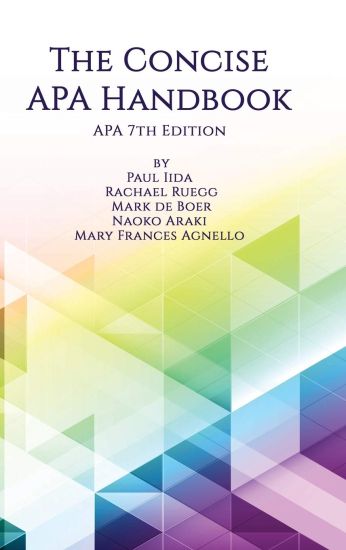
Concise APA Handbook

Concise APA Handbook

Paul Iida; Rachael Ruegg; Mark de Boer; Naoko Araki; Mary Frances Agnello

Information Age Publishing
2020
sidottu
Most students struggle with learning how to find references, use them effectively, and cite them appropriately in a required format. One of the most common formats is that of APA. The authors all have vast experience teaching writing courses to various levels of students from undergraduates to graduates in other countries. However, there was lacking a book that could explain the basics of APA in simple, easy-to-understand language for non-native speakers of English, who are often unfamiliar with using references and formatting an essay in a particular method. In order to offer English Learner student writers a source of information that is appropriate for their level, and is cost-effective, this updated APA 7th edition guidebook provides students with important information in clear, concise, user-friendly language, as well as to offer practical examples that will help them grasp the concept of secondary research writing. Much of the published materials on the market targets native speakers of English. The problem with this is that they present the nitpicky details of APA in ways that do not make sense to native speakers of English, let alone to those for whom English is not their first language, because the information is presented in very technical terms that are not easy to understand. This handbook presents the same information in simplified terms with images and step-by-step instructions in ways that make sense to both native and non-native English speaking student writers. Additionally, student writers often struggle with understanding the concept of plagiarism, as well as how to find sources, evaluate the appropriateness of sources, and use sources in effective ways (e.g., how to integrate quotes, when to paraphrase, among others). This book provides this important information that is concise and easy to understand. NOTE: This is a REVISED edition of our original The Concise APA Handbook, which has been updated for APA 7th edition, which was issued in the fall, 2019.
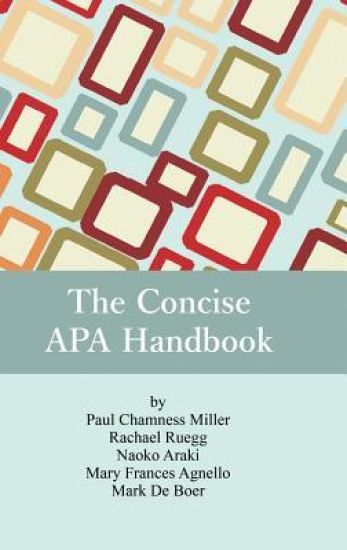
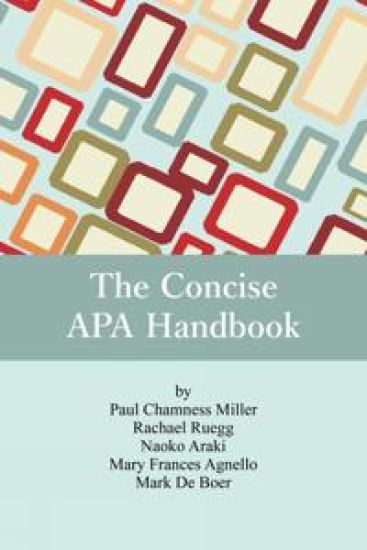
The Concise APA Handbook

The Concise APA Handbook

Paul Chamness Miller; Racheal Ruegg; Naoko Araki; Mary Frances Agnello; Mark de Boer

Information Age Publishing
2017
sidottu
Most students struggle with learning how to find references, use them effectively, and cite them appropriately in a required format. One of the most common formats is that of APA. The authors all teach at the same university, where their current offthe-shelf reference book, while helpful, is filled with a lot of extra information that they do not use and contains missing or incorrect information. The cost of this book also continues to rise. In a search for something else to meet their needs, they discovered that there are no concise guides that deal with APA only that are cost effective or user-friendly for students who are not familiar with using references and formatting an essay in the APA format. In order to offer student writers a source of information that is concise and cost-effective, the authors have written this handbook to provide students with important information in clear, concise, user-friendly language, as well as to offer practical examples that will help them grasp the concept of secondary research writing. Much of the published materials present the nitpicky details of APA in very technical terms that are not easy to understand. This handbook presents the same information in simplified terms with images and step-by-step instructions in ways that will make sense to both undergraduate and graduate student writers. Additionally, student writers often struggle with understanding the concept of plagiarism, as well as how to find sources, evaluate the appropriateness of sources, and use sources in effective ways (e.g., how to integrate quotes, when to paraphrase, among others). This book provides this information in a concise and easy-to-understand format.
The Concise APA Handbook

The Concise APA Handbook

Paul Chamness Miller; Racheal Ruegg; Naoko Araki; Mary Frances Agnello; Mark de Boer

Information Age Publishing
2017
nidottu
Most students struggle with learning how to find references, use them effectively, and cite them appropriately in a required format. One of the most common formats is that of APA. The authors all teach at the same university, where their current offthe-shelf reference book, while helpful, is filled with a lot of extra information that they do not use and contains missing or incorrect information. The cost of this book also continues to rise. In a search for something else to meet their needs, they discovered that there are no concise guides that deal with APA only that are cost effective or user-friendly for students who are not familiar with using references and formatting an essay in the APA format. In order to offer student writers a source of information that is concise and cost-effective, the authors have written this handbook to provide students with important information in clear, concise, user-friendly language, as well as to offer practical examples that will help them grasp the concept of secondary research writing. Much of the published materials present the nitpicky details of APA in very technical terms that are not easy to understand. This handbook presents the same information in simplified terms with images and step-by-step instructions in ways that will make sense to both undergraduate and graduate student writers. Additionally, student writers often struggle with understanding the concept of plagiarism, as well as how to find sources, evaluate the appropriateness of sources, and use sources in effective ways (e.g., how to integrate quotes, when to paraphrase, among others). This book provides this information in a concise and easy-to-understand format.
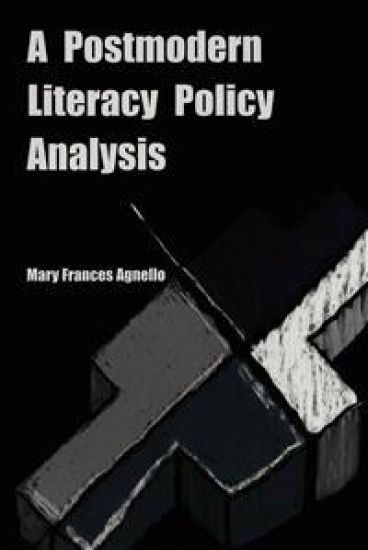
A Postmodern Literacy Policy Analysis

A Postmodern Literacy Policy Analysis

Mary Frances Agnello

Peter Lang Publishing Inc
2001
nidottu
This book traces the development of four literacy discourses over twenty-five years: human capital, cultural, critical, and feminist literacy. By analyzing four federal educational policies and their specific references to literacy, language instruction, and key signifiers of the kinds of literacy prescribed for teachers and students, Mary Frances Agnello describes how the discourses of human capital and cultural literacy have been and remain predominant over the lesser well-known discourses of critical and feminist literacy. Tracing the proliferations and transformations in the meanings of literacy, Agnello looks to trends generated by the last wave of educational reform. She employs a vehicle of literacy policy analysis to locate where power is exercised to both define and develop literacy in the citizenry at large. As teachers and students question their positions with respect to these policies, they can become more self-directed promoters of democratic classroom literacy practices.
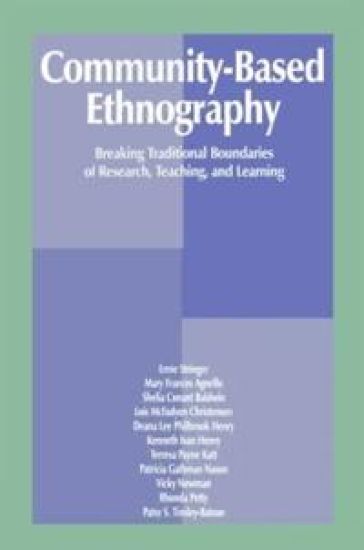
Community-Based Ethnography

Community-Based Ethnography

Ernest T. Stringer; Mary Frances Agnello; Sheila Conant Baldwin; Lois McFayden Christensen; Deana Lee Philb Henry

Psychology Press
1997
nidottu
Co-written by a professor and 10 students, this book explores their attempts to come to grips with fundamental issues related to writing narrative accounts purporting to represent aspects of people's lives. The fundamental project, around which their explorations in writing textual accounts turned, derived from the editor's initial ethnographic question: "Tell me about the [previous] class we did together?" This proved to be a particularly rich exercise, bringing into the arena all of the problems related to choice of data, analysis of data, the structure of the account, the stance of the author, tense, and case, the adequacy of the account, and more. As participants shared versions of their accounts and struggled to analyze the wealth of data they had accumulated in the previous classes -- the products of in-class practice of observation and interview -- they became aware of the ephemeral nature of narrative accounts. Reality, as written in textual form, cannot capture the immense depth, breadth, and complexity of an actual lived experience and can only be an incomplete representation that derives from the interpretive imagination of the author. The final chapter results from a number of discussions during which each contributing author briefly revisited the text and -- through dialogue with others and/or the editor -- identified the elements that would provide an overall framework that represents "the big message" of the book. In this way, the contributors attempted to provide a conceptual context that would indicate ways in which their private experiences could be seen to be relevant to the broader public arenas in which education and research is engaged. In its entirety, the book presents an interpretive study of teaching and learning. It provides a multi-voiced account that reveals how problematic, turning-point experiences in a university class are perceived, organized, constructed, and given meaning by a group of interacting individuals.
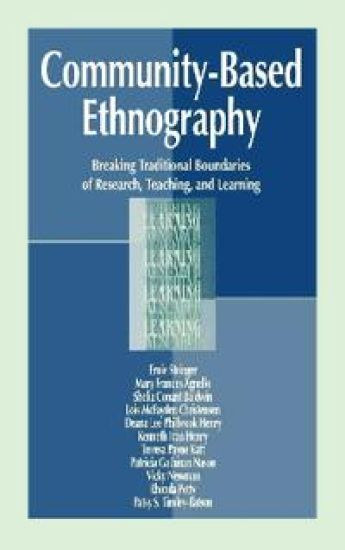
Community-Based Ethnography

Community-Based Ethnography

Ernest T. Stringer; Mary Frances Agnello; Sheila Conant Baldwin; Lois McFayden Christensen; Deana Lee Philb Henry

Psychology Press
1997
sidottu
Co-written by a professor and 10 students, this book explores their attempts to come to grips with fundamental issues related to writing narrative accounts purporting to represent aspects of people's lives. The fundamental project, around which their explorations in writing textual accounts turned, derived from the editor's initial ethnographic question: "Tell me about the [previous] class we did together?" This proved to be a particularly rich exercise, bringing into the arena all of the problems related to choice of data, analysis of data, the structure of the account, the stance of the author, tense, and case, the adequacy of the account, and more. As participants shared versions of their accounts and struggled to analyze the wealth of data they had accumulated in the previous classes -- the products of in-class practice of observation and interview -- they became aware of the ephemeral nature of narrative accounts. Reality, as written in textual form, cannot capture the immense depth, breadth, and complexity of an actual lived experience and can only be an incomplete representation that derives from the interpretive imagination of the author. The final chapter results from a number of discussions during which each contributing author briefly revisited the text and -- through dialogue with others and/or the editor -- identified the elements that would provide an overall framework that represents "the big message" of the book. In this way, the contributors attempted to provide a conceptual context that would indicate ways in which their private experiences could be seen to be relevant to the broader public arenas in which education and research is engaged. In its entirety, the book presents an interpretive study of teaching and learning. It provides a multi-voiced account that reveals how problematic, turning-point experiences in a university class are perceived, organized, constructed, and given meaning by a group of interacting individuals.