Kirjojen hintavertailu – 12 903 724 kirjaa ja 27 kauppaa

Kirjailija

Masahiko Aoki

Kirjat ja teokset yhdessä paikassa: 11 kirjaa, julkaisuja vuosilta 1990–2023, suosituimpiin kuuluu Toward a Comparative Institutional Analysis. Vertaile teosten hintoja ja tarkista saatavuus suomalaisista kirjakaupoista.

11 kirjaa

Kirjojen julkaisuvuodet: 1990–2023.

Toward a Comparative Institutional Analysis
A conceptual and analytical framework for understanding economic institutions and institutional change. Markets are one of the most salient institutions produced by humans, and economists have traditionally analyzed the workings of the market mechanism. Recently, however, economists and others have begun to appreciate the many institution-related events and phenomena that have a significant impact on economic performance. Examples include the demise of the communist states, the emergence of Silicon Valley and e-commerce, the European currency unification, and the East Asian financial crises. In this book Masahiko Aoki uses modern game theory to develop a conceptual and analytical framework for understanding issues related to economic institutions. The wide-ranging discussion considers how institutions evolve, why their overall arrangements are robust and diverse across economies, and why they do or do not change in response to environmental factors such as technological progress, global market integration, and demographic change.
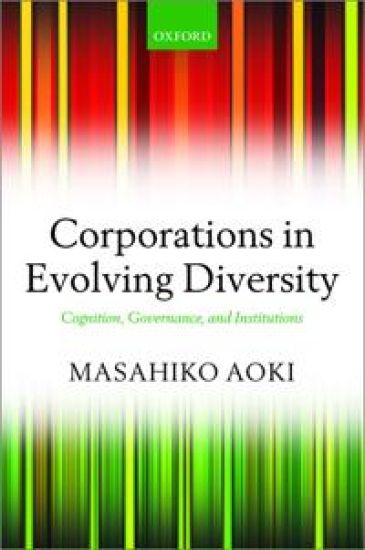
Corporations in Evolving Diversity

Corporations in Evolving Diversity

Masahiko Aoki

Oxford University Press
2019
nidottu
In this classic text, Masahiko Aoki explores how the 2008-9 financial crisis demanded a re-examination of the role of corporations and the working of financial markets around the world, providing a compelling new analysis of the corporate firm; the role of shareholders, managers and workers; and institutional governance structures. In recent decades the firm has predominantly been seen as an organization run and governed in the interests of shareholders, where management act as the agent of shareholders, and the workers simply as instruments for share-value maximization. This book reverses this viewpoint. It sees corporations as associational cognitive systems where 'cognitive actions' are distributed amongst managers and workers, with shareholders supplying 'cognitive tools' and monitoring their use in the systems. Aoki analyses the different relationships that can exist between shareholders, managers, and workers from this perspective, and identifies a range of different models of organizational architecture and associated governance structures. He also discusses ways in which corporations act as players in social, political, and organizational games, as well as global economic games; how these inter-related social dynamics may change particular distinctive national structures into the diversity incorporated in the global corporate landscape; and how they now call for new roles for financial markets.
Transboundary Game of Life

Transboundary Game of Life

Masahiko Aoki

Springer Verlag, Singapore
2019
sidottu
The central part of this book is an English version of the memoir of Masahiko Aoki that was published in Japanese in 2008 (?????????? ?????????????????). In this memoir, Aoki goes over his life as a young boy immediately after World War II, as an activist who opposed the rearmament of Japan under the US-Japan Security Alliance, as a student of Marxist economics first and then modern mathematical economics, as a graduate student at Minnesota, as a young economist at Stanford, Harvard, and then Kyoto, as a central faculty member to develop comparative institutional analysis at Stanford, and as an institutional builder who established the Stanford Kyoto Center, the Research Institute of Economy, Trade, and Industry, the Virtual Center for Advanced Studies Institution in Tokyo, and the Center for Industrial Development and Environmental Governance in Beijing. Until now the memoir has been available only in Japanese and in Chinese. The English edition will allow more young social scientists to touch the life and the work of Masahiko Aoki and be inspired to make their own versions of the “transboundary game of life.”
Comparative Institutional Analysis

Comparative Institutional Analysis

Masahiko Aoki

Edward Elgar Publishing Ltd
2013
sidottu
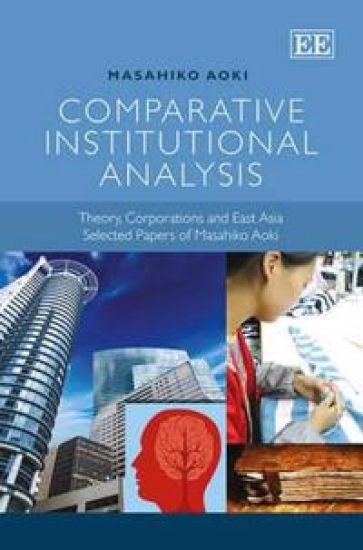
This volume collects 22 articles by Masahiko Aoki, selected from writings published over the course of his 45-year academic career. These fascinating essays cover a range of issues, including mechanism design, comparative governance, corporate governance, institutions and institutional change, but are tied together by a focus on East Asia and a comparative institutional framework. Specific topics include the early stages of mechanism design theory, comparative analysis of vertical, horizontal and modular industrial coordination and its applications, cooperative game-theoretic approaches to the diversity of corporate government structure, the endogenous nature of institutions, and comparative and historical analysis of institutions in Japan, China and Korea. Students, professors and scholars with an interest in comparative institutional studies and East Asian studies will find this book a useful and illuminating resource.
The Chinese Economy

The Chinese Economy

Masahiko Aoki; Jinglian Wu

Palgrave Macmillan
2012
sidottu
China has enjoyed a higher growth rate for a longer period than any other nation to date. This volume brings together leading economists to analyse this unprecedented economic boom, and discuss prospects for the future. Chapters address a wide range of issues, covering not only financial systems, but also the social and cultural impact of growth.
The Chinese Economy

The Chinese Economy

Masahiko Aoki; Jinglian Wu

Palgrave Macmillan
2012
nidottu
China has enjoyed a higher growth rate for a longer period than any other nation to date. This volume brings together leading economists to analyse this unprecedented economic boom, and discuss prospects for the future. Chapters address a wide range of issues, covering not only financial systems, but also the social and cultural impact of growth.
The Global Macro Economy and Finance

The Global Macro Economy and Finance

Franklin Allen; Masahiko Aoki; Nobuhiro Kiyotaki

Palgrave Macmillan
2012
nidottu
This volume explores the measurement of economic and social progress in our societies, and proposes new frameworks to integrate economic dimensions with other aspects of human well-being. Leading economists analyse the light that the recent crisis has shed on the global economic architecture, and the policies needed to address these systemic risks.
The Global Macro Economy and Finance

The Global Macro Economy and Finance

Franklin Allen; Masahiko Aoki; Nobuhiro Kiyotaki

Palgrave Macmillan
2012
sidottu
This volume explores the measurement of economic and social progress in our societies, and proposes new frameworks to integrate economic dimensions with other aspects of human well-being. Leading economists analyse the light that the recent crisis has shed on the global economic architecture, and the policies needed to address these systemic risks.
Corporations in Evolving Diversity

Corporations in Evolving Diversity

Masahiko Aoki

Oxford University Press
2010
sidottu
The 2008-9 financial crisis demands we look anew at the role of corporations, and the working of financial markets around the world. In this challenging and insightful book, one of our most eminent economists provides a compelling new analysis of the corporate firm; the role of shareholders, managers and workers; and institutional governance structures. In recent decades the firm has predominantly been seen as an organization run and governed in the interests of shareholders, where management act as the agent of shareholders, and the workers simply as instruments for share-value maximization. This book reverses this viewpoint. It sees corporations as associational cognitive systems where 'cognitive actions' are distributed amongst managers and workers, with shareholders supplying 'cognitive tools' and monitoring their use in the systems. Aoki analyses the different relationships that can exist between shareholders, managers, and workers from this perspective, and identifies a range of different models of organizational architecture and associated governance structures. He also discusses ways in which corporations act as players in social, political, and organizational games, as well as global economic games; how these inter-related social dynamics may change particular, distinctive national structures into the diversity incorporated in the global corporate landscape; and how they now call for new roles for financial markets.
Information, Corporate Governance, and Institutional Diversity
This book uses comparative institutional analysis to explain differences in national economic performance. Countries have their own rules for corporate governance and they have different market arrangements; and these differences in rules and organization affect the way firms behave. Countries also tend to develop conventions of organizational architecture of firms - whether their hierarchies are functional, horizontal, or decentralized. This affects the way in which they process information, and information management is increasingly seen as being of crucial importance to a firm's performance. Aoki accords more importance to these factors than to the factors conventionally used in applying a neoclassical model of economic efficiency. He applies game theory, contract theory, and information theory. By describing the rules and norms in Japan, the USA, and the transitional economies, Aoki shows how firms can achieve competitive advantage in international markets if these conventions and rules are well suited to the industrial sector in which the firms operate. He is particularly concerned with how Japan, with its main bank and lifelong employment systems, as well as information-sharing firm organizational structure, might reform its institutions to maintain competitive advantage in the world economy.
Information, Incentives and Bargaining in the Japanese Economy
This book is not another parable of Japan’s economic success; it provides rich and systematic descriptions of Japanese microeconomic institutions and interprets their work in terms familiar to Western economists. A systematic, in-depth analysis of Japanese institutions of this kind has never been available before. In making his comparative analysis of the Japanese system, Professor Aoki critically examines conventional notions about the microstructure of the market economy that have strongly shaped and influenced economists’ approach to industrial organization (e.g., hierarchy as the alternative to the market, the firm as a propery of the stockholders, and market-oriented incentive contracts). While these notions may constitute an appropriate foundation for the analysis of the highly market-oriented Western economies, the author has found that a more complete understanding of the Japanese economy requires us to broaden such ‘specific’ notions. At one level, therefore, this book may be regarded as a provocative exercise in comparative industrial organization and the theory of the firm. To the extent that this approach is convincing, the book suggests a reordering of focus and emphasis in these studies.