Kirjojen hintavertailu – 12 859 828 kirjaa ja 27 kauppaa

Kirjailija

Masahisa Fujita

Kirjat ja teokset yhdessä paikassa: 9 kirjaa, julkaisuja vuosilta 1989–2022, suosituimpiin kuuluu Q: Regional and Urban Economics I. Vertaile teosten hintoja ja tarkista saatavuus suomalaisista kirjakaupoista.

9 kirjaa

Kirjojen julkaisuvuodet: 1989–2022.

Spatial Economics for Building Back Better

Spatial Economics for Building Back Better

Masahisa Fujita; Nobuaki Hamaguchi; Yoshihiro Kameyama

SPRINGER VERLAG, SINGAPORE
2022
nidottu
The central theme of this book is national land and infrastructure design in the age of the declining population and the recovery from the Great East Japan Earthquake in the affected regions in Japan. Based on the theory of spatial economics and evidence from Japanese history, the authors show that the growing economy with a population increase develops into a multi-cored and complex structure. In the population decline phase, however, such construction will be destabilized because of agglomeration economies in the central core. Then, a catastrophic shock that strikes may provoke the decline of the lower-rank-size provincial cities and their eventual disappearance if they compete only in lower prices of staple products. Not only is the practice bad for the residents; it also leads to lower national welfare resulting from the loss of diversity and overcrowded big cities. The authors argue that small local towns can recover and will be sustained if they will endeavor in innovative production by making good use of local natural resources and social capital. Under the ongoing declining population in Japan, an undesirable concentration in Tokyo will proceed further with increasing social cost and risk. The recent novel coronavirus pandemic has highlighted that concern.
Spatial Economics for Building Back Better

Spatial Economics for Building Back Better

Masahisa Fujita; Nobuaki Hamaguchi; Yoshihiro Kameyama

SPRINGER VERLAG, SINGAPORE
2021
sidottu
The central theme of this book is national land and infrastructure design in the age of the declining population and the recovery from the Great East Japan Earthquake in the affected regions in Japan. Based on the theory of spatial economics and evidence from Japanese history, the authors show that the growing economy with a population increase develops into a multi-cored and complex structure. In the population decline phase, however, such construction will be destabilized because of agglomeration economies in the central core. Then, a catastrophic shock that strikes may provoke the decline of the lower-rank-size provincial cities and their eventual disappearance if they compete only in lower prices of staple products. Not only is the practice bad for the residents; it also leads to lower national welfare resulting from the loss of diversity and overcrowded big cities. The authors argue that small local towns can recover and will be sustained if they will endeavor in innovative production by making good use of local natural resources and social capital. Under the ongoing declining population in Japan, an undesirable concentration in Tokyo will proceed further with increasing social cost and risk. The recent novel coronavirus pandemic has highlighted that concern.
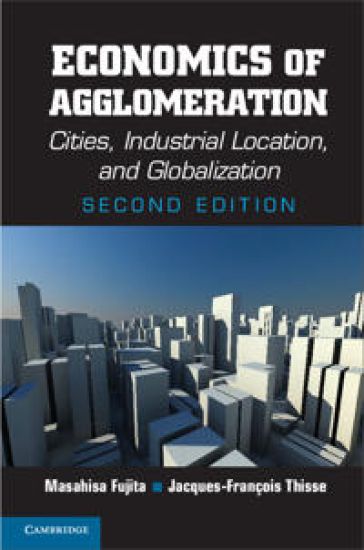
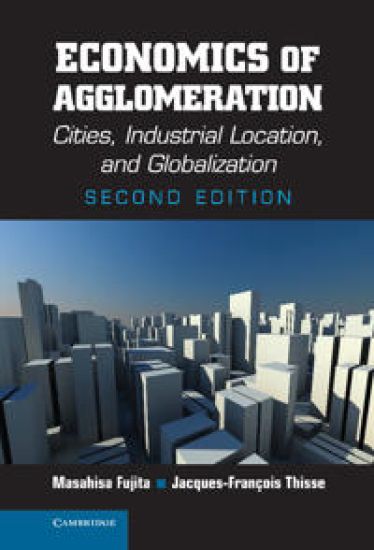
Economics of Agglomeration

Economics of Agglomeration

Masahisa Fujita; Jacques-François Thisse

Cambridge University Press
2013
pokkari
Economic activities are not concentrated on the head of a pin, nor are they spread evenly over a featureless plane. On the contrary, they are distributed very unequally across locations, regions and countries. Even though economic activities are, to some extent, spatially concentrated because of natural features, economic mechanisms that rely on the trade-off between various forms of increasing returns and different types of mobility costs are more fundamental. This book is a study of the economic reasons for the existence of a large variety of agglomerations arising from the global to the local. This second edition combines a comprehensive analysis of the fundamentals of spatial economics and an in-depth discussion of the most recent theoretical developments in new economic geography and urban economics. It aims to highlight several of the major economic trends observed in modern societies. The first edition was the winner of the 2004 William Alonso Memorial Prize for Innovative Work in Regional Science.
Economics of Agglomeration

Economics of Agglomeration

Masahisa Fujita; Jacques-François Thisse

Cambridge University Press
2013
sidottu
Economic activities are not concentrated on the head of a pin, nor are they spread evenly over a featureless plane. On the contrary, they are distributed very unequally across locations, regions and countries. Even though economic activities are, to some extent, spatially concentrated because of natural features, economic mechanisms that rely on the trade-off between various forms of increasing returns and different types of mobility costs are more fundamental. This book is a study of the economic reasons for the existence of a large variety of agglomerations arising from the global to the local. This second edition combines a comprehensive analysis of the fundamentals of spatial economics and an in-depth discussion of the most recent theoretical developments in new economic geography and urban economics. It aims to highlight several of the major economic trends observed in modern societies. The first edition was the winner of the 2004 William Alonso Memorial Prize for Innovative Work in Regional Science.
Urban Economic Theory

Urban Economic Theory

Masahisa Fujita

Cambridge University Press
1991
pokkari
This book examines the economic reasons why people choose to live where they live and develops, through analysis of the bid rent function, a unified theory of urban land use and city size. The first part of the book explicates the basic theory of urban land use and optimal city size. Residential location behavior of households is examined in a microeconomic framework and equilibrium and optimal patterns of residential land use are discussed. The corresponding equilibrium and optimal city sizes are studied in a variety of contexts. Part Two extends the classical theories of von Thunen and Alonso with the addition of externality factors such as local public goods, crowding and congestion, and racial prejudice. The rigorous mathematical approach and theoretical treatment of the material make Urban Economic Theory of interest to researchers in urban economics, location theory, urban geography, and urban planning.
Urban Economic Theory

Urban Economic Theory

Masahisa Fujita

Cambridge University Press
1989
sidottu
This book examines the economic reasons why people choose to live where they live and develops, through analysis of the bid rent function, a unified theory of urban land use and city size. The first part of the book explicates the basic theory of urban land use and optimal city size. Residential location behavior of households is examined in a microeconomic framework and equilibrium and optimal patterns of residential land use are discussed. The corresponding equilibrium and optimal city sizes are studied in a variety of contexts. Part Two extends the classical theories of von Thunen and Alonso with the addition of externality factors such as local public goods, crowding and congestion, and racial prejudice. The rigorous mathematical approach and theoretical treatment of the material make Urban Economic Theory of interest to researchers in urban economics, location theory, urban geography, and urban planning.