Kirjojen hintavertailu – 12 859 826 kirjaa ja 27 kauppaa

Kirjailija

Massimiliano Andretta

Kirjat ja teokset yhdessä paikassa: 5 kirjaa, julkaisuja vuosilta 2006–2018, suosituimpiin kuuluu Late Neoliberalism and its Discontents in the Economic Crisis. Vertaile teosten hintoja ja tarkista saatavuus suomalaisista kirjakaupoista.

5 kirjaa

Kirjojen julkaisuvuodet: 2006–2018.

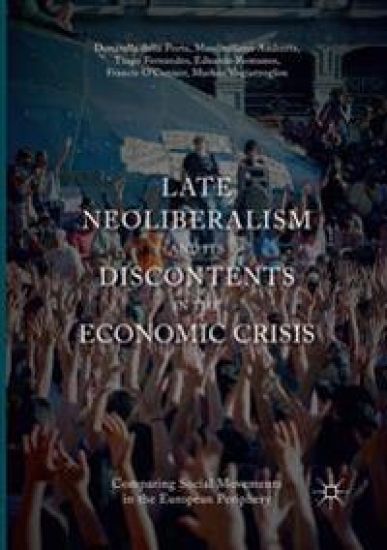
Late Neoliberalism and its Discontents in the Economic Crisis

Late Neoliberalism and its Discontents in the Economic Crisis

Donatella Della Porta; Massimiliano Andretta; Tiago Fernandes; Francis O'Connor; Eduardo Romanos; Markos Vogiatzoglou

Springer International Publishing AG
2018
nidottu
This book analyses protests against the Great Recession in the European periphery. While social movements have long been considered as children of affluent times - or at least of times of opening opportunities - these protests defy such expectations, developing instead in moments of diminishing opportunities in both the economic and the political realms. Can social movement studies still be useful to understanding these movements of troubled times? The authors offer a positive answer to this question, although specify the need to bridge contentious politics with other fields, including political economy. They highlight differences in the social movements’ strength and breadth and attempt to understand them in terms of three sets of dimensions: a) the specific characteristics of the socio-economic crisis and its consequences in terms of mobilization potential; b) the political reactions to it, in what we can define as political opportunities and threats; and c) the social movement cultures and structures that characterize each country. The book discusses these topics through a contextualized analysis of anti-austerity protest in the European periphery.

Legacies and Memories in Movements

Legacies and Memories in Movements

Donatella della Porta; Massimiliano Andretta; Tiago Fernandes; Eduardo Romanos; Markos Vogiatzoglou

Oxford University Press Inc
2018
sidottu
The impact of legacies and memories on social movements has been paid only limited attention in what is now a sizeable literature. While there is a growing interest in memory, there is little systematic theory or comparative research on the long-lasting institutional consequences of important events--or how they are remembered by future generations. In Legacies and Memories in Movements, Donatella della Porta and her collaborators examine the concepts of historical legacy and memory, suggesting ways to apply them in analyses of the long-term effects of movements, movement participation, and movement strategies and tactics. In particular, they explore a critical juncture, rich with consequences for social movements: the transition to democracy. Through a comparative-historical study of social movements in Spain, Portugal, Italy and Greece, the authors tease out the complex and varied ways different modes of transition can produce new types and uses of memories for social movements. To do so, they analyze how moments of transition create institutional change that impacts future movements and consider how past protests enhance and constrain social movements today. Focusing on the reverberation of events and how past events serve as guides for the future, Legacies and Memories in Movements brings together the literature on collective memory and social movements for the first time.
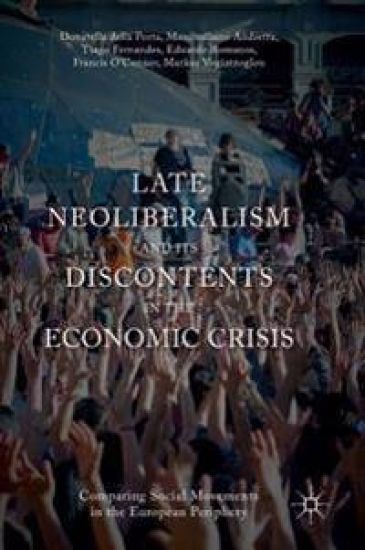
Late Neoliberalism and its Discontents in the Economic Crisis

Late Neoliberalism and its Discontents in the Economic Crisis

Donatella Della Porta; Massimiliano Andretta; Tiago Fernandes; Francis O'Connor; Eduardo Romanos; Markos Vogiatzoglou

Springer International Publishing AG
2016
sidottu
This book analyses protests against the Great Recession in the European periphery. While social movements have long been considered as children of affluent times - or at least of times of opening opportunities - these protests defy such expectations, developing instead in moments of diminishing opportunities in both the economic and the political realms. Can social movement studies still be useful to understanding these movements of troubled times? The authors offer a positive answer to this question, although specify the need to bridge contentious politics with other fields, including political economy. They highlight differences in the social movements’ strength and breadth and attempt to understand them in terms of three sets of dimensions: a) the specific characteristics of the socio-economic crisis and its consequences in terms of mobilization potential; b) the political reactions to it, in what we can define as political opportunities and threats; and c) the social movement cultures and structures that characterize each country. The book discusses these topics through a contextualized analysis of anti-austerity protest in the European periphery.
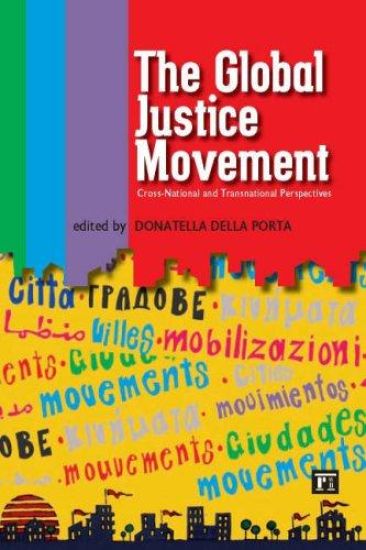
Global Justice Movement

Global Justice Movement

Donatella Della Porta; Massimiliano Andretta; Angel Calle; Helene Combes; Nina Eggert; Marco G. Giugni; Jennifer Hadden; Manuel Jimenez; Raffaele Marchetti

Paradigm
2007
nidottu
"Della Porta has assembled a distinguished group of scholars who have made great strides in illuminating the early phases of the movement. The book includes especially keen analyses of the movement against global capitalism, particularly in its European manifestations." John D. McCarthy, Pennsylvania State University "Della Porta has skillfully coordinated a comparative study in six European countries and the US. Renowned scholars give testimony of the movement in their countries. [This is] the first attempt to document a genuine transnational movement." Bert Klandermans, Vrije Universiteit, Amsterdam You G-8, we 6 billion!" So went the chant at the international parade leading into the summit in Genoa, Italy. The global justice movement has led to a new wave of protest, building up transnational networks, inventing new strategies of action, constructing new images of democracy, and boldly asserting that "another world is possible". This book examines all this and more with case studies drawn from seven different countries, covering transnational networks and making cross-national comparisons. Leading European and American scholars analyze more than 300 organizations and 5,000 activists, looking at mobilizations that bridge old and new movements and bring politics back to the street. Contributors include: Massimiliano Andretta, Angel Calle, Helene Combes, Donatella della Porta, Nina Eggert, Marco Giugni, Jennifer Hadden, Manuel Jimenez, Raffaele Marchetti, Lorenzo Mosca, Mario Pianta, Herbert Reiter, Christopher Rootes, Dieter Rucht, Clare Saunders, Isabelle Sommier, Sidney Tarrow, Simon Teune, Mundo Yang.
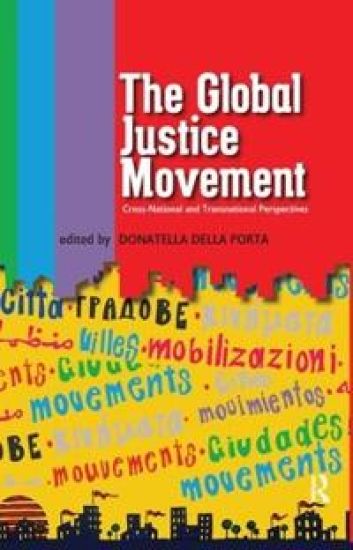
Global Justice Movement

Global Justice Movement

Donatella Della Porta; Massimiliano Andretta; Angel Calle; Helene Combes; Nina Eggert; Marco G. Giugni; Jennifer Hadden; Manuel Jimenez; Raffaele Marchetti

Paradigm
2006
sidottu
"Della Porta has assembled a distinguished group of scholars who have made great strides in illuminating the early phases of the movement. The book includes especially keen analyses of the movement against global capitalism, particularly in its European manifestations." John D. McCarthy, Pennsylvania State University "Della Porta has skillfully coordinated a comparative study in six European countries and the US. Renowned scholars give testimony of the movement in their countries. [This is] the first attempt to document a genuine transnational movement." Bert Klandermans, Vrije Universiteit, Amsterdam You G-8, we 6 billion!" So went the chant at the international parade leading into the summit in Genoa, Italy. The global justice movement has led to a new wave of protest, building up transnational networks, inventing new strategies of action, constructing new images of democracy, and boldly asserting that "another world is possible". This book examines all this and more with case studies drawn from seven different countries, covering transnational networks and making cross-national comparisons. Leading European and American scholars analyze more than 300 organizations and 5,000 activists, looking at mobilizations that bridge old and new movements and bring politics back to the street. Contributors include: Massimiliano Andretta, Angel Calle, Helene Combes, Donatella della Porta, Nina Eggert, Marco Giugni, Jennifer Hadden, Manuel Jimenez, Raffaele Marchetti, Lorenzo Mosca, Mario Pianta, Herbert Reiter, Christopher Rootes, Dieter Rucht, Clare Saunders, Isabelle Sommier, Sidney Tarrow, Simon Teune, Mundo Yang.