
Kirjojen hintavertailu – 12 903 733 kirjaa ja 27 kauppaa

Kirjailija

Mathias Dewatripont

Kirjat ja teokset yhdessä paikassa: 3 kirjaa, julkaisuja vuosilta 2004–2015, suosituimpiin kuuluu Balancing the Banks. Vertaile teosten hintoja ja tarkista saatavuus suomalaisista kirjakaupoista.

3 kirjaa

Kirjojen julkaisuvuodet: 2004–2015.

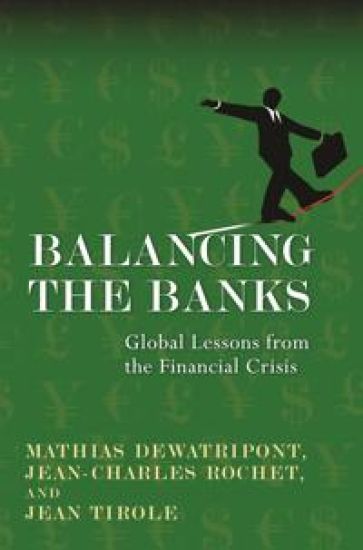
Balancing the Banks

Balancing the Banks

Mathias Dewatripont; Jean-Charles Rochet; Jean Tirole

Princeton University Press
2015
pokkari
The financial crisis that began in 2007 in the United States swept the world, producing substantial bank failures and forcing unprecedented state aid for the crippled global financial system. Bringing together three leading financial economists to provide an international perspective, Balancing the Banks draws critical lessons from the causes of the crisis and proposes important regulatory reforms, including sound guidelines for the ways in which distressed banks might be dealt with in the future. While some recent policy moves go in the right direction, others, the book argues, are not sufficient to prevent another crisis. The authors show the necessity of an adaptive prudential regulatory system that can better address financial innovation. Stressing the numerous and complex challenges faced by politicians, finance professionals, and regulators, and calling for reinforced international coordination (for example, in the treatment of distressed banks), the authors put forth a number of principles to deal with issues regarding the economic incentives of financial institutions, the impact of economic shocks, and the role of political constraints. Offering a global perspective, Balancing the Banks should be read by anyone concerned with solving the current crisis and preventing another such calamity in the future.
Balancing the Banks

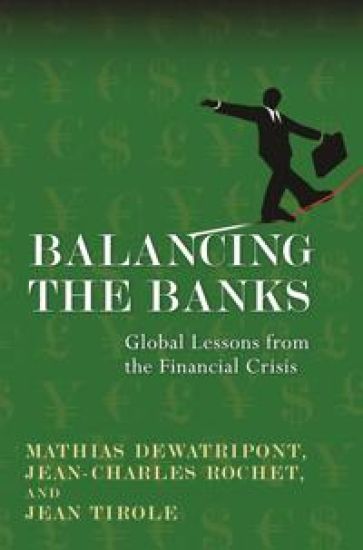
Balancing the Banks

Mathias Dewatripont; Jean-Charles Rochet; Jean Tirole

Princeton University Press
2010
sidottu
The financial crisis that began in 2007 in the United States swept the world, producing substantial bank failures and forcing unprecedented state aid for the crippled global financial system. Bringing together three leading financial economists to provide an international perspective, Balancing the Banks draws critical lessons from the causes of the crisis and proposes important regulatory reforms, including sound guidelines for the ways in which distressed banks might be dealt with in the future. While some recent policy moves go in the right direction, others, the book argues, are not sufficient to prevent another crisis. The authors show the necessity of an adaptive prudential regulatory system that can better address financial innovation. Stressing the numerous and complex challenges faced by politicians, finance professionals, and regulators, and calling for reinforced international coordination (for example, in the treatment of distressed banks), the authors put forth a number of principles to deal with issues regarding the economic incentives of financial institutions, the impact of economic shocks, and the role of political constraints. Offering a global perspective, Balancing the Banks should be read by anyone concerned with solving the current crisis and preventing another such calamity in the future.

Contract Theory

Contract Theory

Patrick Bolton; Mathias Dewatripont

MIT Press
2004
sidottu
A comprehensive introduction to contract theory, emphasizing common themes and methodologies as well as applications in key areas. Despite the vast research literature on topics relating to contract theory, only a few of the field's core ideas are covered in microeconomics textbooks. This long-awaited book fills the need for a comprehensive textbook on contract theory suitable for use at the graduate and advanced undergraduate levels. It covers the areas of agency theory, information economics, and organization theory, highlighting common themes and methodologies and presenting the main ideas in an accessible way. It also presents many applications in all areas of economics, especially labor economics, industrial organization, and corporate finance. The book emphasizes applications rather than general theorems while providing self-contained, intuitive treatment of the simple models analyzed. In this way, it can also serve as a reference for researchers interested in building contract-theoretic models in applied contexts. The book covers all the major topics in contract theory taught in most graduate courses. It begins by discussing such basic ideas in incentive and information theory as screening, signaling, and moral hazard. Subsequent sections treat multilateral contracting with private information or hidden actions, covering auction theory, bilateral trade under private information, and the theory of the internal organization of firms; long-term contracts with private information or hidden actions; and incomplete contracts, the theory of ownership and control, and contracting with externalities. Each chapter ends with a guide to the relevant literature. Exercises appear in a separate chapter at the end of the book.