Kirjojen hintavertailu – 12 876 058 kirjaa ja 26 kauppaa

Kirjailija

Matt Barnes

Kirjat ja teokset yhdessä paikassa: 5 kirjaa, julkaisuja vuosilta 2002–2021, suosituimpiin kuuluu Poverty and Social Exclusion in Europe. Vertaile teosten hintoja ja tarkista saatavuus suomalaisista kirjakaupoista.

5 kirjaa

Kirjojen julkaisuvuodet: 2002–2021.

Region Locked

Region Locked

Matt Barnes; Dazz Brown; Greg S-C

Unbound
2021
sidottu
Not all games are released equal. The barriers of language and culture can leave our world divided, and this includes the video games that we get the chance to play. Matt Barnes, Dazz Brown and Greg Seago-Curl of DidYouKnowGaming? created the YouTube series Region Locked to offer an insight into the weird and wonderful titles that never left their home countries, and now they bring their expertise to you, the gaming reader. Encounter masterpieces you never knew existed from your favourite series and developers, as well as some utterly bizarre creations that seem so outlandish you might wonder how on earth they were released in the first place, from the trippy, meandering dreamscapes of 1998’s LSD: Dream Emulator to The Mysterious Murasame Castle, released in 1986 by Nintendo, and the intergalactic adventures of Crime Crackers (1994). The authors explore what it’s like to play these games, and investigate the fascinating characters and maverick designers behind them to discover why such remarkable creations never enjoyed international exposure. For the casual gamer, keen developer, intrigued reader and hardcore fan alike, Region Locked is the key to a surreal and adventurous journey through the lost world of video games.
Social Exclusion in Great Britain

Social Exclusion in Great Britain

Matt Barnes

TAYLOR FRANCIS LTD
2020
nidottu
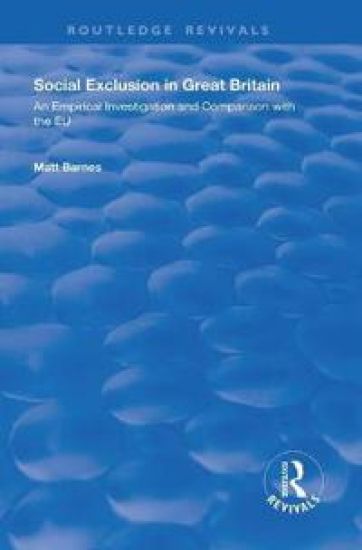
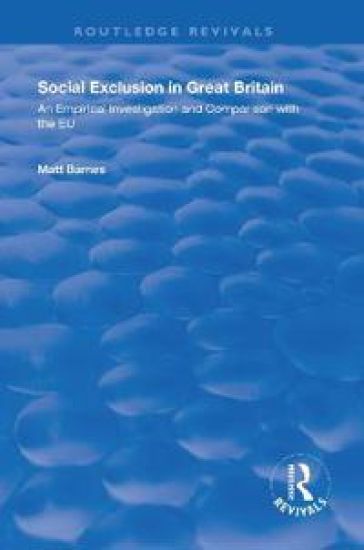
Originally published in 2005. In Great Britain, the reduction of social exclusion has been at the forefront of New Labour's social policy since 1997. However, there is ambiguity about what the notion of social exclusion actually encompasses, caused in part by the limited extent of attempts to measure and understand social exclusion empirically. This key work addresses this problem, employing data from a nationally representative survey of British households to quantify levels of social exclusion and the composition of the socially excluded population. It also incorporates data from a European Commission-funded household survey to compare social exclusion in Great Britain with eleven other countries in the European Union. In the book, Matt Barnes argues that social exclusion refers to enduring disadvantage on a wide range of living standards, not just those that reflect economic values. As well as looking at standard measures of poverty he looks at more relational measures of disadvantage such as neighbourhood discontent and social isolation, in order to determine exclusion from the economic, social and cultural systems that determine the integration of a person in society.
Social Exclusion in Great Britain

Social Exclusion in Great Britain

Matt Barnes

CRC Press Inc
2019
sidottu
Originally published in 2005. In Great Britain, the reduction of social exclusion has been at the forefront of New Labour's social policy since 1997. However, there is ambiguity about what the notion of social exclusion actually encompasses, caused in part by the limited extent of attempts to measure and understand social exclusion empirically. This key work addresses this problem, employing data from a nationally representative survey of British households to quantify levels of social exclusion and the composition of the socially excluded population. It also incorporates data from a European Commission-funded household survey to compare social exclusion in Great Britain with eleven other countries in the European Union. In the book, Matt Barnes argues that social exclusion refers to enduring disadvantage on a wide range of living standards, not just those that reflect economic values. As well as looking at standard measures of poverty he looks at more relational measures of disadvantage such as neighbourhood discontent and social isolation, in order to determine exclusion from the economic, social and cultural systems that determine the integration of a person in society.
Poverty and Social Exclusion in Europe

Poverty and Social Exclusion in Europe

Matt Barnes; Christopher Heady; Sue Middleton; Jane Millar; Fotis Papadopoulos; Graham Room; Panos Tsakloglou

Edward Elgar Publishing Ltd
2003
nidottu
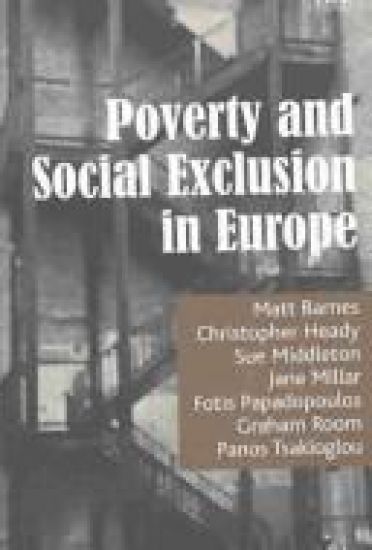
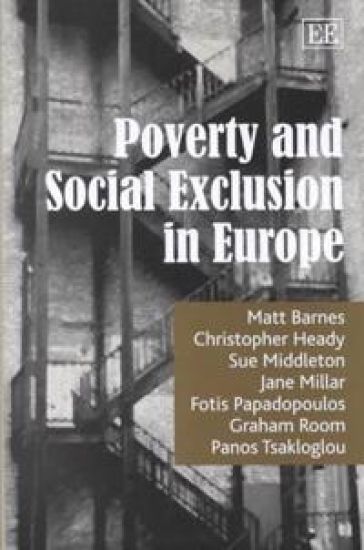
There are estimated to be almost 60 million people living in poverty throughout the European Union. This bleak statistic underlines the value of this important book which explores the nature and extent of poverty and social exclusion in six European countries, namely: Austria, Germany, Greece, Norway, Portugal and the UK. The book focuses on four 'life course' groups who might be considered particularly at risk: young adults, lone parents, the sick and disabled, and the retired. The authors show how poverty is the outcome of the interaction between several factors including education, gender and family structure. They emphasise the importance of distinguishing between poverty and non-monetary measures of deprivation and isolation. Although the poor are more at risk of suffering from deprivation, the authors demonstrate that this relationship is more tenuous than many people suppose. Employing rigorous theoretical and methodological analyses they go on to relate their findings to the policy environment in each of the countries, which were specifically chosen to reflect differing welfare systems. In this way the authors compare the impact of government policy on both the level of poverty and social exclusion, and on who is most at risk of experiencing them. Both statistically and in policy terms this book will be essential reading for students and academics of economics and the social sciences, and policy makers at both the national and European level.
Poverty and Social Exclusion in Europe

Poverty and Social Exclusion in Europe

Matt Barnes; Christopher Heady; Sue Middleton; Jane Millar; Fotis Papadopoulos; Graham Room; Panos Tsakloglou

Edward Elgar Publishing Ltd
2002
sidottu
There are estimated to be almost 60 million people living in poverty throughout the European Union. This bleak statistic underlines the value of this important book which explores the nature and extent of poverty and social exclusion in six European countries, namely: Austria, Germany, Greece, Norway, Portugal and the UK. The book focuses on four 'life course' groups who might be considered particularly at risk: young adults, lone parents, the sick and disabled, and the retired. The authors show how poverty is the outcome of the interaction between several factors including education, gender and family structure. They emphasise the importance of distinguishing between poverty and non-monetary measures of deprivation and isolation. Although the poor are more at risk of suffering from deprivation, the authors demonstrate that this relationship is more tenuous than many people suppose. Employing rigorous theoretical and methodological analyses they go on to relate their findings to the policy environment in each of the countries, which were specifically chosen to reflect differing welfare systems. In this way the authors compare the impact of government policy on both the level of poverty and social exclusion, and on who is most at risk of experiencing them. Both statistically and in policy terms this book will be essential reading for students and academics of economics and the social sciences, and policy makers at both the national and European level.