Kirjojen hintavertailu – 12 903 724 kirjaa ja 27 kauppaa

Kirjailija

Matthew MacDonald

Kirjat ja teokset yhdessä paikassa: 51 kirjaa, julkaisuja vuosilta 2002–2023, suosituimpiin kuuluu Pro ASP.NET 4.5 in C#. Vertaile teosten hintoja ja tarkista saatavuus suomalaisista kirjakaupoista.

51 kirjaa

Kirjojen julkaisuvuodet: 2002–2023.

Beginning ASP.NET 2.0 in C# 2005

Beginning ASP.NET 2.0 in C# 2005

Matthew MacDonald

APress
2006
nidottu
Beginning ASP. NET 2.0 in C# 2005: From Novice to Professional steers you through the maze of ASP. NET web programming concepts. You will learn language and theory simultaneously, mastering the core techniques necessary to develop good coding practices and enhance your skill set. This book provides thorough coverage of ASP. NET, guiding you from beginning to advanced techniques, such as querying databases from within a web page and performance-tuning your site. You'll find tips for best practices and comprehensive discussions of key database and XML principles. The book also emphasizes the invaluable coding techniques of object orientation and code-behind, which will enable you to build real-world websites instead of just scraping by with simplified coding practices. By the time you finish this book, you will have mastered the core techniques essential to professional ASP. NET developers.
Visual C# 2005 Recipes

Visual C# 2005 Recipes

Rakesh Rajan; Matthew MacDonald; Allen Jones

APress
2006
nidottu
Mastering . NET development is as much about understanding the functionality of the . NET Framework as it is about the syntax and grammar of your chosen language. Visual C# 2005 Recipes: A Problem-Solution Approach recognizes this fine balance. This book meets your need for fast, effective solutions to the difficulties you encounter in your coding projects. The recipes included in this book have been chosen and written with emerging pros in mind. The book features an equal balance of code and text. The supplied code gives you everything you need to solve the problem at hand, while the accompanying text provides supporting information. This is a fully up-to-date reference for . NET 2.0 programmers. All code comes as a stand-alone Visual Studio 2005 solution. The book even covers advanced concepts that take you past basic recipe solutions you?ll be able to distill entire concepts and theories.
Pro .NET 2.0 Windows Forms and Custom Controls in C#
Renowned author Matthew MacDonald combines careful treatment of the API with detailed user-interface design principles. Further, this book incorporates C# and the final beta of . NET 2.0. The result: thorough coverage of Windows Forms and GDI+ namespaces for you . NET programmers! You will become equipped to design state-of-the-art Windows interfaces and program graphics, and learn how to create your own controls. As a developer, you must know more than just how to add a control to a window. You must be able to create an entire user interface framework that's scalable, flexible, and reusable. This book is not a reference manual. Instead, it contains detailed discussions about user interface elements that you’ll use on a regular basis.
Pro ASP.NET 1.1 in VB .NET

Pro ASP.NET 1.1 in VB .NET

Laurence Moroney; Matthew MacDonald

APress
2005
nidottu
Pro ASP . NET in VB . NET is the core title in the new Apress ASP. NET book strategy. An all-in-one reference for seasoned ASP. NET developers, it is the successor to Professional ASP. NET which has been reprinted. Updated and written new in places, this will be the seasoned latecomer to the Microsoft web development market. Ur innehållet: ASP. NET Fast Track Tutorial and Architecture Review.- Basic Web Form Controls.- Web Form Validation Controls.- Rich Web Form Controls.- Controlling Forms Programmatically.- Creating Custom Controls with User Controls.- Creating Custom Server Controls.- ADO. NET Basic Best Practices.- ADO. Net Data Objects.- Binding Data To Web Form Controls.- Advanced ADO. NET.- Introducing System. XML - Core Principles.- System. XML 2 and Web Services.- 'Real World' Application Design Guidelines.- Migrating Apps Across ASP and ASP. NET Flavors.- The ASP. NET Environment: Configuration and Extensibility Tools.
ASP.NET 1.1 Solutions Toolkit

ASP.NET 1.1 Solutions Toolkit

Matthew MacDonald; Victor Garcia Aprea; Robin Dewson; Saurabh Nandu; Richard Delorme; Daniel Cazzulino; Fabio Claudio Ferracchiati; David Gottlieb

APress
2005
nidottu
This collection of reusable ASP. NET components serves two purposes. First, the components are ready to use, so you may add exciting features to your own ASP. NET websites. Second, each component's design and implementation is discussed, and you’ll discover tips and tricks applicable for developing your own controls. Controls can be “cut and pasted” or used as templates for you to build your own controls. And the fifteen included controls (programs) cover a broad range of situations, providing you both working coded solutions to your problem and the rationalization behind those solutions. Overall, this highly anticipated book provides immediate solutions to range of common problems.
Pro ASP.NET 1.1 in C#

Pro ASP.NET 1.1 in C#

Matthew MacDonald

APress
2004
nidottu
Pro ASP. Net is the core title in the new Apress ASP. NET book strategy. An all-in-one reference for seasoned ASP. NET developers, it is the successor to the old title, Professional ASP. NET, which Wiley have reprinted. Mined and updated in part from well-known titles that Apress do own and written new in places, this will be the seasoned latecomer to the Microsoft web development market. Ur innehållet: Chapter 1: ASP. NET Fast Track Tutorial & Architecture review Chapter 2: Basic Web Form Controls Chapter 3: Web Form Validation Controls Chapter 4: Rich Web Form Controls Chapter 5: Controlling Forms Programmatically Chapter 6: Creating Custom Controls with User Controls Chapter 7: Creating Custom Server Controls Chapter 8: ADO. NET Basic Best Practices Chapter 9: ADO. Net Data Objects Chapter 10: Binding Data To Web Form Controls Chapter 11: Advanced ADO. NET Chapter 12: Introducing System. XML –Core Principles Chapter 13: System. XML and Web Services Chapter 14: 'Real World' application design guidelines Chapter 14a: Migrating Apps across ASP & ASP. NET flavors Chapter 15: The ASP. NET Environment: Configuration and Extensibility tools Chapter 16 : Working With State and Transactions Chapter 17 : Localization and Internationalization in applications Chapter 18 : Using . NET Components Chapter 19 : Web Services Chapter 20 : Caching Chapter 21 : Performance and Scalability Chapter 22 : Forms-based and Programmatic Security Chapter 23 : Windows-based and Passport-based Security Chapter 24 : Debugging, Tracing and Auditing your App Chapter 25 : Collections, Strings, RegExps Chapter 26 : Files and Serialization Chapter 27 : Email and messaging Chapter 28 : Dynamic Graphics GDI+ Chapter 29 : Case Study 1 – Intranet Application Chapter 30 : Case Study 2 – E-Commerce Application Appendices App A. VS. NET IDE App B. Web Matrix IDE App C. Dreamweaver MX App D. HTML Control Reference App E. Web Control Reference App F. web.config App G. ASP. NET Directives and Syntax App H. Common System Namespaces App I. Common Error Messages
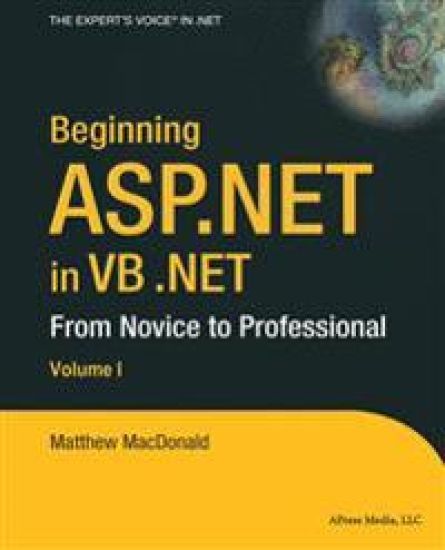
Beginning ASP.NET in VB .NET

Beginning ASP.NET in VB .NET

Matthew MacDonald

APress
2004
nidottu
This book assumes only basic knowledge of VB . NET (although it contains a review of what is needed for those coming from a different background). But, by the end of it, the reader will have mastered the core knowledge needed to begin work as a professional ASP. NET developer. It places special emphasis on the techniques such as "code behind", that professionals need. ASP. NET is the replacement for Microsoft's Active Server Page (ASP). It is more scalable, faster and is arguably the best thing Microsoft has ever done in the Web development space. The recently released 1.1 version should spur adoptions (since many people wait for the 1.1 version of any Microsoft technology) ASP. NET, like its predecessor allows a Web site builder to dynamically build Web pages on the fly by inserting queries to a relational database in the Web page. ASP. NET is different than its predecessor in that it allows use of modern languages like VB . NET instead of scripting languages and it encourages correct programming style by allowing the separation of the design from the operational code.
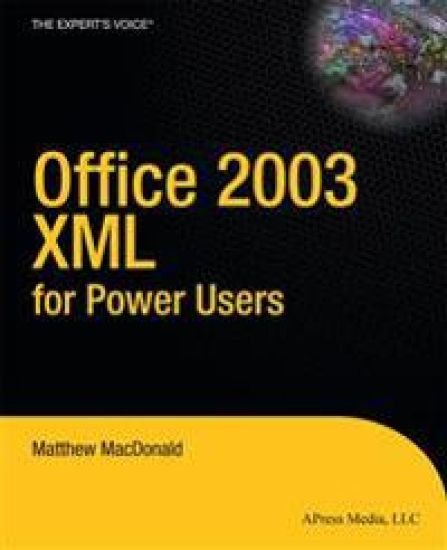
Office 2003 XML for Power Users

Office 2003 XML for Power Users

Matthew MacDonald

APress
2004
nidottu
This book quickly introduces the XML standards (including schemas, XPath, and XML transforms), and the philosophy of XML. It then shows how the XML technology embedded into Office 2003 can be used to share and transform data in an enterprise. This book is aimed at experienced Office users that want to use XML to unlock the data in Office spreadsheets and documents. A secondary audience is IT professionals seeking to learn about XML and how it is implemented in Office 2003. XML (Extensible Markup Language) is a flexible way to create common information formats and share both the format and the data on the World Wide Web, intranets, and elsewhere. For example, computer makers might agree on a standard or common way to describe the information about a computer product (processor speed, memory size, and so forth) and then describe the product information format with XML.
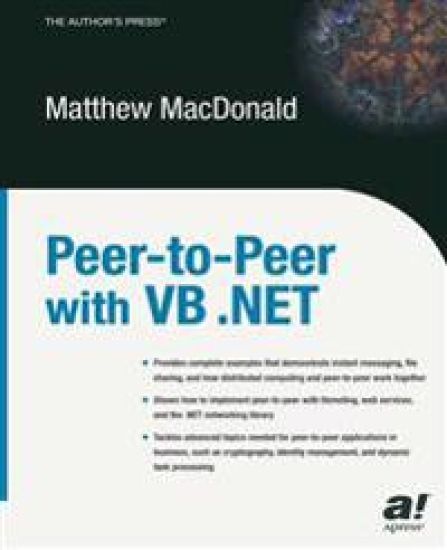
Peer-to-Peer with VB .NET

Peer-to-Peer with VB .NET

Matthew MacDonald

APress
2003
nidottu
Peer-to-peer proponents claim that their technology holds the keys to building virtual supercomputers, sharing vast pools of knowledge, and creating self-sufficient communities on the Internet. Peer-to-Peer with VB . NET explores how these design ideas can be integrated into existing . NET applications. This book is an honest assessment of P2P and . NET. It doesn't just explain how to create P2P applications - it examines the tradeoffs that professional developers will encounter with . NET and P2P. It also considers several different approaches (Remoting, . NET networking, etc.) rather than adopting one fixed technology, and includes detailed examples of several popular P2P applications types (messenger, file sharer, and distributed task manager).
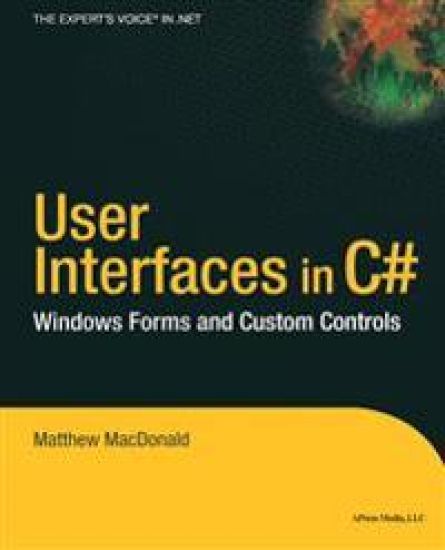
User Interfaces in C#

User Interfaces in C#

Matthew MacDonald

APress
2002
nidottu
This book represents the start of the second wave of . NET books: closely focused works that give you the insight of experienced developers about a single aspect of . NET programming. Here you'll take a close look at all the ingredients you can use to design state-of-the-art application interfaces. You also delve into entirely new topics like custom control design and GDI+, the next-generation painting framework for Windows. You learn about anchoring and docking, plus you work with complete examples that show document-view architectures, custom control layout engines, dockable windows, and hit testing with owner-drawn controls. You also learn how to design irregularly shaped forms, unshackle data binding, and build integrated help systems. With . NET the programming framework is entirely new. A reference that only explains controls and commands is dangerous, and without a proper discussion of best practices and design tips, programmers are likely to wind up in a great deal of trouble-with applications that are difficult to enhance, debug, or scale up. For that reason, the author covers three areas: (1) an overview of how to design elegant user interfaces the average user can understand; (2) a comprehensive examination of the user interface controls and classes in . NET. and (3) a tutorial with best practices and design tips for coding user interfaces and integrating help.
User Interfaces in VB .NET

User Interfaces in VB .NET

Matthew MacDonald

APress
2002
nidottu
In a new approach, this is a closely focused work that gives you the insight of experienced developers about a single aspect of . NET programming. You will find all the ingredients you can use to design state-of-the-art application interfaces. You will also delve into entirely new topics like custom control design and GDI+, the next-generation painting framework for Windows. The author goes beyond the basics and combines user interface design principles with practical guidelines for creating the next generation of software applications. The author covers three areas: 1) an overview of how to design elegant user interfaces the average user can understand; 2) a comprehensive examination of the user interface controls and classes in . NET. and 3) A tutorial with best practices and design tips for coding user interfaces and integrating help.