Kirjojen hintavertailu – 12 859 828 kirjaa ja 27 kauppaa

Kirjailija

Matthew S. Shugart

Kirjat ja teokset yhdessä paikassa: 5 kirjaa, julkaisuja vuosilta 2010–2021, suosituimpiin kuuluu Presidents, Parties, and Prime Ministers. Vertaile teosten hintoja ja tarkista saatavuus suomalaisista kirjakaupoista.

Nimi esiintyy myös muodoissa: Matthew S Shugart

5 kirjaa

Kirjojen julkaisuvuodet: 2010–2021.

Party Personnel Strategies

Party Personnel Strategies

Matthew S Shugart; Matthew E Bergman; Cory L. Struthers; Ellis S Krauss; Robert J Pekkanen

Oxford University Press
2021
sidottu
Key party goals serve to advance a policy brand and maximize seats in the legislature. This book offers a theory of how political parties assign their elected members -- their "personnel" -- to specialized legislative committees to serve collective organizational goals, here known as "party personnel strategies". Individual party members vary in their personal attributes, such as prior occupation, gender, and local experience. Parties seek to harness the attributes of their members by assigning them to committees where their expertise is relevant, and where they may enhance the party's policy brand. However, under some electoral systems, parties may need to trade-off the harnessing of expertise against the pursuit of seats, instead matching legislators according to electoral situation (e.g. marginality of seat) or characteristics of their constituency (e.g. population density). This book offers an analysis of the extent to which parties trade these goals by matching the attributes of their personnel and their electoral needs to the functions of the available committee seats. The analysis is based on a dataset of around six thousand legislators across thirty-eight elections in six established parliamentary democracies with diverse electoral systems.
Votes from Seats

Votes from Seats

Matthew S. Shugart; Rein Taagepera

Cambridge University Press
2017
sidottu
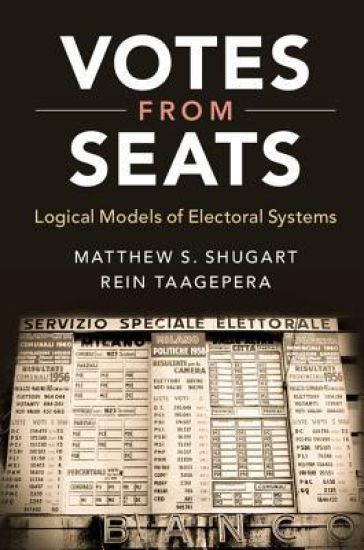
Take the number of seats in a representative assembly and the number of seats in districts through which this assembly is elected. From just these two numbers, the authors of Votes from Seats show that it is possible to deduce the number of parties in the assembly and in the electorate, as well as the size of the largest party. Inside parties, the vote distributions of individual candidates likewise follow predictable patterns. Four laws of party seats and votes are constructed by logic and tested, using scientific approaches rare in social sciences. Both complex and simple electoral systems are covered, and the book offers a set of 'best practices' for electoral system design. The ability to predict so much from so little, and to apply to countries worldwide, is an advance in the systematic analysis of a core institutional feature found in any democracy, and points the way towards making social sciences more predictive.
Votes from Seats

Votes from Seats

Matthew S. Shugart; Rein Taagepera

Cambridge University Press
2017
pokkari
Take the number of seats in a representative assembly and the number of seats in districts through which this assembly is elected. From just these two numbers, the authors of Votes from Seats show that it is possible to deduce the number of parties in the assembly and in the electorate, as well as the size of the largest party. Inside parties, the vote distributions of individual candidates likewise follow predictable patterns. Four laws of party seats and votes are constructed by logic and tested, using scientific approaches rare in social sciences. Both complex and simple electoral systems are covered, and the book offers a set of 'best practices' for electoral system design. The ability to predict so much from so little, and to apply to countries worldwide, is an advance in the systematic analysis of a core institutional feature found in any democracy, and points the way towards making social sciences more predictive.
Presidents, Parties, and Prime Ministers

Presidents, Parties, and Prime Ministers

David J. Samuels; Matthew S. Shugart

Cambridge University Press
2010
pokkari
This book provides a framework for analyzing the impact of the separation of powers on party politics. Conventional political science wisdom assumes that democracy is impossible without political parties, because parties fulfil all the key functions of democratic governance. They nominate candidates, coordinate campaigns, aggregate interests, formulate and implement policy, and manage government power. When scholars first asserted the essential connection between parties and democracy, most of the world's democracies were parliamentary. Yet by the dawn of the twenty-first century, most democracies had directly elected presidents. David J. Samuels and Matthew S. Shugart provide a theoretical framework for analyzing variation in the relationships among presidents, parties, and prime ministers across the world's democracies, revealing the important ways that the separation of powers alters party organization and behavior - thereby changing the nature of democratic representation and accountability.
Presidents, Parties, and Prime Ministers

Presidents, Parties, and Prime Ministers

David J. Samuels; Matthew S. Shugart

Cambridge University Press
2010
sidottu
This book provides a framework for analyzing the impact of the separation of powers on party politics. Conventional political science wisdom assumes that democracy is impossible without political parties, because parties fulfil all the key functions of democratic governance. They nominate candidates, coordinate campaigns, aggregate interests, formulate and implement policy, and manage government power. When scholars first asserted the essential connection between parties and democracy, most of the world's democracies were parliamentary. Yet by the dawn of the twenty-first century, most democracies had directly elected presidents. David J. Samuels and Matthew S. Shugart provide a theoretical framework for analyzing variation in the relationships among presidents, parties, and prime ministers across the world's democracies, revealing the important ways that the separation of powers alters party organization and behavior - thereby changing the nature of democratic representation and accountability.