
Kirjojen hintavertailu – 12 903 725 kirjaa ja 27 kauppaa

Kirjailija

Matthew Weinstein

Kirjat ja teokset yhdessä paikassa: 3 kirjaa, julkaisuja vuosilta 2009–2025, suosituimpiin kuuluu Science Education Towards Social and Ecological Justice. Vertaile teosten hintoja ja tarkista saatavuus suomalaisista kirjakaupoista.

3 kirjaa

Kirjojen julkaisuvuodet: 2009–2025.

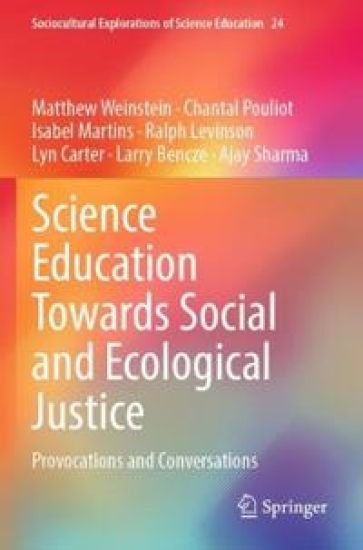
Science Education Towards Social and Ecological Justice

Science Education Towards Social and Ecological Justice

Matthew Weinstein; Chantal Pouliot; Isabel Martins; Ralph Levinson; Lyn Carter; Larry Bencze; Ajay Sharma

Springer International Publishing AG
2025
nidottu
This book consists of stories of struggles in science education presented by a network of science educators working in Australia, Brazil, Canada, Britain, and the United States. The common goal of these educators is to produce more socially/ecologically just models and practices of science education. The book considers and reworks the key-terms of current social justice: agency, realism, justice, and power. Its first section explores re-inhabiting science in the quest for more just worlds including reterritorializing science within emergent theories of critical realism, engaging citizens activists with corporate science, and challenging neoliberalism and the forces that organize (structure) knowledge. The second section redefines praxis of science education itself through nuanced explorations of agency, decolonialism, and justice in ways that emphasize complexity, hybridity, ambivalence, and contradiction. The stories of this international group capture individual and collective efforts, motivated by a persistent sense that science and science education matter for questions of justice.
Science Education Towards Social and Ecological Justice

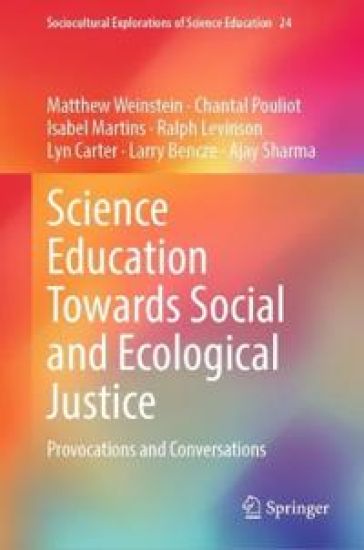
Science Education Towards Social and Ecological Justice

Matthew Weinstein; Chantal Pouliot; Isabel Martins; Ralph Levinson; Lyn Carter; Larry Bencze; Ajay Sharma

Springer International Publishing AG
2023
sidottu
This book consists of stories of struggles in science education presented by a network of science educators working in Australia, Brazil, Canada, Britain, and the United States. The common goal of these educators is to produce more socially/ecologically just models and practices of science education. The book considers and reworks the key-terms of current social justice: agency, realism, justice, and power. Its first section explores re-inhabiting science in the quest for more just worlds including reterritorializing science within emergent theories of critical realism, engaging citizens activists with corporate science, and challenging neoliberalism and the forces that organize (structure) knowledge. The second section redefines praxis of science education itself through nuanced explorations of agency, decolonialism, and justice in ways that emphasize complexity, hybridity, ambivalence, and contradiction. The stories of this international group capture individual and collective efforts, motivated by a persistent sense that science and science education matter for questions of justice.
Bodies Out of Control

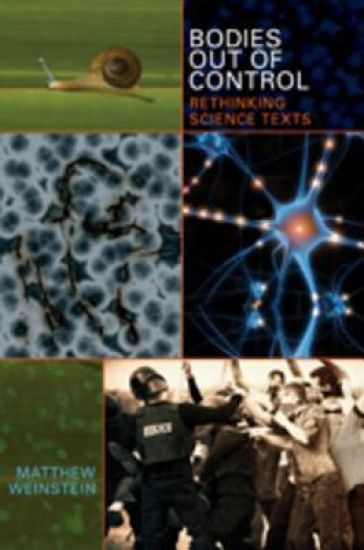
Bodies Out of Control

Matthew Weinstein

Peter Lang Publishing Inc
2009
nidottu
What is the cultural politics of science, health, and disease in the U. S.? Bodies Out of Control explores this question through a series of case studies. From its in-depth examination of the discussions of sickle-cell anemia, schistosomiasis, and cancer in middle school and high school textbooks to its analysis of the news coverage of the anthrax attacks of 2001, the book reveals the entanglements of science, colonialism, nationalism, and identity. The book also explores how the meaning of science itself is worked through in public discourses, offering alternatively medical salvation, confusion, and a vision of a world without pleasure. Finally, to explore what agency and a critical practice of engaging science in classrooms and elsewhere might look like, the book turns to the writings of politicized human research subjects, which demonstrate a spectrum of possibilities for more democratic engagements with science. As a whole, the book emphasizes the importance of engaging texts critically in science education and the ways that the cultural politics of science works through images of human and institutional bodies in and out of control.