
Kirjojen hintavertailu – 12 903 725 kirjaa ja 27 kauppaa

Kirjailija

Matthieu Charpe

Kirjat ja teokset yhdessä paikassa: 2 kirjaa, julkaisuja vuosilta 2015–2021, suosituimpiin kuuluu Financial Assets, Debt and Liquidity Crises. Vertaile teosten hintoja ja tarkista saatavuus suomalaisista kirjakaupoista.

2 kirjaa

Kirjojen julkaisuvuodet: 2015–2021.

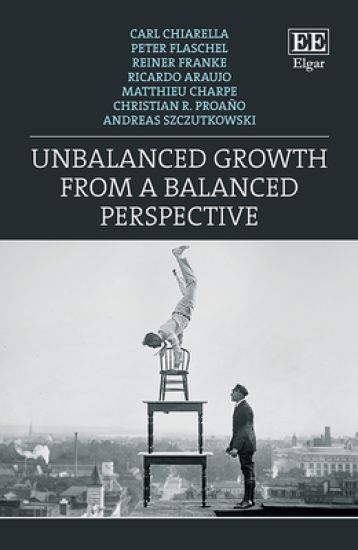
Unbalanced Growth from a Balanced Perspective

Unbalanced Growth from a Balanced Perspective

Carl Chiarella; Peter Flaschel; Reiner Franke; Ricardo Araujo; Matthieu Charpe; Christian R. Proaño; Andreas Szczutkowski

Edward Elgar Publishing Ltd
2021
sidottu
Synthesising Marx’s, Keynes’s and Schumpeter’s theories on wage-price dynamics, effective demand, real innovations and financial markets into a coherent whole, this book goes significantly beyond a consideration of their work in isolation. It focuses on exploring and analysing Goodwin’s integrated Marx-Keynes-Schumpeter system (MKS), approaching this from a historical perspective. Chapters start from Harrod’s and Kaldor’s work, reconsidering prominent demand- and supply-side approaches to Keynesian macro-dynamics, supplemented by Goodwin’s distributive cycle. The book presents a baseline MKS-type model, considering the rigorous treatment of uncertainty, opinion dynamics, the movement from flexicurity to social capitalism and democracy, and a high-order MKS macro-model. The exploration of the MKS model from a historical basis will make this a useful book for macroeconomics and history of economics scholars and students. It will also be helpful for those looking at macrodynamics in more depth.

Financial Assets, Debt and Liquidity Crises

Financial Assets, Debt and Liquidity Crises

Matthieu Charpe; Carl Chiarella; Peter Flaschel; Willi Semmler

Cambridge University Press
2015
pokkari
The macroeconomic development of most major industrial economies is characterised by boom-bust cycles. Normally such boom-bust cycles are driven by specific sectors of the economy. In the financial meltdown of the years 2007–9 it was the credit sector and the real-estate sector that were the main driving forces. This book takes on the challenge of interpreting and modelling this meltdown. In doing so it revives the traditional Keynesian approach to the financial-real economy interaction and the business cycle, extending it in several important ways. In particular, it adopts the Keynesian view of a hierarchy of markets and introduces a detailed financial sector into the traditional Keynesian framework. The approach of the book goes beyond the currently dominant paradigm based on the representative agent, market clearing and rational economic agents. Instead it proposes an economy populated with heterogeneous, rationally bounded agents attempting to cope with disequilibria in various markets.