Kirjojen hintavertailu – 12 859 818 kirjaa ja 27 kauppaa

Kirjailija

Maureen Swinger

Kirjat ja teokset yhdessä paikassa: 5 kirjaa, julkaisuja vuosilta 2017–2023, suosituimpiin kuuluu Plough Quarterly No. 12 - Courage. Vertaile teosten hintoja ja tarkista saatavuus suomalaisista kirjakaupoista.

5 kirjaa

Kirjojen julkaisuvuodet: 2017–2023.

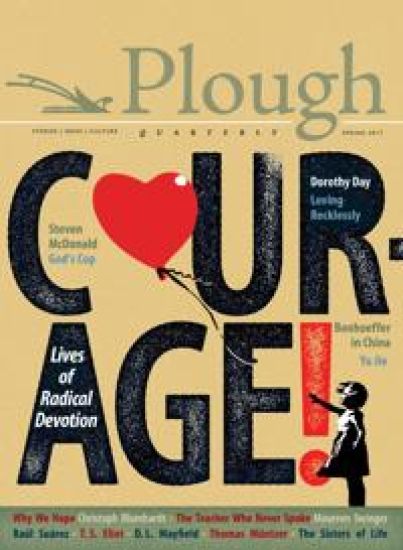
Plough Quarterly No. 12 - Courage

Plough Quarterly No. 12 - Courage

Yu Jie; Ral Surez; Julian Peters; Dorothy Day; Sam Hine; Maureen Swinger; George Bernard Shaw; Meister Eckhart

Plough Publishing House
2017
pokkari
To give hope in uncertain times, this issue of Plough profiles people who have lived courageously. In unsettling times such as these, being told to “take courage” can sound like a grim joke. Yet courage is precisely what we’re in need of today: courage to stand by the truth, and courage to stand by the gospel’s claim that everyone belongs to God, because Jesus has overcome the world. To inspire such courage – and to guard against a failure of nerve or of imagination – this issue of Plough highlights people who have lived courageously. In this issue: • Chinese dissident Yu Jie looks at the challenges facing the church in China. • Cuban pastor Raúl Suárez reveals how encounters with Christians thawed Fidel Castro’s atheism. • Plough pays tribute to NYPD Det. Steven McDonald, who forgave the young shooter who paralyzed him. • Maureen Swinger tells how a young man with severe disabilities became an exceptional teacher. • Evangelical activist D. L. Mayfield finds an unsettling role model in Dorothy Day. • Comic artist Julian Peters illustrates T. S. Eliot’s poem “Little Gidding.” Plus: • Insights on courage from Teresa of Avila, George Bernard Shaw, Meister Eckhart, and Mother Teresa • Original poetry by Christopher Zimmerman • Reviews of Martin Scorsese’s Silence, Mark Sundeen’s The Unsettlers, and Craig Greenfield’s Subversive Jesus • Profiles of Thomas Müntzer, Traudl Wallbrecher, and the Sisters of Life • Art and photography by Nikolay Ge, Boris Ivanovich Kopylov, Taisia Afonina, Wayne Forte, Dave Beckerman, Luca Sartoni, Wu Guanzhong, and Sadao Watanabe Plough Quarterly features stories, ideas, and culture for people eager to put their faith into action. Each issue brings you in-depth articles, interviews, poetry, book reviews, and art to help you put Jesus’ message into practice and find common cause with others.
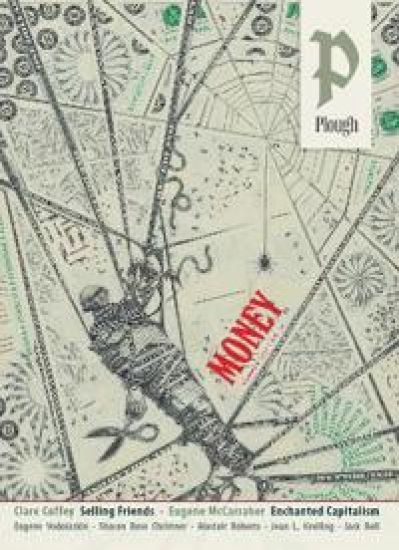
Plough Quarterly No. 36 – Money

Plough Quarterly No. 36 – Money

Eugene Vodolazkin; Clare Coffey; Eugene McCarraher; Sharon Rose Christner; Jack Bell; Alastair Roberts; Maureen Swinger

PLOUGH PUBLISHING HOUSE
2023
nidottu
Main Description: This issue opens with the story of Melania and her real estate-magnate husband, who decide to divest themselves of their entire wealth. These early Christians, who sold off their many estates and freed eight thousand slaves, were only exceptional in the amount they gave away. Jesus, after all, had advised a rich man, “Go, sell your possessions, and give the money to the poor.” And he emphatically warned that you cannot serve two masters: you cannot serve God and money. What does that mean for Christians today, in a society and economy premised on the accumulation of capital? How can we resist and subvert the power of money? On this theme: - Clare Coffey looks at how multilevel marketing commodifies friendship. - Sharon Rose Christner describes what happens when a Vatican palace becomes a homeless shelter. - Alastair Roberts writes in praise of Mary of Bethany’s extravagant love. - A photojournalist asks what’s left of the Cuban Revolution seventy years after it began. - Jack Bell revisits William Cobbett’s spirited defense of the vanishing British commons. - Maria Weiss finds pain and friendship in the forced community of a leper colony. - Maureen Swinger reveals the joys and pitfalls of owning twenty-two cars (collectively). - Robert Lockridge describes what he’s learned running a pay-as-you-can café. Also in the issue: - The winning poems in the 2023 Rhina Espaillat Poetry Award contest - An excerpt from Eugene Vodolazkin’s new novel, A History of the Island - Reviews of Kerri ní Dochartaigh’s Thin Places, Lydia Millet’s Dinosaurs, and Jennifer Banks’s Natality - Readings on Christianity and money from Eberhard Arnold, Peter Riedemann, Nicolai Berdyaev, Basil of Caesarea, Maria Skobtsova, C. S. Lewis, and Dorothy Day Plough Quarterly features stories, ideas, and culture for people eager to apply their faith to the challenges we face. Each issue includes in-depth articles, interviews, poetry, book reviews, and art.
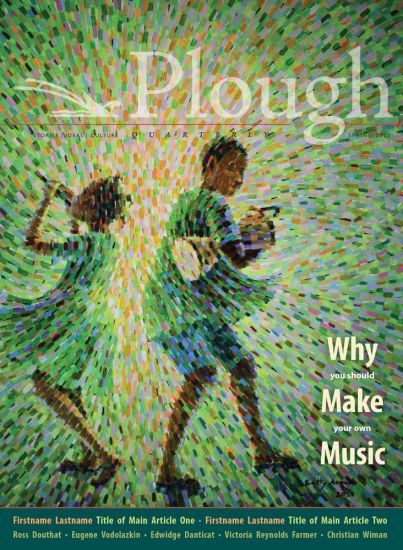
Plough Quarterly No. 31 – Why We Make Music

Plough Quarterly No. 31 – Why We Make Music

Christopher Tin; Stephen Michael Newby; Mary Townsend; Maureen Swinger; Joseph Julián González; Phil Christman; Eugene Vodolazkin; Esther Maria Magnis; Ben Crosby; Nathan Schram; Brittany Petruzzi; Norann Voll

PLOUGH PUBLISHING HOUSE
2022
pokkari
Communal music has the power to shape a soul and a society. In many places today, a culture of singing and making music remains robust, despite pressure from the commercial music industry. Or it was until the Covid pandemic hit and we glimpsed what a world without communal music-making could be like. According to Plato, virtuous music is vital for building a virtuous community. Jewish and Christian traditions take this insight even further: good communal music shapes and builds up the people of God. So how can we choose good music and avoid the bad? The sheer ubiquity of music available for consumption – its presence as a near-constant soundtrack to our daily lives – poses a hazard. Digital music on tap is a temptation to chronic distraction of the soul, to a habit of superficiality and non-attention. Fortunately, the remedy is straightforward: spend less time consuming prepackaged tunes and more time making music. This will be doubly rewarding if done with others – singing with one’s family, singing in church, playing in a string quartet, starting a regular jam session. If personal media players tend to cut us off from the physical presence of others, sharing in good music together breaks the spell of isolation and disembodiment. It builds friendship and community. On this theme:- Maureen Swinger’s amateur choir sings Bach’s Saint Matthew Passion.- Stephen Michael Newby says Black spirituals aren’t just for Black people. - Mary Townsend finds Dolly Parton magnificent, but would Aristotle? - Phil Christman finds catharsis in the YouTube comments of eighties songs. - Ben Crosby says congregational singing should be unabashedly weird to visitors.- Joseph Julián González draws on ancient Nahua poets in his music.- Christopher Tin explains why he weaves so many historical influences into his music. - Seven musicians talk about making your own music in schools, churches, prisons, backyards, or children’s bedrooms: Nathan Schram, Esther Keiderling, Norann Voll, Chaka Watch Ngwenya, Eileen Maendel, Adora Wong, and Brittany Petruzzi. Also in the issue: Exclusive excerpts from forthcoming books by Eugene Vodolazkin and Esther Maria Magnis- Thoughts on music from Augustine, Gregory of Nyssa, Hildegard of Bingen, Martin Luther, and Eberhard Arnold- Catholics and Anabaptists unite to commemorate the Radical Reformation- New poems by Jacqueline Saphra- A profile of Argentinian singer Mercedes Sosa.- Reviews of Kate Clifford Larson’s Walk with Me, Rowan Williams’s Shakeshafte, and Sam Quinones’s The Least of UsPlough Quarterly features stories, ideas, and culture for people eager to apply their faith to the challenges we face. Each issue includes in-depth articles, interviews, poetry, book reviews, and art.
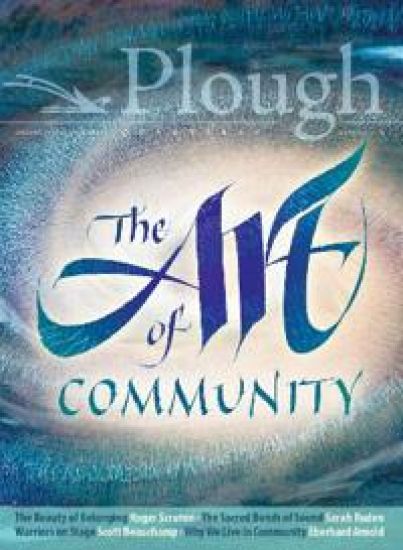
Plough Quarterly No. 18 - The Art of Community

Plough Quarterly No. 18 - The Art of Community

Scott Beauchamp; Roger Scruton; Kermani Navid; Fadi Mikhail; James Baldwin; Dorothy L. Sayers; Susannah Black; John Berger; John Carlin; Eberhard Arnold; Sarah Ruden; Maureen Swinger; Emily Hallock

Plough Publishing House
2018
pokkari

Halvin toimitettuna 16,00 €

Can beauty save the world? These days criticism of art--whether visual, musical, or literary--is often marked by a suspicion of beauty. What happened to the belief that the creativity of the artist reflects the creativity of the Maker of heaven and earth, and that art can therefore be a channel for divine truth? Anyone who has joined with others to sing Bach’s Saint Matthew Passion or stood before a painting by Raphael or Chagall can attest to this. At such moments, art binds people together. This issue of Plough focuses on art that leads to such community: through theater, painting, music, and the objects and architecture of everyday life. And while art fosters community, building community is itself a work of creativity. Also in this issue: original poetry by Cozine Welch Jr.; reviews of new books by Eliza Griswold, Alissa Quart, Eugene Vodolazkin, and Nathan Englander; and art by Denis Brown, JR, Valérie Jardin, Isaiah King, Isaiah Tanenbaum, George Makary, Oriol Malet, Alex Nwokolo, Ashik and Jenelle Mohan, Raphael, Aaron Douglas, Winslow Homer, Vincent van Gogh, Wassily Kandinsky, and Jason Landsel. Plough Quarterly features stories, ideas, and culture for people eager to put their faith into action. Each issue brings you in-depth articles, interviews, poetry, book reviews, and art to help you put Jesus’ message into practice and find common cause with others.
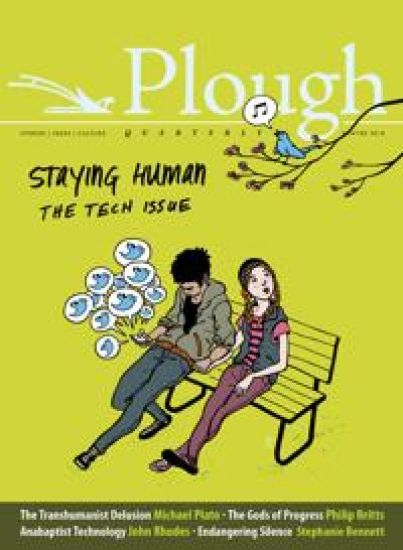
Plough Quarterly No. 15 - Staying Human

Plough Quarterly No. 15 - Staying Human

Eberhard Arnold; Michael Plato; Alexi Sargeant; Susannah Black; Stephanie Bennett; Johann Christoph Arnold; Philip Britts; John Rhodes; Chico Fajardo-Heflin; Mark Bauerlein; Michael T. McRay; C. S. Lewis; Wendell Berry; Alfred Delp; Timothy Cardinal Dolan; Maureen Swinger

Plough Publishing House
2018
pokkari
This issue of Plough Quarterly explores the effects of technology on human flourishing. Whether its artificial intelligence, genome editing, Big Tech monopolies, or social media–induced depression, we live in a world that is being reshaped by technology from the ground up. How do we stay human? This issue of Plough Quarterly addresses challenges ranging from the lure of transhumanism to the erosion of silence by the smartphone. Technophobia is no answer, our contributors agree, but neither is a refusal to tackle real dangers. They ask: Why not try living without a computer or a television? Why give tablets to children when Steve Jobs refused to give them to his kids? Why write using a keyboard when you could wield a fountain pen? Technological asceticism of this kind won’t solve society-wide dilemmas. But it can help us maintain the spiritual independence needed to respond to them rightly. Also in this issue: original poetry by Jacob Stratman; reviews of new books by Ian Johnson, Steve Roud, and Markus Rathey; insights from Wendell Berry, Viktor Frankl, Ivan Illich, Carl Sandburg, C. S. Lewis, Alfred Delp, and Christoph Blumhardt; and art by Pieter Bruegel the Elder, Jack Baumgartner, Nicholas Roerich, Rachel Newling, Kay Polk, Suellen McCrary, Stephen Scott Young, Jie Wei Zhou, Kiéra Malone, Torkel Pettersson, Mari Rast, Albrecht Dürer, René Magritte, and Kyle T. Webster. Plough Quarterly features stories, ideas, and culture for people eager to put their faith into action. Each issue brings you in-depth articles, interviews, poetry, book reviews, and art to help you put Jesus’ message into practice and find common cause with others.