Kirjojen hintavertailu – 12 903 725 kirjaa ja 27 kauppaa

Kirjailija

Maurice Matloff

Kirjat ja teokset yhdessä paikassa: 5 kirjaa, julkaisuja vuosilta 1996–2015, suosituimpiin kuuluu Strategic Planning for Coalition Warfare: 1943-1944. Vertaile teosten hintoja ja tarkista saatavuus suomalaisista kirjakaupoista.

5 kirjaa

Kirjojen julkaisuvuodet: 1996–2015.

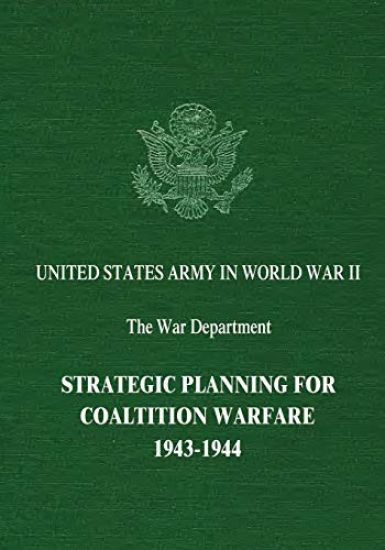
Strategic Planning for Coalition Warfare: 1943-1944

Strategic Planning for Coalition Warfare: 1943-1944

Maurice Matloff

Createspace Independent Publishing Platform
2015
nidottu
Within a generation the attitude and policy of the United States toward alliances have undergone a revolutionary reversal. The nation has passed from its traditional suspicion and fear of "entangling alliances" to a policy that heavily stakes its security and interests on the co-operation of other powers. In World War I the U. S. Government cautiously defined its relationship with the powers allied against Germany as that of an Associated Power. In World War II, though last to join the Grand Alliance, it virtually integrated its resources with those of the British Commonwealth and coordinated its strategy and war aims with the British and the USSR in the most powerful wartime partnership ever forged. Since 1945 it has emerged as the leader in the North Atlantic Treaty Organization (NATO) and has diligently sought allies and built up alliances all over the troubled world. The climax of its most intensive experience with coalition strategy came in the phase of World War II described in this volume, which should therefore have a special interest for all who are concerned with the implications of the revolution in U. S. foreign policy that has taken place in the twentieth century.

Strategic Planning for Coalition Warfare: 1941-1942

Strategic Planning for Coalition Warfare: 1941-1942

Edwin M. Snell; Maurice Matloff

Createspace Independent Publishing Platform
2015
nidottu
This volume is a study of the evolution of American strategy before and during the first year of American participation in World War II. It is the story of planning by the War Department during that early and significant period in which the foundations of the strategy for the conduct of the war were established. The authors not only present the problems of the Chief of Staff of the U. S. Army and of his principal plans and operations officers, but also emphasize joint and combined problems-the reconciliation of the Army views on strategy with those of the Navy and the integration of American and British views and their adjustment to the military policies of other associated powers, notably the Soviet Union. It may seem to the reader that controversy and differences of opinion are stressed and that agreement and co-operative endeavor are slighted. Since planners are occupied with unsettled problems, their work necessarily involves differences of opinion. It is only when all sides of an issue are forcefully presented and the various solutions thereof closely scrutinized that the final plan has any validity. The reader must bear in mind that the differences related herein are those among comrades in arms who in the end always made the adjustments required of the members of a team engaged in a common enterprise. The execution of strategic decisions-the end result of debates, negotiations, and compromises set forth in the book-is narrated in the combat volumes of this series. Mr. Maurice Matloff and Mr. Edwin M. Snell collaborated in writing this volume. Mr. Snell was formerly an instructor in English at Harvard University and Mr. Matloff an instructor in History at Brooklyn College. Mr. Snell served in the Army and Mr. Matloff in the Army Air Forces during World War II. Both joined the Operations Division historical project of the War Department General Staff in 1946. Mr. Matloff is now the Chief, Strategic Plans Section, Office of the Chief of Military History, Department of the Army.
American Military History, Vol. 2

American Military History, Vol. 2

Maurice Matloff

Da Capo Press Inc
1996
pokkari
American Military History makes available to a civilian audience for the first time a comprehensive view of the parallel development of the American military and the American nation, evaluated in light of the nine principles of war currently recognized by the U. S. military. Volume 2 of this influential work takes the American people and their armed forces in the wider world of the twentieth century, with its global commitments, multi-national operations and mass citizen armies. The decade leading up to 1917 is seen in light of the mixed results of the Spanish-American War, with the Army striving to improve weapons, training, organization and structures of command. America's late entry into World War I is seen as leading to two remarkable accomplishments: the U. S. Army under John J. Pershing maintaining its separate identity despite British and French demands for piecemeal troop replacements, and the rapid mobilization of a large citizen army and wartime industrial production without damaging the domestic economy. The rapidly changing world situation of the 1980s and the U. S. response are fully covered, culminating in the Persian Gulf War. The Gulf War appears in many ways to be a summation of the American military experience, incorporating the rapid mobilization and technical expertise of the world wars with principles of command and maneuver developed by small numbers of determined men at King's Mountain and in the Shenandoah. American Military History was originally designed by the U. S. Army's Office of Military History for the instruction of officer cadets and other military personnel. The work went through various editions from 1956 to 1988, under the direction of Dr. Maurice Matloff. The current two-volume edition has some revisions and has been expanded to give full coverage of the operations and lessons of the Persian Gulf War by Dr. Albert A. Nofi and others.
American Military History

American Military History

Maurice Matloff

Da Capo Press Inc
1996
pokkari
American Military History cuts to the heart of each war or military campaign in American history. Originally designed with future United States Army officers in mind, this is a true nuts and bolts approach to military history. Volume 1 of this landmark work offers a unique opportunity to learn the principles of war as seen by the current U. S. military leadership. The smaller campaigns and simpler world of the eighteenth and nineteenth centuries are utilized by the authors to go into greater depth on the principles of war followed or violated by American commanders during the early wars from the Revolution to the War with Spain. A fascinating introduction discusses in depth the nine principles of war currently recognized by the U. S. Army. This is history as few outside of professional military circles have seen it before. American history is presented from a new perspective, beginning with the War of Independence. Some readers will learn for the first time how lesser-known battles like Oriskany and King's Mountain decisively shaped subsequent military thinking, how supply oversights helped doom Burgoyne at Saratoga, or how Nathanael Greene set the stage for Cornwallis' defeat by violating European military principles to meet the conditions for the American frontier. Volume 1 ends with the Spanish-American War, the Philippine Insurrection and the Boxer Rebellion, with the United States on the brink of its twentieth century role as a world power. The account of the War with Spain candidly examines the Army's lack of preparedness in contrast to the Navy, and the Importance of the Navy's role in the campaign. The Philippine involvement is placed in the context of America's growing interest in the Pacific, and the Boxer Rebellion is presented as the first time since 1781 that Americans had participated in a multi-national force, the harbinger of things to come. American Military History was originally designed by the U. S. Army's Office of Military History for the instruction of officer cadets and other military personnel. The work went through various editions from 1956 to 1988, under the direction of Dr. Maurice Matloff. The current two-volume edition has some revisions and has been expanded to give full coverage of the operations and lessons of the Persian Gulf War by Dr. Albert A. Nofi and others.