Kirjojen hintavertailu – 12 859 828 kirjaa ja 27 kauppaa
Kirjailija
Maurice Merleau-Ponty
Kirjat ja teokset yhdessä paikassa: 42 kirjaa, julkaisuja vuosilta 1964–2026, suosituimpiin kuuluu Phanomenologie Der Wahrnehmung. Vertaile teosten hintoja ja tarkista saatavuus suomalaisista kirjakaupoista.
Maurice Merleau-Ponty is one of the few major phenomenologists to engage extensively with empirical research in the sciences, and the only one to examine child psychology with rigor and in such depth. His writings have recently become increasingly influential, as the findings of psychology and cognitive science inform and are informed by phenomenological inquiry. Merleau-Ponty’s Sorbonne lectures of 1949 to 1952 are a broad investigation into child psychology, psychoanalysis, pedagogy, phenomenology, sociology, and anthropology. They argue that the subject of child psychology is critical for any philosophical attempt to understand individual and intersubjective existence. Talia Welsh’s new translation provides Merleau-Ponty’s complete lectures on the seminal engagement of phenomenology and psychology.
Maurice Merleau-Ponty is one of the few major phenomenologists to engage extensively with empirical research in the sciences, and the only one to examine child psychology with rigor and in such depth. His writings have recently become increasingly influential, as the findings of psychology and cognitive science inform and are informed by phenomenological inquiry. Merleau-Ponty’s Sorbonne lectures of 1949 to 1952 are a broad investigation into child psychology, psychoanalysis, pedagogy, phenomenology, sociology, and anthropology. They argue that the subject of child psychology is critical for any philosophical attempt to understand individual and intersubjective existence. Talia Welsh’s new translation provides Merleau-Ponty’s complete lectures on the seminal engagement of phenomenology and psychology.
Institution and Passivity is based on course notes for classes taught at the Bibliothèque Nationale de Paris. Philosophically, this collection connects the issue of passive constitution of meaning with the dimension of history, furthering discussions and completing arguments started in The Visible and the Invisible and Signs (both published by Northwestern). Leonard Lawlor and Heath Massey’s translation makes available to an English-speaking readership a critical transitional text in the history of phenomenology.
'In simple prose Merleau-Ponty touches on his principle themes. He speaks about the body and the world, the coexistence of space and things, the unfortunate optimism of science – and also the insidious stickiness of honey, and the mystery of anger.' - James ElkinsMaurice Merleau-Ponty was one of the most important thinkers of the post-war era. Central to his thought was the idea that human understanding comes from our bodily experience of the world that we perceive: a deceptively simple argument, perhaps, but one that he felt had to be made in the wake of attacks from contemporary science and the philosophy of Descartes on the reliability of human perception. From this starting point, Merleau-Ponty presented these seven lectures on The World of Perception to French radio listeners in 1948. Available in a paperback English translation for the first time in the Routledge Classics series to mark the centenary of Merleau-Ponty’s birth, this is a dazzling and accessible guide to a whole universe of experience, from the pursuit of scientific knowledge, through the psychic life of animals to the glories of the art of Paul Cézanne.
Malerkunstens problemer anskueliggjør kroppens gåte, og kroppens gåte anskueliggjør malerkunstens problemer. Det er ved å låne verden sin kropp at maleren forvandler verden til maleri. Maleren er ubestridelig suveren i sin fortolkning av verden som han utfører uten noen annen "teknikk" enn den hans øyne og hender erverver seg ved uopphørlig å se og male; utrettelig i sin bestrebelse for å fravriste verden lerreter. Hvilken hemmelig vitenskap er det han besitter eller søker? Ikke den vitenskapelige som vil gjøre verden til sitt objekt, men en vitenskap som kan følge verden i dens tilsynekomst. Det "verdens øyeblikk" som Cezanne ville male og som for lengst er svunnet, springer oss fortsatt i møte på hans lerreter, og hans Montagne Sainte-Victorie kommer atter og atter til syne hver gang vi betrakter det i hans bilder.
Gjennom en rekke fenomenologiske analyser av patologiske forstyrrelser etc. nærmer Merleau-Ponty seg en ny innsikt i subjektets kroppslige væren og den legemligjorte bevissthet og erkjennelse. Boken utgjør den første delen av hans verk "Phenomenologie de la perception" (1945). Har litteraturliste.
Der Gedanke, dass jede Präsenz mit Absenz durchsetzt ist und jedes Selbe ein anderes bleibt, begegnet uns nicht erst bei Derrida, sondern schon in Merleau-Pontys später Ontologie. Die Suche richtet sich hier auf ein Unsichtbares, das dieser Welt selbst zugehört und ihr Struktur und Relief gibt, und auf ein Nichtsehen, das sich dem Bewusstseinsfeld selbst einschreibt als blinder Fleck, der jeder Welt- und Selbstverfügung spottet. Das Sein bekommt Risse. Es ist nicht vor uns, sondern um uns, eher Element als Gegenstand. Fassen lässt es sich nur indirekt, in den Höhlungen, Kreuzungsstellen und Verschachtelungen dessen, was uns in der Erfahrung begegnet.
'Painting does not imitate the world, but is a world of its own.'In 1948, Maurice Merleau-Ponty wrote and delivered on French radio a series of seven lectures on the theme of perception. Translated here into English for the first time, they offer a lucid and concise insight into one of the great philosophical minds of the twentieth-century. These lectures explore themes central not only to Merleau-Ponty's philosophy but phenomenology as a whole. He begins by rejecting the idea - inherited from Descartes and influential within science - that perception is unreliable and prone to distort the world around us. Merleau-Ponty instead argues that perception is inseparable from our senses and it is how we make sense of the world. Merleau-Ponty explores this guiding theme through a brilliant series of reflections on science, space, our relationships with others, animal life and art. Throughout, he argues that perception is never something learned and then applied to the world. As creatures with embodied minds, he reminds us that we are born perceiving and share with other animals and infants a state of constant, raw, unpredictable contact with the world. He provides vivid examples with the help of Kafka, animal behaviour and above all modern art, particularly the work of Cezanne. A thought-provoking and crystalline exploration of consciousness and the senses, The World of Perception is essential reading for anyone interested in the work of Merleau-Ponty, twentieth-century philosophy and art.
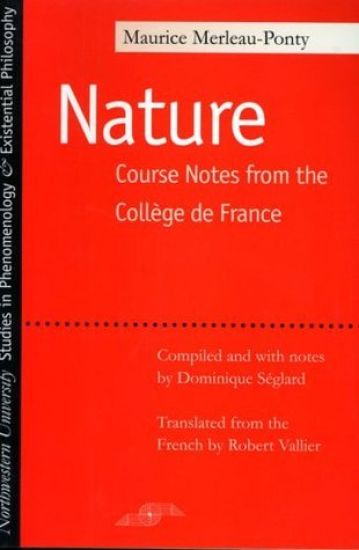
Collected here are the written traces of courses on the concept of nature given by Maurice Merleau-Ponty at the Collège de France in the 1950s-notes that provide a window on the thinking of one of the most influential philosophers of the twentieth century. In two courses distilled by a student and in a third composed of Merleau-Ponty's own notes, the ideas that animated the philosopher's lectures and that informed his later publications emerge in an early, fluid form in the process of being elaborated, negotiated, critiqued, and reconsidered. Merleau-Ponty's project in these courses is an interrogation of nature, a task at the center of his investigation of perception, truth, and subjectivity. The first course, a survey of the historical elements in our concept of nature, examines first the Cartesian concept of nature and then historical and contemporary responses to Descartes, all with an eye toward developing a vision of nature more consistent with the findings of contemporary science. In the second course, Merleau-Ponty takes up the problem of the relation of nature to ontology in general. Here, the key question is how the animal finds itself in its world. Because the human body is ultimately "an animal of movements and perceptions," humanity is intertwined with animality. In the third course, "Nature and Logos: The Human Body," Merleau-Ponty assesses his previous findings and examines the emergence of the human body at the intersection of nature and Logos. This course, contemporaneous with the working notes for The Visible and the Invisible, allows us to observe the evolution of that work as well as to revisit the research he had begun in Primacy of Perception. In these traces: a new reading of Descartes; a measured appreciation of Schelling; an assessment of recent developments in the sciences (both physical and biological) that leads to the notion of the body as a "system of equivalencies"; and an examination of the phenomenon of life. We have a wealth of material that allows us to reconsider Merleau-Ponty's thinking and to engage his philosophical project anew.
Collected here are the written traces of courses on the concept of nature given by Maurice Merleau-Ponty at the Collège de France in the 1950s-notes that provide a window on the thinking of one of the most influential philosophers of the twentieth century. In two courses distilled by a student and in a third composed of Merleau-Ponty's own notes, the ideas that animated the philosopher's lectures and that informed his later publications emerge in an early, fluid form in the process of being elaborated, negotiated, critiqued, and reconsidered. Merleau-Ponty's project in these courses is an interrogation of nature, a task at the center of his investigation of perception, truth, and subjectivity. The first course, a survey of the historical elements in our concept of nature, examines first the Cartesian concept of nature and then historical and contemporary responses to Descartes, all with an eye toward developing a vision of nature more consistent with the findings of contemporary science. In the second course, Merleau-Ponty takes up the problem of the relation of nature to ontology in general. Here, the key question is how the animal finds itself in its world. Because the human body is ultimately "an animal of movements and perceptions," humanity is intertwined with animality. In the third course, "Nature and Logos: The Human Body," Merleau-Ponty assesses his previous findings and examines the emergence of the human body at the intersection of nature and Logos. This course, contemporaneous with the working notes for The Visible and the Invisible, allows us to observe the evolution of that work as well as to revisit the research he had begun in Primacy of Perception. In these traces: a new reading of Descartes; a measured appreciation of Schelling; an assessment of recent developments in the sciences (both physical and biological) that leads to the notion of the body as a "system of equivalencies"; and an examination of the phenomenon of life. We have a wealth of material that allows us to reconsider Merleau-Ponty's thinking and to engage his philosophical project anew. Before his death in 1961, Maurice Merleau-Ponty was chair in philosophy at the Collège de France. Robert Vallier is completing his doctoral work on Merleau-Ponty and Schelling at DePaul University. He has also taught at the Universite de Paris-X (Nanterre) and at the College Internationale de Philosophie.
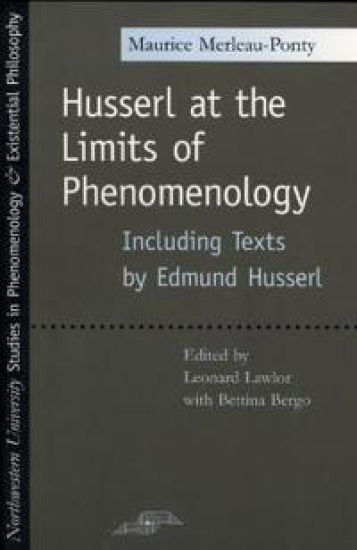
Combining Maurice Merleau-Ponty's 1960 course notes on Edmund Husserl's The Origin of Geometry, his course summary, related texts, and critical essays, this collection offers a unique and welcome glimpse into both Merleau-Ponty's nuanced reading of Husserl's famed late writings and his persistent effort to track the very genesis of truth through the incarnate idealization of language.
A glimpse into Maurice Merleau-Ponty's nuanced reading of Husserl and his effort to track the genesis of truth through the idealization of language. It combines Merleau-Ponty's notes on Husserl's ""Origin of Geometry"", his ""Course Summary"", related texts, and essays by the co-translators.
Raymond Aron called Merleau-Ponty "the most influential French philosopher of his generation." First published in France in 1947, Humanism and Terror was in part a response to Arthur Koestler's Darkness at Noon, and in a larger sense a contribution to the political and moral debates of a postwar world suddenly divided into two ideological armed camps. For Merleau-Ponty, the central question was: could Communism transcend its violence and intentions? The value of a society is the value it places upon man's relation to man, Merleau-Ponty examines not only the Moscow trials of the late thirties but also Koestler's re-creation of them. He argues that violence in general in the Communist world can be understood only in the context of revolutionary activism. He demonstrates that it is pointless to ask whether Communism respects the rules of liberal society; it is evident that Communism does not. In post-Communist Europe, when many are addressing similar questions throughout the world, Merleau-Ponty's discourse is of prime importance; it stands as a major and provocative contribution to limits on the use of violence. The argument is placed in its current context in a brilliant new introduction by John O'Neill. His remarks extend the line of argument originally developed by the great French political philosopher. This is a major contribution to political theory and philosophy.
First published in France In 1947, Merleau-Ponty's essay was in part a response to Arthur Koestler's novel, Darkness at Noon, and in a larger sense a contribution to the political and moral debates of a postwar world suddenly divided into two armed camps. For Merleau-Ponty, the basic question was: given the violence in Communism, is Communism still equal to its humanist intentions? Starting with the assumption that a society is not a "temple of value-idols that figure on the front of its monuments or in its constitutional scrolls; the value of a society is the value It places upon man's relation to man," Merleau-ponty examines not only the Moscow trials of the late thirties but also Koestler's re-creation of them. And Merleau-Ponty makes it clear that the Moscow trials--and violence in general in the Communist world--can be understood only In the context of revolutionary violence. He demonstrates that it is pointless to begin an examination of Communist violence by asking whether Communism respects the rules of liberal thought; it is evident that Communism does not. The question that should be asked is whether the violence Communism exercises is revolutionary violence, capable of building humane relations among men. At a time when many are addressing similar questions to societies both in the East and in the West, Merleau-Ponty's investigations and speculations are of prime importance; they stand as a major and provocative contribution to the argument surrounding the use of violence.
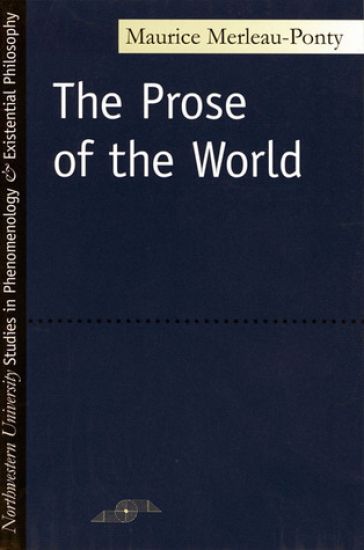
The work that Maurice Merleau-Ponty planned to call The Prose of the World, or Introduction to the Prose of the World, was unfinished at the time of his death. The book was to constitute the first section of a two-part work whose aim was to offer, as an extension of his Phenomenology of Perception, a theory of truth. This edition's editor, Claude Lefort, has interpreted and transcribed the surviving typescript, reproducing Merleau-Ponty's own notes and adding documentation and commentary.
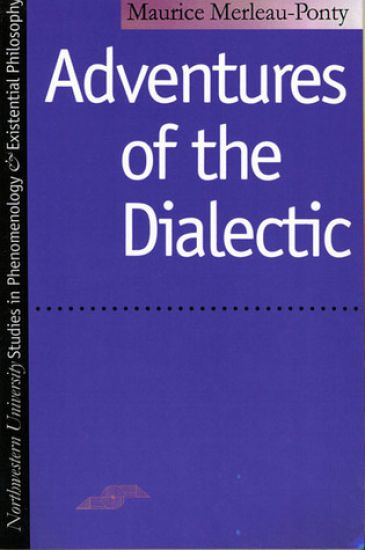
We need a philosophy of both history and spirit to deal with the problems we touch upon here. Yet we would be unduly rigorous if we were to wait for perfectly elaborated principles before speaking philosophically of politics." Thus Merleau-Ponty introduces Adventures of the Dialectic, his study of Marxist philosophy and thought. In this study, containing chapters on Weber, Lukacs, Lenin, Sartre, and Marx himself, Merleau-Ponty investigates and attempts to go beyond the dialectic.