Kirjojen hintavertailu – 12 903 725 kirjaa ja 27 kauppaa

Kirjailija

Maurice Mullard

Kirjat ja teokset yhdessä paikassa: 13 kirjaa, julkaisuja vuosilta 1993–2026, suosituimpiin kuuluu Local Government and Thatcherism. Vertaile teosten hintoja ja tarkista saatavuus suomalaisista kirjakaupoista.

13 kirjaa

Kirjojen julkaisuvuodet: 1993–2026.

Local Government and Thatcherism

Local Government and Thatcherism

Hugh Butcher; Ian G. Law; Robert Leach; Maurice Mullard

TAYLOR FRANCIS LTD
2024
sidottu
The 1980s witnessed an unprecedented series of initiatives aimed at transforming the role and manner of local government operations in Britain. First published in 1990, Local Government and Thatcherism provides a clear and up-to-date framework for understanding the impact of ‘Thatcherism’ on local government during this period and explores future prospects. The authors examine the effect of the ‘Thatcher Revolution’ on the policy and practice of local government, looking at the role of ideology in key policy areas such as finance, public services, local economic development, race, and decentralization. Beginning with an analysis of the evolution of local government, the authors situate Thatcherism in the context of ‘Municipal Toryism’, and discuss changes in local finance, including the introduction of the community charge. They focus on changes in public policy, particularly innovations like grant-maintained schools and Housing Action Trusts and look in detail at economic regeneration and equal opportunities, two areas in local policy development which are increasingly under threat from centralizing tendencies. The authors conclude that the revolution in local government is aimed at nothing less than recasting the local socio-political order and political process. Coming to terms with these challenges, they believe, will change the face of local government in 1990s; the contract authority, the enterprising authority, and the business-corporatist authority. Lucid and stimulating, this discussion will be invaluable to students of British politics, and public and social administration, and to all those who wish to know more about the future of local government.

Local Government and Thatcherism

Local Government and Thatcherism

Hugh Butcher; Ian G. Law; Robert Leach; Maurice Mullard

TAYLOR FRANCIS LTD
2026
nidottu
The 1980s witnessed an unprecedented series of initiatives aimed at transforming the role and manner of local government operations in Britain. First published in 1990, Local Government and Thatcherism provides a clear and up-to-date framework for understanding the impact of ‘Thatcherism’ on local government during this period and explores future prospects. The authors examine the effect of the ‘Thatcher Revolution’ on the policy and practice of local government, looking at the role of ideology in key policy areas such as finance, public services, local economic development, race, and decentralization. Beginning with an analysis of the evolution of local government, the authors situate Thatcherism in the context of ‘Municipal Toryism’, and discuss changes in local finance, including the introduction of the community charge. They focus on changes in public policy, particularly innovations like grant-maintained schools and Housing Action Trusts and look in detail at economic regeneration and equal opportunities, two areas in local policy development which are increasingly under threat from centralizing tendencies. The authors conclude that the revolution in local government is aimed at nothing less than recasting the local socio-political order and political process. Coming to terms with these challenges, they believe, will change the face of local government in 1990s; the contract authority, the enterprising authority, and the business-corporatist authority. Lucid and stimulating, this discussion will be invaluable to students of British politics, and public and social administration, and to all those who wish to know more about the future of local government.

200 Years and Beyond

200 Years and Beyond

Maurice Mullard

Nova Science Publishers Inc
2020
sidottu
This book examines the changing social political and economics landscapes that continue to shape and define the Britain and America that we know today. The industrial Revolution was defined by technology in cotton spinning, in the building of canals, railways and telegraphy. The intensity of economic change meant changes in social and political expectations from the Chartists seeking to widen the franchise in Britain to Civil War and slavery in America. Social progress ebbs and flows; nothing in history is linear. Strikes were won and lost. Coxey's army marched to show the plight of unemployment as many others would do during the Depression of the 1930s. America had the New Deal and Britain provided social forms of protection to deal with unemployment. The 1950s to 1970s are described as the years of calm waters of fully employment continuing prosperity people buying their first cars their first homes and domestic appliances. Stagflation became the problem for the 1980s of dealing with inflation and revisiting unemployment to new prosperity of the 1990s and the financial meltdown of 2008. People in 2020 have different lived experiences to those of 1820. Yet life in 2020 brings new but different challenges to 1820. The books is aimed at students of history of economics of social change and politics. It is however also aimed at a wider readership as it tries to tell 200 years of history as a journey that continues to shape both countries.
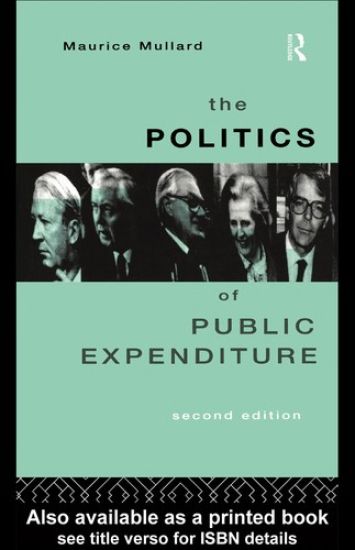
The Politics of Public Expenditure

The Politics of Public Expenditure

Maurice Mullard

Routledge
2017
sidottu
The question of public expenditure has proved to be one of the perennial problems for British Governments. Given forecasts of low growth and record levels of unemployment, the present Government could be faced with dilemmas of greater magnititude than ever. This new edition of Maurice Mullard's book has been carefully revised to provide students with an accessible text. It is principally concerned with explaining the political contexts in which public expenditure decisions have had to be made over the last twenty years. It examines the way in which Governments make choices according to public pressure and the fact that bargains and compromises have to be made in order to maintain political credibility. Maurice Mullard provides examples of the way in which Government policy and individual expenditure programmes have been shaped according to the political climate. The text combines theoretical framworks with policy analysis. This edition contains new chapters on Conservative and Labour politics and a section on John Major's government.
The Politics of Recession

The Politics of Recession

Maurice Mullard

Edward Elgar Publishing Ltd
2012
nidottu
This timely book utilizes the tools of politics, economics and public policy to explore the causes of the recent global financial crisis, which, the author argues, can be explained as the absence of a public interest perspective in policy making. Maurice Mullard points out that recessions are not collective shared experiences. Recessions create winners and losers. Furthermore, recessions are not an external event but reflect the outcomes of the policy process. The author looks beyond economic explanations for the economic crisis, and instead points towards a structural explanation. He explores the concept of social structures, the effects of the relationships between power and influence, and the role of ideology and income inequalities as contributory factors. The commitment to deregulated financial markets created an over the counter derivatives market worth some $640 trillion dollars compared to a global GDP worth $65 trillion dollars. The growth of derivatives markets, the role of credit rating agencies, major shifts in policy making and growing income inequalities are described as major factors explaining the present economic recession. The absence of a public interest perspective, the breakdown of trust in institutions, policy makers dependence on financial contributions, the housing bubble, and the increased concentration of income have distorted the democratic process. Thought provoking and stimulating, this book will provide a fascinating study for students and academics with an interest in politics, economics, political economy and public policy.
The Politics of Recession

The Politics of Recession

Maurice Mullard

Edward Elgar Publishing Ltd
2011
sidottu
This timely book utilizes the tools of politics, economics and public policy to explore the causes of the recent global financial crisis, which, the author argues, can be explained as the absence of a public interest perspective in policy making. Maurice Mullard points out that recessions are not collective shared experiences. Recessions create winners and losers. Furthermore, recessions are not an external event but reflect the outcomes of the policy process. The author looks beyond economic explanations for the economic crisis, and instead points towards a structural explanation. He explores the concept of social structures, the effects of the relationships between power and influence, and the role of ideology and income inequalities as contributory factors. The commitment to deregulated financial markets created an over the counter derivatives market worth some $640 trillion dollars compared to a global GDP worth $65 trillion dollars. The growth of derivatives markets, the role of credit rating agencies, major shifts in policy making and growing income inequalities are described as major factors explaining the present economic recession. The absence of a public interest perspective, the breakdown of trust in institutions, policy makers dependence on financial contributions, the housing bubble, and the increased concentration of income have distorted the democratic process. Thought provoking and stimulating, this book will provide a fascinating study for students and academics with an interest in politics, economics, political economy and public policy.
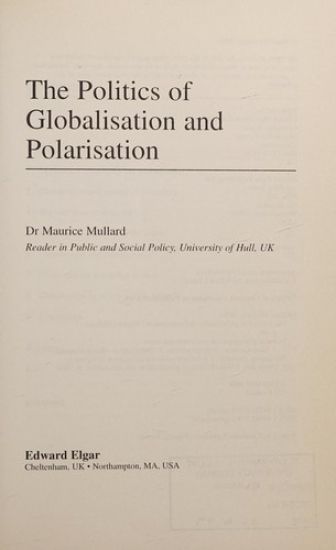
The Politics of Globalisation and Polarisation

The Politics of Globalisation and Polarisation

Maurice Mullard

Edward Elgar Publishing Ltd
2006
nidottu
This book deals with the nature of contemporary globalisation. Maurice Mullard aims to show that globalisation is not an inescapable, unstoppable process somehow beyond human control, rather that it represents, and is being shaped by, a series of deliberate policy choices and policy decisions. The emphasis of this fascinating work is on how these policy choices are creating new forms of economic inequalities and also political elites that distort the democratic process. The mapping of winners and losers goes beyond the usual analysis of the rich North versus the poor South, by including an examination of the widening inequalities in the North and the emergence of new elites in the South. Policies of privatisation and liberalisation of water and electricity create new political elites. The author reveals the shift in the North towards multi national corporations with their emphasis on profits and stock market prices, while at the same time incomes for most employees have either stagnated or actually declined. The standard discourse on globalisation and market flexibility often blurs the issues of declining trade union influence and corporations moving to countries offering lower labour costs. Maurice Mullard herein attempts to rectify this imbalance. The Politics of Globalisation and Polarisation is interdisciplinary and will therefore be relevant for academics and researchers of politics, social policy, public policy and economics. Scholars involved in globalisation will find this book to be a major contribution to the ongoing debate.
The Politics of Globalisation and Polarisation

The Politics of Globalisation and Polarisation

Maurice Mullard

Edward Elgar Publishing Ltd
2004
sidottu
This book deals with the nature of contemporary globalisation. Maurice Mullard aims to show that globalisation is not an inescapable, unstoppable process somehow beyond human control, rather that it represents, and is being shaped by, a series of deliberate policy choices and policy decisions. The emphasis of this fascinating work is on how these policy choices are creating new forms of economic inequalities and also political elites that distort the democratic process. The mapping of winners and losers goes beyond the usual analysis of the rich North versus the poor South, by including an examination of the widening inequalities in the North and the emergence of new elites in the South. Policies of privatisation and liberalisation of water and electricity create new political elites. The author reveals the shift in the North towards multi national corporations with their emphasis on profits and stock market prices, while at the same time incomes for most employees have either stagnated or actually declined. The standard discourse on globalisation and market flexibility often blurs the issues of declining trade union influence and corporations moving to countries offering lower labour costs. Maurice Mullard herein attempts to rectify this imbalance. The Politics of Globalisation and Polarisation is interdisciplinary and will therefore be relevant for academics and researchers of politics, social policy, public policy and economics. Scholars involved in globalisation will find this book to be a major contribution to the ongoing debate.
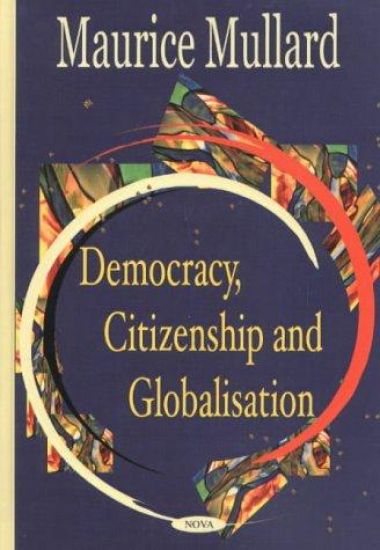
Democracy CitizenshipGlobalisation

Democracy CitizenshipGlobalisation

Maurice Mullard

Nova Science Publishers Inc
2003
sidottu
The concern of this book is to ask who are the winners and the losers of globalisation. Globalisation is currently being presented as something which is inevitable and to which there exists no alternative. However, present globalisation is increasingly defined in the context of market liberalism where the language of markets and competition has become interchangeable with the language of globalisation. This approach represents specific political decisions on liberalisation and privatisation. Present forms of globalisation have contributed to major shifts in income distribution both between and within countries. Wage earners in the advanced industrial economies have experienced stagnating 'take home pay', while the incomes of the top one percent of earners secured a larger share of income. There is now emerging a plutocracy that through financial contributions to political parties and the financing of academic think tanks are also distorting the democratic process. There is little evidence of the trickle down process. Market liberals continue to influence the definitions and the shape of globalisation. Increased integration and interconnectedness depends on the ability to listen and to honour alternative views of development.
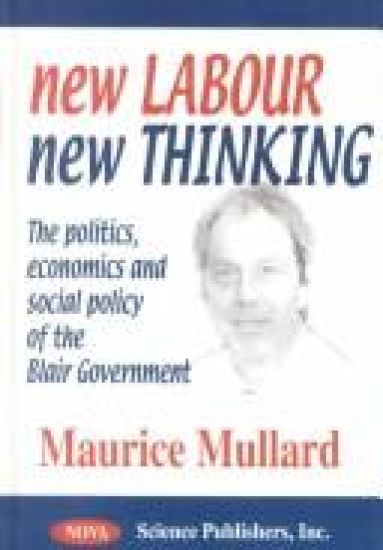
New Labour / New Thinking

New Labour / New Thinking

Maurice Mullard

Nova Science Publishers Inc
2000
sidottu
The focus of this outstanding book is the politics, economics and social policy of the UK Labour Government of Tony Blair. There is always a problem in the attempt to make sense of something that is still taking shape. However, there is equally a problem of writing with hindsight. While hindsight provides the opportunity for perfect vision of the past -- the art of policy making is about the here and now. While the experience and impact of the Blair Government can only be described as unfinished business and work in progress -- there are already a series of pillars, which are giving shape to the Government. Although the shape of policy is not yet clear some analysis can be made of the emerging structure. This book elucidates the Labour Government's underlying pillars and clarifies the developing structures.
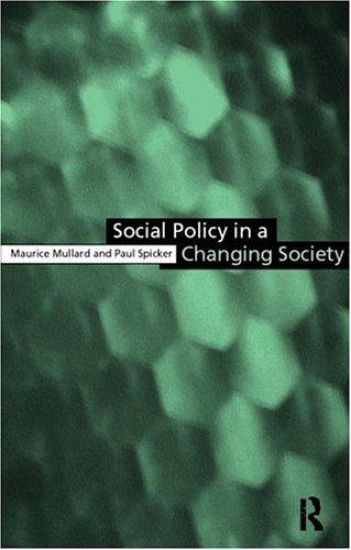
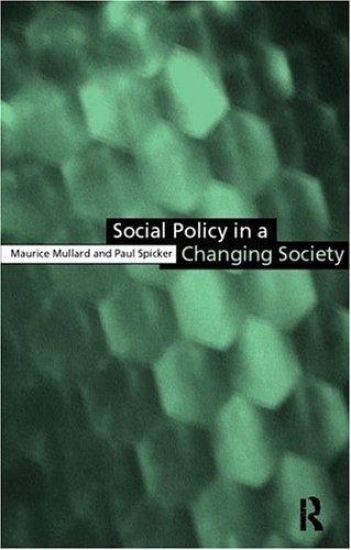
Social Policy in a Changing Society

Social Policy in a Changing Society

Maurice Mullard; Paul Spicker

Routledge
1998
nidottu
Social Policy in a Changing Society is a critical guide to theories about society, exploring the links between social theory and social policy. It considers a range of interpretations of changes in society, politics and the economy, and assesses their practical implications for social welfare. Social Policy in a Changing Society will be essential reading for undergraduates studying social policy and sociology.
Social Policy in a Changing Society

Social Policy in a Changing Society

Maurice Mullard; Paul Spicker

Routledge
1998
sidottu
Social Policy in a Changing Society is a critical guide to theories about society, exploring the links between social theory and social policy. It considers a range of interpretations of changes in society, politics and the economy, and assesses their practical implications for social welfare. Social Policy in a Changing Society will be essential reading for undergraduates studying social policy and sociology.
The Politics of Public Expenditure

The Politics of Public Expenditure

Maurice Mullard

Routledge
1993
nidottu
The question of public expenditure has proved to be one of the perennial problems for British Governments. Given forecasts of low growth and record levels of unemployment, the present Government could be faced with dilemmas of greater magnititude than ever. This new edition of Maurice Mullard's book has been carefully revised to provide students with an accessible text. It is principally concerned with explaining the political contexts in which public expenditure decisions have had to be made over the last twenty years. It examines the way in which Governments make choices according to public pressure and the fact that bargains and compromises have to be made in order to maintain political credibility. Maurice Mullard provides examples of the way in which Government policy and individual expenditure programmes have been shaped according to the political climate. The text combines theoretical framworks with policy analysis. This edition contains new chapters on Conservative and Labour politics and a section on John Major's government.