

Kirjailija
Max Duncker
Kirjat ja teokset yhdessä paikassa: 96 kirjaa, julkaisuja vuosilta 1851–2026, suosituimpiin kuuluu The History of Antiquity. Vertaile teosten hintoja ja tarkista saatavuus suomalaisista kirjakaupoista.
96 kirjaa
Kirjojen julkaisuvuodet: 1851–2026.

History of Greece - from the earliest times to the end of the Persian war - Vol. 1 is an unchanged, high-quality reprint of the original edition of 1883. Hansebooks is editor of the literature on different topic areas such as research and science, travel and expeditions, cooking and nutrition, medicine, and other genres. As a publisher we focus on the preservation of historical literature. Many works of historical writers and scientists are available today as antiques only. Hansebooks newly publishes these books and contributes to the preservation of literature which has become rare and historical knowledge for the future.
History of Greece - from the earliest times to the end of the Persian war - Vol. 2 is an unchanged, high-quality reprint of the original edition of 1883. Hansebooks is editor of the literature on different topic areas such as research and science, travel and expeditions, cooking and nutrition, medicine, and other genres. As a publisher we focus on the preservation of historical literature. Many works of historical writers and scientists are available today as antiques only. Hansebooks newly publishes these books and contributes to the preservation of literature which has become rare and historical knowledge for the future.

Zur Geschichte der deutschen Reichsversammlung in Frankfurt
Max Duncker
TP Verone Publishing
2017
nidottu

Zur Geschichte der deutschen Reichsversammlung in Frankfurt
Max Duncker
Salzwasser-Verlag Gmbh
2015
sidottu
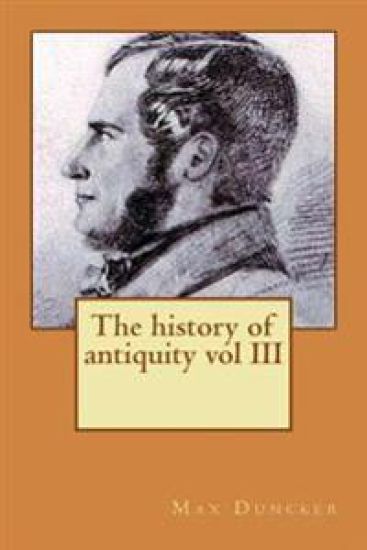
The history of antiquity vol III
Max Duncker
Createspace Independent Publishing Platform
2015
nidottu
The history of antiquity Vol VI
Max Duncker
Createspace Independent Publishing Platform
2015
nidottu
CHAPTER I. As far back as our information extends, we find the table-land of Iran occupied by a group of nations closely related to each other, and speaking dialects of the same language. On the edges of that great desert, which occupies the centre of the land, are tracts of pasture, and further inland, treeless steppes, which, however, are watered here and there by brackish pools, and produce a salt vegetation barely sufficient to provide buffaloes and camels with sustenance, until the soil becomes entirely barren. In the western part of these steppes wandered a pastoral people, whom Herodotus calls Sagartians. They were horsemen, but, according to the historian's statement, carried no weapons of attack beyond a dagger and a rope of twisted straps, at one end of which was a loop. In this they placed their confidence in battle; they threw it over men and horses, and so dragged them down and strangled them. In the inscriptions of the Ach menids this nation is called A agarta. 2] Close to the Indus, and beyond the bare, hot, treeless shores of the ocean, the southern part of the plain consists of sandy flats, in which nothing grows but prickly herbs and a few palms. The springs are a day's journey from each other, and often more. This region was possessed by a people whom Herodotus calls Sattagyd , and the companions of Alexander of Macedonia, Gedrosians. 3] Among the nations of the East who were subject to them, the inscriptions of the Ach menids mention the "Thataghus," which the Greeks understood as Sattagush and Gadrush. Neighbours of the Gandarians, who, as we know, dwelt on the right bank of the Indus down to the Cabul, the Gedrosians led a wandering, predatory life; under the Persian kings they were united into one satrapy with the Gandarians. 4] To the south of the Gedrosians, on the coast, there dwelt, according to the Greeks, a miserable race, eaters of fish and tortoises, who built their houses of the bones of whales thrown up by the sea. They wove their nets from the bark of palms, and their weapons were javelins hardened in the fire. 5] The edge on the south allows no streams of any size to flow to the sea, so that even to this day this coast presents only a few small fertile spots. About equally distant from the northern and southern edge of the table-land, to the east of the desert of the interior, lies a considerable lake, now called Hamun, but known to the Greeks as Areios. It forms the centre of a cultivated district, though the storms from the west often drive the sand of the desert to its shores. This basin is formed by and receives important streams flowing from the inner slopes of the northern and eastern edge. From the southern spurs of the Hindu Kush comes the Hilmend, the Haetumat of the Avesta, i. e. rich in bridges, the Etymandros of the Greeks, which has a course of about 400 miles, and before falling into the lake is joined by the Arghandab. The Lora, which flows from the east, but further to the south, does not now reach the lake. From the north flow the Harut and Chashrud. Round this lake, and on the banks of the Hilmend, the Arghandab, and the Lora, lies a fruitful region; higher up the walls of the valleys are covered with forests, until towards the east the upper course of the rivers is enclosed by bare cliffs. On the shores of the Hamun, and in the valley of the Hilmend, dwelt a people whom the inscriptions of the Ach menids call Zaraka, i. e. dwellers on the lake. A lake in Old Persian is Daraya; in the ancient language of the East, Zarayanh; in modern Persian, Zareh. Hence we understand why Herodotus calls this nation Sarangians, the later Greeks, Zarangians and Drangians. According to the Greeks the Zarakas were a warlike nation, armed with Median bows and spears, unsurpassed in battle on horseback; and a tribe of them which lived under good and equitable laws bore the name of Aria pians. 6] The ruins of cities and works of irrigation testify to the former prosperity of this r
The history of antiquity Vol IV
Max Duncker
Createspace Independent Publishing Platform
2015
nidottu
CHAPTER I. THE LAND AND THE PEOPLE. It was not only in the lower valley of the Nile, on the banks of the Euphrates and the Tigris, and along the coast and on the heights of Syria that independent forms of intellectual and civic life grew up in antiquity. By the side of the early civilisation of Egypt, and the hardly later civilisation of that unknown people from which Elam, Babylon, and Asshur borrowed such important factors in the development of their own capacities; along with the civilisation of the Semites of the East and West, who here observed the heavens, there busily explored the shores of the sea; here erected massive buildings, and there were so earnestly occupied with the study of their own inward nature, are found forms of culture later in their origin, and represented by a different family of nations. This family, the Indo-European, extends over a far larger area than the Semitic. We find branches of it in the wide districts to the east of the Semitic nations, on the table-land of Iran, in the valleys of the Indus and the Ganges. Other branches we have already encountered on the heights of Armenia, and the table-land of Asia Minor (I. 512, 524). Others again obtained possession of the plains above the Black Sea; others, of the peninsulas of Greece and Italy. Nations of this stock have forced their way to the shores of the Atlantic Ocean; we find them settled on the western coast of the Spanish peninsula, from the mouth of the Garonne to the Channel, in Britain and Ireland no less than in Scandinavia, on the shores of the North Sea and the Baltic. Those branches of the family which took up their abodes the farthest to the East exhibit the most independent and peculiar form of civilisation. The mutual relationship of the Arian, Greek, Italian, Letto-Sclavonian, Germanic, and Celtic languages proves the relationship of the nations who have spoken and still speak them; it proves that all these nations have a common origin and descent. The words, of which the roots in these languages exhibit complete phonetic agreement, must be considered as a common possession, acquired before the separation; and from this we can discover at what stage of life the nation from which these languages derive their origin stood at the time when it was not yet divided into these six great branches, and separated into the nations which subsequently occupied abodes so extensive and remote from each other. We find common terms for members of the family, for house, yard, garden, and citadel; common words for horses, cattle, dogs, swine, sheep, goats, mice, geese, ducks; common roots for wool, hemp or flax, corn (i. e. wheat, spelt, or barley), for ploughing, grinding, and weaving, for certain metals (copper or iron), for some weapons and tools, for waggon, boat and rudder, for the elementary numbers, and the division of the year according to the moon. 1] Hence the stock, whose branches and shoots have spread over the whole continent of Europe and Asia from Ceylon to Britain and Scandinavia, cannot, even before the separation, have been without a certain degree of civilisation. On the contrary, this common fund of words proves that even in that early time it tilled the field, and reared cattle; that it could build waggons and boats, and forge weapons, and if the general name for the gods and some names of special deities are the same in widely remote branches of this stock, -in India, Iran, Greece, and Italy, and even on the plains of Lithuania, -it follows that the notions which lie at the base of these names must also be counted among the common possessions existing before the separation....
The History of Antiquity, Vol. III (of VI)
Max Duncker
Createspace Independent Publishing Platform
2015
nidottu
The History of Antiquity, Vol. V (of VI)
Max Duncker
Createspace Independent Publishing Platform
2015
nidottu
The History of Antiquity, Vol. VI (of VI)
Max Duncker
Createspace Independent Publishing Platform
2015
nidottu
The History of Antiquity, Vol. I (of VI)
Max Duncker
Createspace Independent Publishing Platform
2015
nidottu