Kirjojen hintavertailu – 12 903 725 kirjaa ja 27 kauppaa

Kirjailija

Maznah Mohamad

Kirjat ja teokset yhdessä paikassa: 4 kirjaa, julkaisuja vuosilta 2020–2026, suosituimpiin kuuluu Visual Interrogations of Femininities in the Malay World. Vertaile teosten hintoja ja tarkista saatavuus suomalaisista kirjakaupoista.

4 kirjaa

Kirjojen julkaisuvuodet: 2020–2026.

Visual Interrogations of Femininities in the Malay World

Visual Interrogations of Femininities in the Malay World

Maznah Mohamad; Bahar Gürsel; Suriani Suratman

AMSTERDAM UNIVERSITY PRESS
2026
sidottu
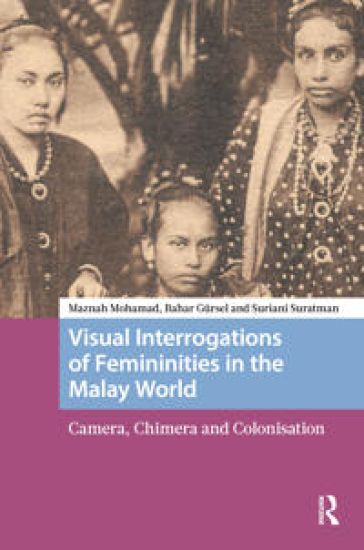
This book curates and examines colonial-era photographs from the late nineteenth to early twentieth centuries sourced from photo-archives of former British and Dutch colonies in Southeast Asia, uncovering how femininities in the Malay world are represented through visual imagery and their role in shaping colonial social relations. Through seven thematic chapters ranging from colonial exhibitions to women's work, fashion, postcard representation, and girls' schooling, the book demonstrates how photographs contain dialogic potential to question colonial power structures. Using visual ethnography and decolonial analysis, it reveals how the intersections of camera, chimera, and colonisation subtly divided people along lines of race, class, and gender. Although many subjects remain nameless, their images reveal layered narratives of colonial social formations and evolving national histories. This book is perfect for those studying visual ethnography, decolonial methodologies, and the intersection of photography and colonialism in the Malay world, as well as scholars, postgraduate students, and researchers in postcolonial studies, Southeast Asian studies, visual culture, gender studies, and colonial history.
Sexuality and Islamic Spirituality in Early Malay Writings

Sexuality and Islamic Spirituality in Early Malay Writings

Maznah Mohamad; Syahirah Rasheed

BLOOMSBURY PUBLISHING PLC
2025
sidottu
It is argued here that before the extensive formalization of sharia laws from the late nineteenth century onwards, Islam was prominently influenced by elements of enchantment and mysticism, mirrored in its textual portrayal of passionate and sexual relations. This book’s analysis is based on Malay manuscripts and texts about the body, sex, and sexuality. These include religious guidebooks on sexual techniques and etiquette, of which some are translated from the original Arabic or Persian, but almost all of which have been adapted for local Malay relevance. Also analyzed are collections of Malay erotic poetry from the sixteenth to nineteenth centuries and the only known female-authored early twentieth-century text on sex and women’s sexual pleasure. Over the centuries changing sexual norms and attitudes in the Malay world has disengaged sex and sexuality from being a crucial component of faith and spirituality—gradually receding into the discreet margins of contemporary discourse on gender relations.
The Divine Bureaucracy and Disenchantment of Social Life

The Divine Bureaucracy and Disenchantment of Social Life

Maznah Mohamad

Springer Verlag, Singapore
2021
nidottu
This book traces the expansion of Islamisation within a modern and plural state such as Malaysia. It elaborates on how elements of theology, sacred space, resources, and their interactivity with secular instruments such as legislative, electoral, and new social technological platforms are all instrumentally employed to consolidate a divine bureaucracy. The book makes the point that religious social movements and political parties are only few of the important agents of Islamisation in society. The other is the modern and secular state structure itself. Weber’s legal rational bureaucracy or Hegel’s ethical bureaucracy predominantly characterises a modern feature of governmentality. In this instance an Islamic bureaucracy is advantageously situated not only within an ambit of modernity and therefore legality, but divinity and therefore sacrality as well. This positioning gives religious state agents more salience than any other form of bureaucracy leading to their unquestioned authorityin the current contexts of societies with Muslim majority rule. One of the requisites of this condition is the homogenisation of Islam followed by ring-fencing of its constituents. The latter can involve contestations with women, other genders, ‘secular’ Muslims, non-Muslims as well as dissenting Muslims with their differing truthful ‘Islams’.
The Divine Bureaucracy and Disenchantment of Social Life

The Divine Bureaucracy and Disenchantment of Social Life

Maznah Mohamad

Springer Verlag, Singapore
2020
sidottu
This book traces the expansion of Islamisation within a modern and plural state such as Malaysia. It elaborates on how elements of theology, sacred space, resources, and their interactivity with secular instruments such as legislative, electoral, and new social technological platforms are all instrumentally employed to consolidate a divine bureaucracy. The book makes the point that religious social movements and political parties are only few of the important agents of Islamisation in society. The other is the modern and secular state structure itself. Weber’s legal rational bureaucracy or Hegel’s ethical bureaucracy predominantly characterises a modern feature of governmentality. In this instance an Islamic bureaucracy is advantageously situated not only within an ambit of modernity and therefore legality, but divinity and therefore sacrality as well. This positioning gives religious state agents more salience than any other form of bureaucracy leading to their unquestioned authorityin the current contexts of societies with Muslim majority rule. One of the requisites of this condition is the homogenisation of Islam followed by ring-fencing of its constituents. The latter can involve contestations with women, other genders, ‘secular’ Muslims, non-Muslims as well as dissenting Muslims with their differing truthful ‘Islams’.