Kirjojen hintavertailu – 12 859 828 kirjaa ja 27 kauppaa

Kirjailija

Megan Bang

Kirjat ja teokset yhdessä paikassa: 7 kirjaa, julkaisuja vuosilta 2014–2026, suosituimpiin kuuluu Who's Asking?. Vertaile teosten hintoja ja tarkista saatavuus suomalaisista kirjakaupoista.

7 kirjaa

Kirjojen julkaisuvuodet: 2014–2026.

Who's Asking?

Who's Asking?

Douglas L. Medin; Megan Bang

MIT Press
2014
sidottu
Analysis and case studies show that including different orientations toward the natural world makes for more effective scientific practice and science education. The answers to scientific questions depend on who's asking, because the questions asked and the answers sought reflect the cultural values and orientations of the questioner. These values and orientations are most often those of Western science. In Who's Asking?, Douglas Medin and Megan Bang argue that despite the widely held view that science is objective, value-neutral, and acultural, scientists do not shed their cultures at the laboratory or classroom door; their practices reflect their values, belief systems, and worldviews. Medin and Bang argue further that scientist diversity-the participation of researchers and educators with different cultural orientations-provides new perspectives and leads to more effective science and better science education. Medin and Bang compare Native American and European American orientations toward the natural world and apply these findings to science education. The European American model, they find, sees humans as separated from nature; the Native American model sees humans as part of a natural ecosystem. Medin and Bang then report on the development of ecologically oriented and community-based science education programs on the Menominee reservation in Wisconsin and at the American Indian Center of Chicago. Medin and Bang's novel argument for scientist diversity also has important implications for questions of minority underrepresentation in science.
Across Lands and Waters

Across Lands and Waters

Megan Bang; Bryan Brayboy; Ananda Marin; Linda Tuhiwai Smith; Justin Hill

THE NEW PRESS
2026
sidottu
Experts from the field of Indigenous education offer inspiring and vital perspectives, wonders, and responses for transforming the future for Native students“Indigenous peoples have always been futurists, always taking into the heart, mind, and prayer future generations, always understanding that Native Nation–building is a project of immediacy and longevity.” —Theresa Stewart-Ambo, from Across Lands and Waters Across Lands and Waters is the first book to offer a future vision for Indigenous education in the United States—a rich tapestry of ideas, frameworks, and dreams for educators, youth, and communities about Indigenous peoples and ideas. Across Lands and Waters was developed as an urgent response to the erasure of Indigenous futures, bringing together scholars from Alaska to Hawai‘i to Rhode Island, and places in between, including poets, psychologists, language revitalizers, hula practitioners, philosophers, and others. Across Lands and Waters offers a deep well of stories and perspectives from different Indigenous traditions. The contributors examine why we educate, what the role of schools, histories, and philosophies can be in overcoming racist and colonial legacies, and how to envision a radically different future. They discuss how a colonial system of education erases Indigenous realities; the vital importance of reclaiming Indigenous languages; the urgency of dismantling systems of oppression; the varied experiences of Indigenous peoples; and the crucial contributions of traditional ways of being and knowing. Graced with original artwork by the celebrated artist Maria Hupfield and contributions by Pulitzer Prize–winning poet Natalie Diaz, Across Lands and Waters is a groundbreaking project that will serve as a beacon for teachers everywhere.
Across Lands and Waters

Across Lands and Waters

Megan Bang; Bryan Brayboy; Linda Tuhiwai Smith

THE NEW PRESS
2026
sidottu
Experts from the field of indigenous education offer vital perspectives and resources for transforming the future for Native students Across Lands and Waters is the first book to offer a vision for the future of Indigenous education in the United States—a rich tapestry of ideas, frameworks, and dreams for teachers and educators grappling with how to educate and inspire the nation’s native students. The result of a unique, years-long collaboration among the leading experts and practitioners in the field. Across Lands and Waters was developed as an urgent resource for classrooms and other educational settings in every state and tribal nation. Offering a deep well of stories and perspectives from different Indigenous traditions, the contributors examine why we educate, what the role of schools can be in overcoming racist and colonial legacies, and how to envision a radically different future. They also discuss such crucial topics as how a colonial system of education erases Indigenous realities, the vital importance of reclaiming indigenous languages, the varied experiences of indigenous peoples, and the crucial contributions of traditional ways of being and knowing. Graced with original full-color cover artwork by the celebrated artist Maria Hupfield and contributions by Pulitzer Prize–winning poet Natalie Diaz, Across Lands and Waters is a groundbreaking project that will serve as a beacon of inspiration and hope for teachers everywhere.
Doing the Work of Equity Leadership for Justice and Systems Change

Doing the Work of Equity Leadership for Justice and Systems Change

Na'ilah Suad Nasir; Megan Bang; Keisha Scarlett

TEACHERS' COLLEGE PRESS
2025
sidottu
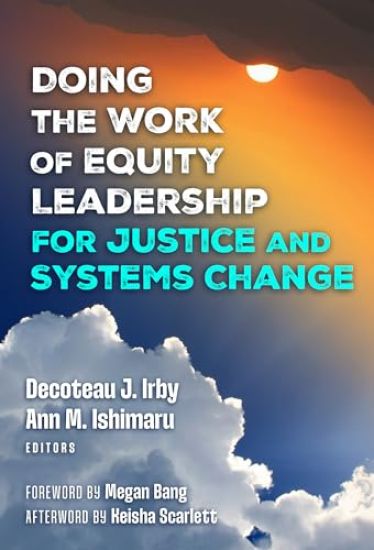
This book reveals the complex and crucial work of sustaining justice-focused educational systems change in the face of subtle resistance and outright attacks. Scholars and practitioners, who have worked together in various capacities across different school systems, examine systemic equity leadership in U. S. public schools over the course of nearly a decade and across a time of profound racial and historical change. This volume weaves together real-world insights, research-based strategies, and practical tools for transforming P– 2 education systems into more equitable and just learning spaces. Contributors explore the early days of district equity leadership sparked by the Obama administration's focus on civil rights in education Black Lives Matter (beginning with the Million Hoodies Movement for Justice) the proliferation of formal equity director roles, policies, and priorities and the recent politically driven anti-DEI backlash. This book is important reading for school leaders, district personnel, policymakers, and everyone who cares about a public education that works for all students. Book Features: Provides bird's-eye and on-the-ground accounts of equity leadership to address broad questions and map invisible trends that have influenced how equity leadership happens. Explores approaches to district-wide equity leadership that emerged on the heels of Trayvon Martin's death, in what we now understand as the era of Black Lives Matter. Uses a frame of mornings, middays, and evenings to account for the cyclical nature of equity leadership and the limits and possibilities of working from within school systems to affect transformative change. Goes beyond the experience of any one school leader or team by illuminating organizational conditions, routines, networks, and practices. Includes insights on establishing district equity offices and institutionalizing equitable processes using data to influence change and create accountability and designing formal and informal networks that support the day-to-day work.
Doing the Work of Equity Leadership for Justice and Systems Change

Doing the Work of Equity Leadership for Justice and Systems Change

Na'ilah Suad Nasir; Megan Bang; Keisha Scarlett

TEACHERS' COLLEGE PRESS
2025
nidottu
This book reveals the complex and crucial work of sustaining justice-focused educational systems change in the face of subtle resistance and outright attacks. Scholars and practitioners, who have worked together in various capacities across different school systems, examine systemic equity leadership in U. S. public schools over the course of nearly a decade and across a time of profound racial and historical change. This volume weaves together real-world insights, research-based strategies, and practical tools for transforming P– 2 education systems into more equitable and just learning spaces. Contributors explore the early days of district equity leadership sparked by the Obama administration's focus on civil rights in education Black Lives Matter (beginning with the Million Hoodies Movement for Justice) the proliferation of formal equity director roles, policies, and priorities and the recent politically driven anti-DEI backlash. This book is important reading for school leaders, district personnel, policymakers, and everyone who cares about a public education that works for all students. Book Features: Provides bird's-eye and on-the-ground accounts of equity leadership to address broad questions and map invisible trends that have influenced how equity leadership happens. Explores approaches to district-wide equity leadership that emerged on the heels of Trayvon Martin's death, in what we now understand as the era of Black Lives Matter. Uses a frame of mornings, middays, and evenings to account for the cyclical nature of equity leadership and the limits and possibilities of working from within school systems to affect transformative change. Goes beyond the experience of any one school leader or team by illuminating organizational conditions, routines, networks, and practices. Includes insights on establishing district equity offices and institutionalizing equitable processes using data to influence change and create accountability and designing formal and informal networks that support the day-to-day work.
Protecting the Promise

Protecting the Promise

Timothy San Pedro; Megan Bang

Teachers' College Press
2021
nidottu
Protecting the Promise is the first book in the Culturally Sustaining Pedagogies Series edited by Django Paris. It features a collection of short stories told in collaboration with five Native families that speak to the everyday aspects of Indigenous educational resurgence rooted in the intergenerational learning that occurs between mothers and their children. The author defines "resurgence" as the ongoing actions that recenter Indigenous realities and knowledges, while simultaneously denouncing and healing from the damaging effects of settler colonial systems. By illuminating the potential of such educational resurgence, the book counters deficit paradigms too often placed on Indigenous communities. It also demonstrates the need to include Indigenous Knowledges within the curriculum for both in-school and out-of-school settings. These engaging narratives reframe Indigenous parents as critical and compassionate educators, cultural brokers, and storytellers who are central partners in the education of their children. Book Features:A window into how and why Indigenous resurgence through (and sometimes in resistance to) education can happen. A narrative style of writing that builds accessible stories that are both relatable and connected to larger social issues. An interdisciplinary approach that has implications for pre- and in-service teachers and school administrators, as well as for the communities from which these stories originated. A teacher-friendly Afterword that offers lesson ideas for the classroom and companion questions to the short stories.
Protecting the Promise

Protecting the Promise

Timothy San Pedro; Megan Bang

Teachers' College Press
2021
sidottu
Protecting the Promise is the first book in the Culturally Sustaining Pedagogies Series edited by Django Paris. It features a collection of short stories told in collaboration with five Native families that speak to the everyday aspects of Indigenous educational resurgence rooted in the intergenerational learning that occurs between mothers and their children. The author defines "resurgence" as the ongoing actions that recenter Indigenous realities and knowledges, while simultaneously denouncing and healing from the damaging effects of settler colonial systems. By illuminating the potential of such educational resurgence, the book counters deficit paradigms too often placed on Indigenous communities. It also demonstrates the need to include Indigenous Knowledges within the curriculum for both in-school and out-of-school settings. These engaging narratives reframe Indigenous parents as critical and compassionate educators, cultural brokers, and storytellers who are central partners in the education of their children. Book Features:A window into how and why Indigenous resurgence through (and sometimes in resistance to) education can happen. A narrative style of writing that builds accessible stories that are both relatable and connected to larger social issues. An interdisciplinary approach that has implications for pre- and in-service teachers and school administrators, as well as for the communities from which these stories originated. A teacher-friendly Afterword that offers lesson ideas for the classroom and companion questions to the short stories.