Kirjojen hintavertailu – 12 903 735 kirjaa ja 27 kauppaa

Kirjailija

Meir Shillor

Kirjat ja teokset yhdessä paikassa: 3 kirjaa, julkaisuja vuosilta 2004–2010, suosituimpiin kuuluu Analysis and Approximation of Contact Problems with Adhesion or Damage. Vertaile teosten hintoja ja tarkista saatavuus suomalaisista kirjakaupoista.

3 kirjaa

Kirjojen julkaisuvuodet: 2004–2010.

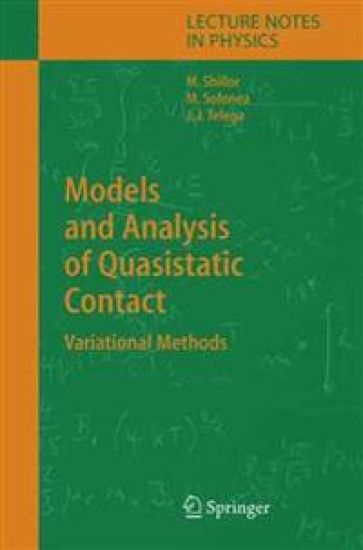
Models and Analysis of Quasistatic Contact

Models and Analysis of Quasistatic Contact

Meir Shillor; Mircea Sofonea; Józef Joachim Telega

Springer-Verlag Berlin and Heidelberg GmbH Co. K
2010
nidottu
The mathematical theory of contact mechanics is a growing field in engineering and scientific computing. This book is intended as a unified and readily accessible source for mathematicians, applied mathematicians, mechanicians, engineers and scientists, as well as advanced students. The first part describes models of the processes involved like friction, heat generation and thermal effects, wear, adhesion and damage. The second part presents many mathematical models of practical interest and demonstrates the close interaction and cross-fertilization between contact mechanics and the theory of variational inequalities. The last part reviews further results, gives many references to current research and discusses open problems and future developments. The book can be read by mechanical engineers interested in applications. In addition, some theorems and their proofs are given as examples for the mathematical tools used in the models.

Analysis and Approximation of Contact Problems with Adhesion or Damage

Analysis and Approximation of Contact Problems with Adhesion or Damage

Mircea Sofonea; Weimin Han; Meir Shillor

Chapman Hall/CRC
2005
sidottu
Research into contact problems continues to produce a rapidly growing body of knowledge. Recognizing the need for a single, concise source of information on models and analysis of contact problems, accomplished experts Sofonea, Han, and Shillor carefully selected several models and thoroughly study them in Analysis and Approximation of Contact Problems with Adhesion or Damage. The book describes very recent models of contact processes with adhesion or damage along with their mathematical formulations, variational analysis, and numerical analysis. Following an introduction to modeling and functional and numerical analysis, the book devotes individual chapters to models involving adhesion and material damage, respectively, with each chapter exploring a particular model. For each model, the authors provide a variational formulation and establish the existence and uniqueness of a weak solution. They study a fully discrete approximation scheme that uses the finite element method to discretize the spatial domain and finite differences for the time derivatives. The final chapter summarizes the results, presents bibliographic comments, and considers future directions in the field. Employing recent results on elliptic and evolutionary variational inequalities, convex analysis, nonlinear equations with monotone operators, and fixed points of operators, Analysis and Approximation of Contact Problems with Adhesion or Damage places these important tools and results at your fingertips in a unified, accessible reference.
Models and Analysis of Quasistatic Contact

Models and Analysis of Quasistatic Contact

Meir Shillor; Mircea Sofonea; Józef Joachim Telega

Springer-Verlag Berlin and Heidelberg GmbH Co. K
2004
sidottu
The mathematical theory of contact mechanics is a growing field in engineering and scientific computing. This book is intended as a unified and readily accessible source for mathematicians, applied mathematicians, mechanicians, engineers and scientists, as well as advanced students. The first part describes models of the processes involved like friction, heat generation and thermal effects, wear, adhesion and damage. The second part presents many mathematical models of practical interest and demonstrates the close interaction and cross-fertilization between contact mechanics and the theory of variational inequalities. The last part reviews further results, gives many references to current research and discusses open problems and future developments. The book can be read by mechanical engineers interested in applications. In addition, some theorems and their proofs are given as examples for the mathematical tools used in the models.