Kirjojen hintavertailu – 12 903 724 kirjaa ja 27 kauppaa

Kirjailija

Meng Liu

Kirjat ja teokset yhdessä paikassa: 3 kirjaa, julkaisuja vuosilta 2010–2025, suosituimpiin kuuluu Intelligent and Efficient Video Moment Localization. Vertaile teosten hintoja ja tarkista saatavuus suomalaisista kirjakaupoista.

3 kirjaa

Kirjojen julkaisuvuodet: 2010–2025.

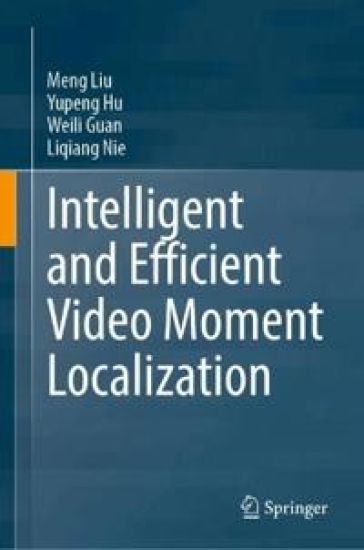
Intelligent and Efficient Video Moment Localization

Intelligent and Efficient Video Moment Localization

Meng Liu; Yupeng Hu; Weili Guan; Liqiang Nie

Springer International Publishing AG
2025
sidottu
This book provides a comprehensive exploration of video moment localization, a rapidly emerging research field focused on enabling precise retrieval of specific moments within untrimmed, unsegmented videos. With the rapid growth of digital content and the rise of video-sharing platforms, users face significant challenges when searching for particular content across vast video archives. This book addresses how video moment localization uses natural language queries to bridge the gap between video content and semantic understanding, offering an intuitive solution for locating specific moments across diverse domains like surveillance, education, and entertainment. This book explores the latest advancements in video moment localization, addressing key issues such as accuracy, efficiency, and scalability. It presents innovative techniques for contextual understanding and cross-modal semantic alignment, including attention mechanisms and dynamic query decomposition. Additionally, the book discusses solutions for enhancing computational efficiency and scalability, such as semantic pruning and efficient hashing, while introducing frameworks for better integration between visual and textual data. It also examines weakly-supervised learning approaches to reduce annotation costs without sacrificing performance. Finally, the book covers real-world applications and offers insights into future research directions.
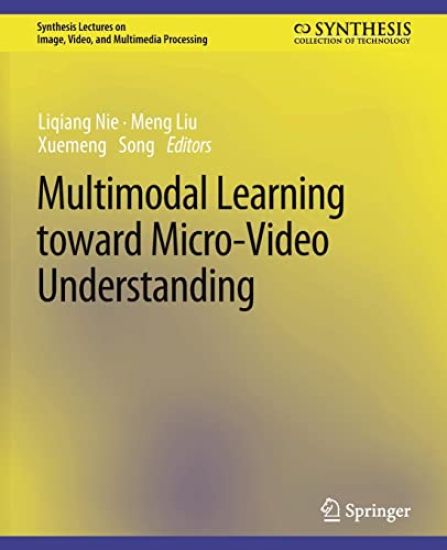
Multimodal Learning toward Micro-Video Understanding

Multimodal Learning toward Micro-Video Understanding

Liqiang Nie; Meng Liu; Xuemeng Song

Springer International Publishing AG
2019
nidottu
Micro-videos, a new form of user-generated contents, have been spreading widely across various social platforms, such as Vine, Kuaishou, and Tik Tok. Different from traditional long videos, micro-videos are usually recorded by smart mobile devices at any place within a few seconds. Due to its brevity and low bandwidth cost, micro-videos are gaining increasing user enthusiasm. The blossoming of micro-videos opens the door to the possibility of many promising applications, ranging from network content caching to online advertising. Thus, it is highly desirable to develop an effective scheme for the high-order micro-video understanding. Micro-video understanding is, however, non-trivial due to the following challenges: (1) how to represent micro-videos that only convey one or few high-level themes or concepts; (2) how to utilize the hierarchical structure of the venue categories to guide the micro-video analysis; (3) how to alleviate the influence of low-quality caused by complex surrounding environments and the camera shake; (4) how to model the multimodal sequential data, {i.e.}, textual, acoustic, visual, and social modalities, to enhance the micro-video understanding; and (5) how to construct large-scale benchmark datasets for the analysis? These challenges have been largely unexplored to date. In this book, we focus on addressing the challenges presented above by proposing some state-of-the-art multimodal learning theories. To demonstrate the effectiveness of these models, we apply them to three practical tasks of micro-video understanding: popularity prediction, venue category estimation, and micro-video routing. Particularly, we first build three large-scale real-world micro-video datasets for these practical tasks. We then present a multimodal transductive learning framework for micro-video popularity prediction. Furthermore, we introduce several multimodal cooperative learning approaches and a multimodal transfer learning scheme for micro-video venue category estimation. Meanwhile, we develop a multimodal sequential learning approach for micro-video recommendation. Finally, we conclude the book and figure out the future research directions in multimodal learning toward micro-video understanding.