Kirjojen hintavertailu – 12 903 742 kirjaa ja 27 kauppaa

Kirjailija

Michael A. Bailey

Kirjat ja teokset yhdessä paikassa: 5 kirjaa, julkaisuja vuosilta 2009–2024, suosituimpiin kuuluu Polling at a Crossroads. Vertaile teosten hintoja ja tarkista saatavuus suomalaisista kirjakaupoista.

5 kirjaa

Kirjojen julkaisuvuodet: 2009–2024.

Polling at a Crossroads

Polling at a Crossroads

Michael A. Bailey

Cambridge University Press
2024
pokkari
Survey research is in a state of crisis. People have become less willing to respond to polls and recent misses in critical elections have undermined the field's credibility. Pollsters have developed many tools for dealing with the new environment, an increasing number of which rely on risky opt-in samples. Virtually all of these tools require that respondents in each demographic category are a representative sample of all people in each demographic category, something that is unlikely to be reliably true. Polling at a Crossroads moves beyond such strong limitations, providing tools that work even when survey respondents are unrepresentative in complex ways. This book provides case studies that show how to avoid underestimating Trump support and how conventional polls exaggerate partisan differences. This book also helps us think in clear and sometimes counterintuitive ways and points toward simple, low-cost changes that can better address contemporary polling challenges.
Polling at a Crossroads

Polling at a Crossroads

Michael A. Bailey

Cambridge University Press
2024
sidottu
Survey research is in a state of crisis. People have become less willing to respond to polls and recent misses in critical elections have undermined the field's credibility. Pollsters have developed many tools for dealing with the new environment, an increasing number of which rely on risky opt-in samples. Virtually all of these tools require that respondents in each demographic category are a representative sample of all people in each demographic category, something that is unlikely to be reliably true. Polling at a Crossroads moves beyond such strong limitations, providing tools that work even when survey respondents are unrepresentative in complex ways. This book provides case studies that show how to avoid underestimating Trump support and how conventional polls exaggerate partisan differences. This book also helps us think in clear and sometimes counterintuitive ways and points toward simple, low-cost changes that can better address contemporary polling challenges.
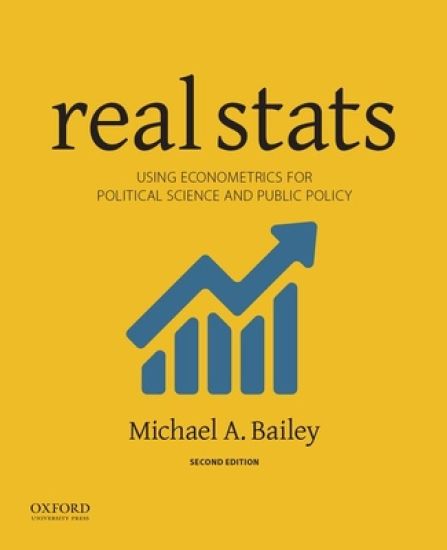
Real STATS: Using Econometrics for Political Science and Public Policy
Real Stats: Using Econometrics for Political Science and Public Policy offers an engaging and practical introduction to statistical analysis for political science, public policy, and law. Grounded in contemporary causal inference, the text invites students to see how statistical tools can help answer important and interesting questions. This emphasis on practical applications, combined with a lively and conversational narrative, provides students with a solid foundation in the analytical tools they will use throughout their academic and professional careers.
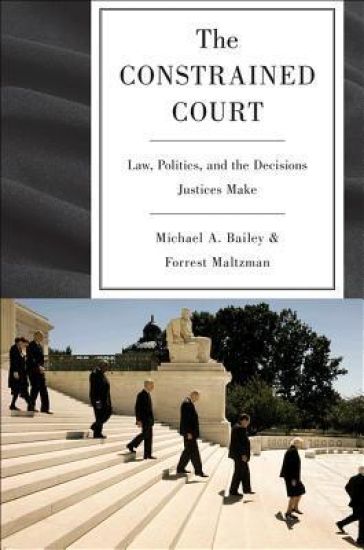
The Constrained Court

The Constrained Court

Michael A. Bailey; Forrest Maltzman

Princeton University Press
2011
pokkari
How do Supreme Court justices decide their cases? Do they follow their policy preferences? Or are they constrained by the law and by other political actors? The Constrained Court combines new theoretical insights and extensive data analysis to show that law and politics together shape the behavior of justices on the Supreme Court. Michael Bailey and Forrest Maltzman show how two types of constraints have influenced the decision making of the modern Court. First, Bailey and Maltzman document that important legal doctrines, such as respect for precedents, have influenced every justice since 1950. The authors find considerable variation in how these doctrines affect each justice, variation due in part to the differing experiences justices have brought to the bench. Second, Bailey and Maltzman show that justices are constrained by political factors. Justices are not isolated from what happens in the legislative and executive branches, and instead respond in predictable ways to changes in the preferences of Congress and the president. The Constrained Court shatters the myth that justices are unconstrained actors who pursue their personal policy preferences at all costs. By showing how law and politics interact in the construction of American law, this book sheds new light on the unique role that the Supreme Court plays in the constitutional order.