Kirjojen hintavertailu – 12 859 829 kirjaa ja 27 kauppaa

Kirjailija

Michael A. Henning

Kirjat ja teokset yhdessä paikassa: 10 kirjaa, julkaisuja vuosilta 2013–2024, suosituimpiin kuuluu Transversals in Linear Uniform Hypergraphs. Vertaile teosten hintoja ja tarkista saatavuus suomalaisista kirjakaupoista.

10 kirjaa

Kirjojen julkaisuvuodet: 2013–2024.

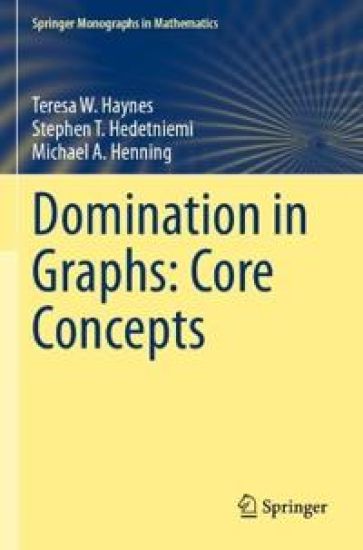
Domination in Graphs: Core Concepts

Domination in Graphs: Core Concepts

Teresa W. Haynes; Stephen T. Hedetniemi; Michael A. Henning

Springer International Publishing AG
2024
nidottu
This monograph is designed to be an in-depth introduction to domination in graphs. It focuses on three core concepts: domination, total domination, and independent domination. It contains major results on these foundational domination numbers, including a wide variety of in-depth proofs of selected results providing the reader with a toolbox of proof techniques used in domination theory. Additionally, the book is intended as an invaluable reference resource for a variety of readerships, namely, established researchers in the field of domination who want an updated, comprehensive coverage of domination theory; next, researchers in graph theory who wish to become acquainted with newer topics in domination, along with major developments in the field and some of the proof techniques used; and, graduate students with interests in graph theory, who might find the theory and many real-world applications of domination of interest for masters and doctoral thesis topics. The focusedcoverage also provides a good basis for seminars in domination theory or domination algorithms and complexity. The authors set out to provide the community with an updated and comprehensive treatment on the major topics in domination in graphs. And by Jove, they’ve done it! In recent years, the authors have curated and published two contributed volumes: Topics in Domination in Graphs, © 2020 and Structures of Domination in Graphs, © 2021. This book rounds out the coverage entirely. The reader is assumed to be acquainted with the basic concepts of graph theory and has had some exposure to graph theory at an introductory level. As graph theory terminology sometimes varies, a glossary of terms and notation is provided at the end of the book.
Graph and Network Theory

Graph and Network Theory

Michael A. Henning; Jan H. van Vuuren

Springer International Publishing AG
2023
nidottu
This textbook covers a diversity of topics in graph and network theory, both from a theoretical standpoint, and from an applied modelling point of view. Mathematica® is used to demonstrate much of the modelling aspects. Graph theory and model building tools are developed in tandem with effective techniques for solving practical problems via computer implementation. The book is designed with three primary readerships in mind. Individual syllabi or suggested sequences for study are provided for each of three student audiences: mathematics, applied mathematics/operations research, and computer science. In addition to the visual appeal of each page, the text contains an abundance of gems. Most chapters open with real-life problem descriptions which serve as motivation for the theoretical development of the subject matter. Each chapter concludes with three different sets of exercises. The first set of exercises are standard and geared toward the more mathematically inclined reader. Many of these are routine exercises, designed to test understanding of the material in the text, but some are more challenging. The second set of exercises is earmarked for the computer technologically savvy reader and offer computer exercises using Mathematica. The final set consists of larger projects aimed at equipping those readers with backgrounds in the applied sciences to apply the necessary skills learned in the chapter in the context of real-world problem solving. Additionally, each chapter offers biographical notes as well as pictures of graph theorists and mathematicians who have contributed significantly to the development of the results documented in the chapter. These notes are meant to bring the topics covered to life, allowing the reader to associate faces with some of the important discoveries and results presented. In total, approximately 100 biographical notes are presented throughout the book. The material in this book has been organizedinto three distinct parts, each with a different focus. The first part is devoted to topics in network optimization, with a focus on basic notions in algorithmic complexity and the computation of optimal paths, shortest spanning trees, maximum flows and minimum-cost flows in networks, as well as the solution of network location problems. The second part is devoted to a variety of classical problems in graph theory, including problems related to matchings, edge and vertex traversal, connectivity, planarity, edge and vertex coloring, and orientations of graphs. Finally, the focus in the third part is on modern areas of study in graph theory, covering graph domination, Ramsey theory, extremal graph theory, graph enumeration, and application of the probabilistic method.
Domination in Graphs: Core Concepts

Domination in Graphs: Core Concepts

Teresa W. Haynes; Stephen T. Hedetniemi; Michael A. Henning

Springer International Publishing AG
2023
sidottu
This monograph is designed to be an in-depth introduction to domination in graphs. It focuses on three core concepts: domination, total domination, and independent domination. It contains major results on these foundational domination numbers, including a wide variety of in-depth proofs of selected results providing the reader with a toolbox of proof techniques used in domination theory. Additionally, the book is intended as an invaluable reference resource for a variety of readerships, namely, established researchers in the field of domination who want an updated, comprehensive coverage of domination theory; next, researchers in graph theory who wish to become acquainted with newer topics in domination, along with major developments in the field and some of the proof techniques used; and, graduate students with interests in graph theory, who might find the theory and many real-world applications of domination of interest for masters and doctoral thesis topics. The focusedcoverage also provides a good basis for seminars in domination theory or domination algorithms and complexity. The authors set out to provide the community with an updated and comprehensive treatment on the major topics in domination in graphs. And by Jove, they’ve done it! In recent years, the authors have curated and published two contributed volumes: Topics in Domination in Graphs, © 2020 and Structures of Domination in Graphs, © 2021. This book rounds out the coverage entirely. The reader is assumed to be acquainted with the basic concepts of graph theory and has had some exposure to graph theory at an introductory level. As graph theory terminology sometimes varies, a glossary of terms and notation is provided at the end of the book.
Graph and Network Theory

Graph and Network Theory

Michael A. Henning; Jan H. van Vuuren

Springer International Publishing AG
2022
sidottu
This textbook covers a diversity of topics in graph and network theory, both from a theoretical standpoint, and from an applied modelling point of view. Mathematica® is used to demonstrate much of the modelling aspects. Graph theory and model building tools are developed in tandem with effective techniques for solving practical problems via computer implementation. The book is designed with three primary readerships in mind. Individual syllabi or suggested sequences for study are provided for each of three student audiences: mathematics, applied mathematics/operations research, and computer science. In addition to the visual appeal of each page, the text contains an abundance of gems. Most chapters open with real-life problem descriptions which serve as motivation for the theoretical development of the subject matter. Each chapter concludes with three different sets of exercises. The first set of exercises are standard and geared toward the more mathematically inclined reader. Many of these are routine exercises, designed to test understanding of the material in the text, but some are more challenging. The second set of exercises is earmarked for the computer technologically savvy reader and offer computer exercises using Mathematica. The final set consists of larger projects aimed at equipping those readers with backgrounds in the applied sciences to apply the necessary skills learned in the chapter in the context of real-world problem solving. Additionally, each chapter offers biographical notes as well as pictures of graph theorists and mathematicians who have contributed significantly to the development of the results documented in the chapter. These notes are meant to bring the topics covered to life, allowing the reader to associate faces with some of the important discoveries and results presented. In total, approximately 100 biographical notes are presented throughout the book. The material in this book has been organizedinto three distinct parts, each with a different focus. The first part is devoted to topics in network optimization, with a focus on basic notions in algorithmic complexity and the computation of optimal paths, shortest spanning trees, maximum flows and minimum-cost flows in networks, as well as the solution of network location problems. The second part is devoted to a variety of classical problems in graph theory, including problems related to matchings, edge and vertex traversal, connectivity, planarity, edge and vertex coloring, and orientations of graphs. Finally, the focus in the third part is on modern areas of study in graph theory, covering graph domination, Ramsey theory, extremal graph theory, graph enumeration, and application of the probabilistic method.
Transversals in Linear Uniform Hypergraphs

Transversals in Linear Uniform Hypergraphs

Michael A. Henning; Anders Yeo

Springer Nature Switzerland AG
2021
nidottu
This book gives the state-of-the-art on transversals in linear uniform hypergraphs. The notion of transversal is fundamental to hypergraph theory and has been studied extensively. Very few articles have discussed bounds on the transversal number for linear hypergraphs, even though these bounds are integral components in many applications. This book is one of the first to give strong non-trivial bounds on the transversal number for linear hypergraphs. The discussion may lead to further study of those problems which have not been solved completely, and may also inspire the readers to raise new questions and research directions. The book is written with two readerships in mind. The first is the graduate student who may wish to work on open problems in the area or is interested in exploring the field of transversals in hypergraphs. This exposition will go far to familiarize the student with the subject, the research techniques, and the major accomplishments in the field. The photographs included allow the reader to associate faces with several researchers who made important discoveries and contributions to the subject. The second audience is the established researcher in hypergraph theory who will benefit from having easy access to known results and latest developments in the field of transversals in linear hypergraphs.
Domination Games Played on Graphs

Domination Games Played on Graphs

Boštjan Brešar; Michael A. Henning; Sandi Klavžar; Douglas F. Rall

Springer Nature Switzerland AG
2021
nidottu
This concise monograph present the complete history of the domination game and its variants up to the most recent developments and will stimulate research on closely related topics, establishing a key reference for future developments. The crux of the discussion surrounds new methods and ideas that were developed within the theory, led by the imagination strategy, the Continuation Principle, and the discharging method of Bujtás, to prove results about domination game invariants. A toolbox of proof techniques is provided for the reader to obtain results on the domination game and its variants. Powerful proof methods such as the imagination strategy are presented. The Continuation Principle is developed, which provides a much-used monotonicity property of the game domination number. In addition, the reader is exposed to the discharging method of Bujtás. The power of this method was shown by improving the known upper bound, in terms of a graph's order, on the (ordinary) domination number of graphs with minimum degree between 5 and 50. The book is intended primarily for students in graph theory as well as established graph theorists and it can be enjoyed by anyone with a modicum of mathematical maturity. The authors include exact results for several families of graphs, present what is known about the domination game played on subgraphs and trees, and provide the reader with the computational complexity aspects of domination games. Versions of the games which involve only the “slow” player yield the Grundy domination numbers, which connect the topic of the book with some concepts from linear algebra such as zero-forcing sets and minimum rank. More than a dozen other related games on graphs and hypergraphs are presented in the book. In all these games there are problems waiting to be solved, so the area is rich for further research. The domination game belongs to the growing family of competitive optimization graph games. The game is played by two competitors who take turns adding a vertex to a set of chosen vertices. They collaboratively produce a special structure in the underlying host graph, namely a dominating set. The two players have complementary goals: one seeks to minimize the size of the chosen set while the other player tries to make it as large as possible. The game is not one that is either won or lost. Instead, if both players employ an optimal strategy that is consistent with their goals, the cardinality of the chosen set is a graphical invariant, called the game domination number of the graph. To demonstrate that this is indeed a graphical invariant, the game tree of a domination game played on a graph is presented for the first time in the literature.
Transversals in Linear Uniform Hypergraphs

Transversals in Linear Uniform Hypergraphs

Michael A. Henning; Anders Yeo

Springer Nature Switzerland AG
2020
sidottu
This book gives the state-of-the-art on transversals in linear uniform hypergraphs. The notion of transversal is fundamental to hypergraph theory and has been studied extensively. Very few articles have discussed bounds on the transversal number for linear hypergraphs, even though these bounds are integral components in many applications. This book is one of the first to give strong non-trivial bounds on the transversal number for linear hypergraphs. The discussion may lead to further study of those problems which have not been solved completely, and may also inspire the readers to raise new questions and research directions. The book is written with two readerships in mind. The first is the graduate student who may wish to work on open problems in the area or is interested in exploring the field of transversals in hypergraphs. This exposition will go far to familiarize the student with the subject, the research techniques, and the major accomplishments in the field. The photographs included allow the reader to associate faces with several researchers who made important discoveries and contributions to the subject. The second audience is the established researcher in hypergraph theory who will benefit from having easy access to known results and latest developments in the field of transversals in linear hypergraphs.
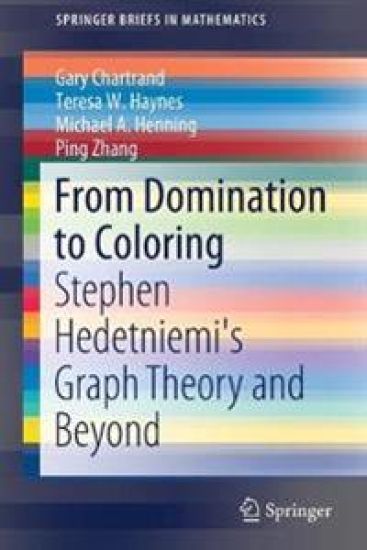
From Domination to Coloring

From Domination to Coloring

Gary Chartrand; Teresa W. Haynes; Michael A. Henning; Ping Zhang

Springer Nature Switzerland AG
2019
nidottu
This book is in honor of the 80th birthday of Stephen Hedetniemi. It describes advanced material in graph theory in the areas of domination, coloring, spanning cycles and circuits, and distance that grew out of research topics investigated by Stephen Hedetniemi. The purpose of this book is to provide background and principal results on these topics, along with same related problems and conjectures, for researchers in these areas. The most important features deal with material, results, and problems that researchers may not be aware of but may find of interest. Each chapter contains results, methods and information that will give readers the necessary background to investigate each topic in more detail.
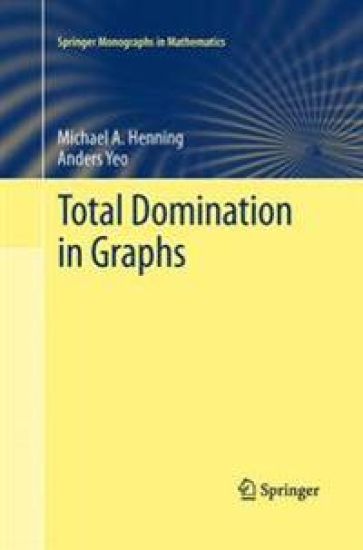
Total Domination in Graphs

Total Domination in Graphs

Michael A. Henning; Anders Yeo

Springer-Verlag New York Inc.
2015
nidottu
Total Domination in Graphs gives a clear understanding of this topic to any interested reader who has a modest background in graph theory. This book provides and explores the fundamentals of total domination in graphs. Some of the topics featured include the interplay between total domination in graphs and transversals in hypergraphs, and the association with total domination in graphs and diameter-2-critical graphs. Several proofs are included in this text which enables readers to acquaint themselves with a toolbox of proof techniques and ideas with which to attack open problems in the field. This work is an excellent resource for students interested in beginning their research in this field. Additionally, established researchers will find the book valuable to have as it contains the latest developments and open problems.
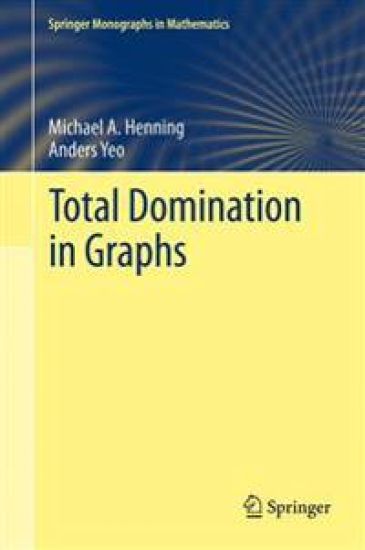
Total Domination in Graphs

Total Domination in Graphs

Michael A. Henning; Anders Yeo

Springer-Verlag New York Inc.
2013
sidottu
Total Domination in Graphs gives a clear understanding of this topic to any interested reader who has a modest background in graph theory. This book provides and explores the fundamentals of total domination in graphs. Some of the topics featured include the interplay between total domination in graphs and transversals in hypergraphs, and the association with total domination in graphs and diameter-2-critical graphs. Several proofs are included in this text which enables readers to acquaint themselves with a toolbox of proof techniques and ideas with which to attack open problems in the field. This work is an excellent resource for students interested in beginning their research in this field. Additionally, established researchers will find the book valuable to have as it contains the latest developments and open problems.