
Kirjojen hintavertailu – 12 903 725 kirjaa ja 27 kauppaa

Kirjailija

Michael A. Woodley of Menie

Kirjat ja teokset yhdessä paikassa: 3 kirjaa, julkaisuja vuosilta 2018–2019, suosituimpiin kuuluu Life History Evolution. Vertaile teosten hintoja ja tarkista saatavuus suomalaisista kirjakaupoista.

3 kirjaa

Kirjojen julkaisuvuodet: 2018–2019.

Life History Evolution

Life History Evolution

Steven C. Hertler; Aurelio José Figueredo; Mateo Peñaherrera-Aguirre; Heitor B. F. Fernandes; Michael A. Woodley of Menie

Springer Nature Switzerland AG
2019
nidottu
The social sciences share a mission to shed light on human nature and society. However, there is no widely accepted meta-theory; no foundation from which variables can be linked, causally sequenced, or ultimately explained. This book advances “life history evolution” as the missing meta-theory for the social sciences. Originally a biological theory for the variation between species, research on life history evolution now encompasses psychological and sociological variation within the human species that has long been the stock and trade of social scientific study. The eighteen chapters of this book review six disciplines, eighteen authors, and eighty-two volumes published between 1734 and 2015—re-reading the texts in the light of life history evolution.
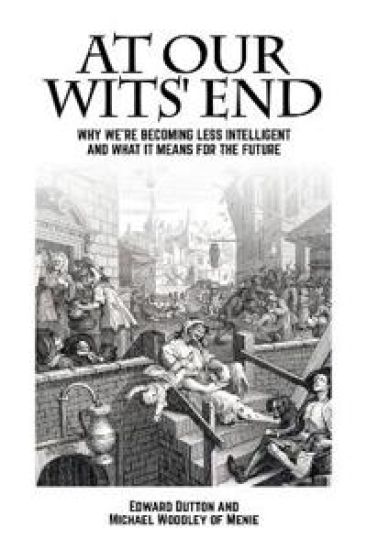
At Our Wits' End

At Our Wits' End

Edward Dutton; Michael A. Woodley of Menie

Societas
2018
pokkari
We are becoming less intelligent. This is the shocking yet fascinating message of At Our Wits' End. The authors take us on a journey through the growing body of evidence that we are significantly less intelligent now than we were a hundred years ago. The research proving this is, at once, profoundly thought-provoking, highly controversial, and it’s currently only read by academics. But the authors are passionate that it cannot remain ensconced in the ivory tower any longer. With At Our Wits’ End, they present the first ever popular scientific book on this crucially important issue. They prove that intelligence — which is strongly genetic — was increasing up until the breakthrough of the Industrial Revolution, because we were subject to the rigors of Darwinian Selection, meaning that lots of surviving children was the preserve of the cleverest. But since then, they show, intelligence has gone into rapid decline, because large families are increasingly the preserve of the least intelligent. The book explores how this change has occurred and, crucially, what its consequences will be for the future. Can we find a way of reversing the decline of our IQ? Or will we witness the collapse of civilization and the rise of a new Dark Age?
Life History Evolution

Life History Evolution

Steven C. Hertler; Aurelio José Figueredo; Mateo Peñaherrera-Aguirre; Heitor B. F. Fernandes; Michael A. Woodley of Menie

Springer International Publishing AG
2018
sidottu
The social sciences share a mission to shed light on human nature and society. However, there is no widely accepted meta-theory; no foundation from which variables can be linked, causally sequenced, or ultimately explained. This book advances “life history evolution” as the missing meta-theory for the social sciences. Originally a biological theory for the variation between species, research on life history evolution now encompasses psychological and sociological variation within the human species that has long been the stock and trade of social scientific study. The eighteen chapters of this book review six disciplines, eighteen authors, and eighty-two volumes published between 1734 and 2015—re-reading the texts in the light of life history evolution.