Kirjojen hintavertailu – 12 903 725 kirjaa ja 27 kauppaa

Kirjailija

Michael Beenstock

Kirjat ja teokset yhdessä paikassa: 7 kirjaa, julkaisuja vuosilta 2011–2022, suosituimpiin kuuluu The Econometric Analysis of Non-Stationary Spatial Panel Data. Vertaile teosten hintoja ja tarkista saatavuus suomalaisista kirjakaupoista.

7 kirjaa

Kirjojen julkaisuvuodet: 2011–2022.

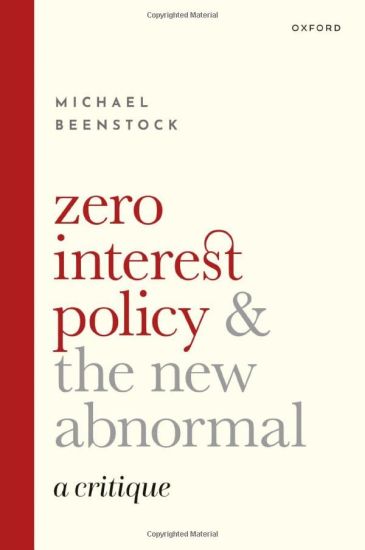
Zero Interest Policy and the New Abnormal

Zero Interest Policy and the New Abnormal

Michael Beenstock

Oxford University Press
2022
sidottu
In the 'New Normal' central banks set their interest rate to zero and print money through massive quantitative easing, while finance ministries run huge fiscal deficits. Yet inflation remains minimal. Zero Interest Policy and the New Abnormal explains why. It also explains why the New Normal is really the New Abnormal, and why it can't last. This study traces the academic roots of the New Abnormal to a conceptual confusion about the 'natural rates of interest', and postmodernism in macroeconomics, exemplified by the DSGE (dynamic stochastic general equilibrium) movement. It develops a theory of 'existential risk' which is concerned with the collapse of political economies such the Bretton Woods system and the New Abnormal. The book demonstrates that existential risk expresses itself in the growing gap between the natural rate of interest, measured by the rate of return on capital, and the real rate of interest, as well as in the development of cryptocurrencies. Beenstock develops a theory of 'kinetic inflation' based on Keynes' liquidity trap, which accounts for the absence of inflation in the New Abnormal, and predicts its outbreak when zero interest policy ends. He also explores the adverse social consequences of the New Abnormal for fertility, pensions, house prices, economic inequality, and intergenerational equity and establishes a causal link from the New Abnormal to Covid-19 mitigation policy, and from the latter to the intensification of the New Abnormal. Finally, it assesses the prospects for ending the New Abnormal, and an orderly return to the Old Normal. The alternative is to crash-out of the New Abnormal chaotically.

Recurrence Risk in Autism Spectrum Disorders

Recurrence Risk in Autism Spectrum Disorders

Michael Beenstock

NOVA SCIENCE PUBLISHERS INC
2021
sidottu
The study of autism development disorders has been dominated by the neurodevelopmental paradigm for almost 50 years. This book challenges the exclusivity of the neurodevelopmental paradigm by using unique population cohort data to study recurrence risk of ASD in Israel. Randomness in the timing of ASD diagnoses of index children is exploited, as in a natural experiment, to randomise within-group reproductive stoppage. Some parents of children on the spectrum consciously refrained from reproductive stoppage by having further children. Other parents had further children before their index child was diagnosed. The former parents raised their further children having gained experience in raising children on the spectrum. The latter parents raised their children under a veil of ignorance, to be broken when their index children were diagnosed. Whereas neurodevelopmental theory predicts that recurrence risk is the same for both types of parents, behavioural theory predicts that they should be different. Population cohort data for Israel corroborate the predictions of behavioural theory. Indeed, corroboration applies in four different tests. More generally, the author calls for a level playing field in which behavioural theory of recurrence risk is placed on an equal footing as the dominant neurodevelopmental paradigm. He also argues for methodological pluralism in which the epidemiological toolbox is augmented with methods from statistics and econometrics. In summary, the author offers a critique of the current state of research on recurrence risk of ASD.
The Econometric Analysis of Non-Stationary Spatial Panel Data

The Econometric Analysis of Non-Stationary Spatial Panel Data

Michael Beenstock; Daniel Felsenstein

Springer Nature Switzerland AG
2019
sidottu
This monograph deals with spatially dependent nonstationary time series in a way accessible to both time series econometricians wanting to understand spatial econometics, and spatial econometricians lacking a grounding in time series analysis. After charting key concepts in both time series and spatial econometrics, the book discusses how the spatial connectivity matrix can be estimated using spatial panel data instead of assuming it to be exogenously fixed. This is followed by a discussion of spatial nonstationarity in spatial cross-section data, and a full exposition of non-stationarity in both single and multi-equation contexts, including the estimation and simulation of spatial vector autoregression (VAR) models and spatial error correction (ECM) models. The book reviews the literature on panel unit root tests and panel cointegration tests for spatially independent data, and for data that are strongly spatially dependent. It provides for the first time critical valuesfor panel unit root tests and panel cointegration tests when the spatial panel data are weakly or spatially dependent. The volume concludes with a discussion of incorporating strong and weak spatial dependence in non-stationary panel data models. All discussions are accompanied by empirical testing based on a spatial panel data of house prices in Israel.
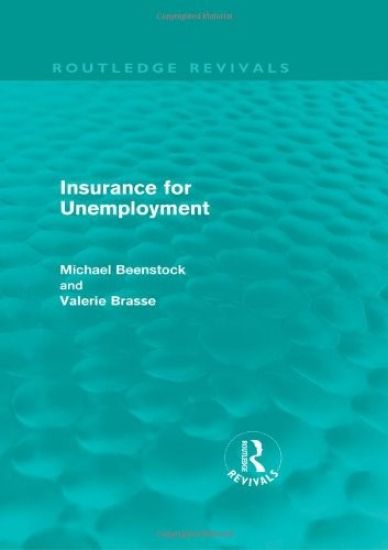
Insurance for Unemployment

Insurance for Unemployment

Michael Beenstock; Valerie Brasse

Routledge
2012
nidottu
First published in 1986, Insurance for Unemployment proposes a radical approach to the reform of unemployment and social insurance. The book develops the ethical, economic and actuarial case for the proposed reforms, whereby the individual pays the contributions which reflect the unemployment risk that he wishes to insure. Such ideas provide a libertarian alternative to the social security systems that have been adopted by most countries in the world based on Beveridge’s conception of social insurance, and the book provides an original basis for privatising unemployment insurance. Conventional acceptance of the welfare state is challenged, while the book stands as a landmark in relating market principles to issues of social policy.
The World Economy in Transition (Routledge Revivals)
First published in 1984, Michael Beenstock develops in The World Economy in Transition an original, stimulating and accessible analysis of the world economy in its many aspects, and this second edition includes a chapter on the International Banking Crisis in line with the author’s Transition Theory. The book embraces numerous strands of economic debate as the author provides a powerful and original thesis which focuses on the changing economic relationship between developed and developing nations as well as between manufacturing and primary producing sectors. The analysis also extends to international trade, commodity markets, international finance, energy and economic history. The book discusses, in addition to Transition Theory, other global approaches to the subject, including technology diffusion, long waves, commodity price effects and the oil price hikes, and the insights of Transition Theory are also applied to the historical experience of the British economy, concluding with an evaluation of policy implications.
Insurance for Unemployment

Insurance for Unemployment

Michael Beenstock; Valerie Brasse

Routledge
2011
sidottu
First published in 1986, Insurance for Unemployment proposes a radical approach to the reform of unemployment and social insurance. The book develops the ethical, economic and actuarial case for the proposed reforms, whereby the individual pays the contributions which reflect the unemployment risk that he wishes to insure. Such ideas provide a libertarian alternative to the social security systems that have been adopted by most countries in the world based on Beveridge’s conception of social insurance, and the book provides an original basis for privatising unemployment insurance. Conventional acceptance of the welfare state is challenged, while the book stands as a landmark in relating market principles to issues of social policy.
The World Economy in Transition (Routledge Revivals)
First published in 1984, Michael Beenstock develops in The World Economy in Transition an original, stimulating and accessible analysis of the world economy in its many aspects, and this second edition includes a chapter on the International Banking Crisis in line with the author’s Transition Theory. The book embraces numerous strands of economic debate as the author provides a powerful and original thesis which focuses on the changing economic relationship between developed and developing nations as well as between manufacturing and primary producing sectors. The analysis also extends to international trade, commodity markets, international finance, energy and economic history. The book discusses, in addition to Transition Theory, other global approaches to the subject, including technology diffusion, long waves, commodity price effects and the oil price hikes, and the insights of Transition Theory are also applied to the historical experience of the British economy, concluding with an evaluation of policy implications.