Kirjojen hintavertailu – 12 903 724 kirjaa ja 27 kauppaa

Kirjailija

Michael Brecher

Kirjat ja teokset yhdessä paikassa: 13 kirjaa, julkaisuja vuosilta 1997–2022, suosituimpiin kuuluu A Century of Crisis and Conflict in the International System. Vertaile teosten hintoja ja tarkista saatavuus suomalaisista kirjakaupoista.

13 kirjaa

Kirjojen julkaisuvuodet: 1997–2022.

Decisions in Crisis

Decisions in Crisis

Michael Brecher

University of California Press
2022
sidottu
Decisions in Crisis: Israel, 1967 and 1973 explores the intricate dynamics of decision-making during two pivotal crises in Israeli history: the Six-Day War of 1967 and the Yom Kippur War of 1973. This comprehensive study delves into the psychological, political, and strategic factors that shaped Israeli leaders’ responses under the intense pressures of international crisis. By examining decision flows, military balances, and coping mechanisms, the book reveals patterns of behavior and stress responses unique to state actors in moments of existential threat. Michael Brecher and Benjamin Geist utilize a multidisciplinary approach, blending qualitative and quantitative methods within the framework of the International Crisis Behavior (ICB) Project. This comparative analysis provides insights into the broader implications of crisis-induced stress on state behavior, contributing to the development of general theories in international relations. Supported by rigorous research and expert contributions, Decisions in Crisis is an essential resource for understanding the complexities of crisis management and decision-making in the context of global conflict. This title is part of UC Press's Voices Revived program, which commemorates University of California Press’s mission to seek out and cultivate the brightest minds and give them voice, reach, and impact. Drawing on a backlist dating to 1893, Voices Revived makes high-quality, peer-reviewed scholarship accessible once again using print-on-demand technology. This title was originally published in 1980.

Decisions in Crisis

Decisions in Crisis

Michael Brecher

University of California Press
2022
pokkari
Decisions in Crisis: Israel, 1967 and 1973 explores the intricate dynamics of decision-making during two pivotal crises in Israeli history: the Six-Day War of 1967 and the Yom Kippur War of 1973. This comprehensive study delves into the psychological, political, and strategic factors that shaped Israeli leaders’ responses under the intense pressures of international crisis. By examining decision flows, military balances, and coping mechanisms, the book reveals patterns of behavior and stress responses unique to state actors in moments of existential threat. Michael Brecher and Benjamin Geist utilize a multidisciplinary approach, blending qualitative and quantitative methods within the framework of the International Crisis Behavior (ICB) Project. This comparative analysis provides insights into the broader implications of crisis-induced stress on state behavior, contributing to the development of general theories in international relations. Supported by rigorous research and expert contributions, Decisions in Crisis is an essential resource for understanding the complexities of crisis management and decision-making in the context of global conflict. This title is part of UC Press's Voices Revived program, which commemorates University of California Press’s mission to seek out and cultivate the brightest minds and give them voice, reach, and impact. Drawing on a backlist dating to 1893, Voices Revived makes high-quality, peer-reviewed scholarship accessible once again using print-on-demand technology. This title was originally published in 1980.

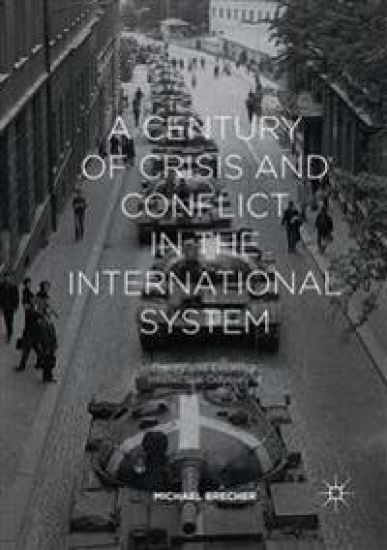
A Century of Crisis and Conflict in the International System

A Century of Crisis and Conflict in the International System

Michael Brecher

Springer International Publishing AG
2018
nidottu
This book is designed to present a fully developed theory of international crisis and conflict, along with substantial evidence of these two closely related phenomena. The book begins with a discussion of these topics at a theoretical level, defining and elaborating on core concepts: international crisis, interstate conflict, severity, and impact. This is followed by a discussion of the international system, along with two significant illustrations, the Berlin Blockade crisis (1948) and the India-Pakistan crisis over Kashmir (1965-66). The book then presents a unified model of crisis, focusing on the four phases of an international crisis, which incorporate the four periods of foreign policy crises for individual states. Findings from thirteen conflicts representing six regional clusters are then analyzed, concluding with a set of hypotheses and evidence on conflict onset, persistence, and resolution.
Dynamics of the Arab-Israel Conflict

Dynamics of the Arab-Israel Conflict

Michael Brecher

Springer International Publishing AG
2018
nidottu
This book comprises findings from the author's wide-ranging research since 1948 on the unresolved Arab/Israel protracted conflict. Brecher reflects back on his detailed analysis of the UN Commission created in November 1947, and his near-seven decades of research and publications on this complex protracted conflict continued since the first of nine Arab/Israeli wars. The book includes an analysis of the crucial early phase of the unresolved struggle for control of Jerusalem in 1948-49 and beyond, based on extensive interviews with Israel’s leaders and prominent Egyptian senior officials, journalists and academics. It addresses the many diverse attempts at conflict resolution, including a peace plan to resolve the Arab/Israel conflict of the author's own design. It concludes with historical reflections about Israel’s behavior, domestically and externally, in 1948-1949 and 2008 and beyond. No other book on this protracted conflict contains so many important interviews with the first twogenerations of Israeli leaders and Egyptian officials and academics, and no other author can speak from such a deep and prolonged engagement.
The World of Protracted Conflicts

The World of Protracted Conflicts

Michael Brecher

Lexington Books
2018
nidottu
The World of Protracted Conflicts seeks to frame the models to answer three crucial questions about interstate protracted conflict: what are the most likely conditions for the onset of a protracted conflict, its escalation/persistence, and its termination? It presents the findings on protracted conflict occurrence, continuation, and resolution through testing these models and their derived hypotheses against the evidence from 33 interstate protracted conflicts in the last century. These findings will, in turn, shed further light on the conflict-crisis-war linkage. This book examines and explains patterns that exist in the eruption, evolution, and winding down of these conflicts through a systematic comparison of recent and contemporary PCs.
Political Leadership and Charisma

Political Leadership and Charisma

Michael Brecher

Springer International Publishing AG
2018
nidottu
This book is unique in illuminating and comparing the charismatic role of two political leaders, Jawaharlal Nehru and David Ben-Gurion, along with assessments of many other 20th century political leaders. Its aim is to enrich our knowledge of an important dimension of global politics: charismatic leadership. The central role of political leaders in shaping the behavior of states has been universally recognized since the political systems of antiquity in East Asia, the Middle East, and Europe. With the massive increase of independent states since the end of World War II, from 55 initial members of the United Nations to more than 200 today, and especially the emergence of awesome weapons of mass destruction, the centrality of political leaders in the survival of the planet has grown exponentially. Both India and Israel have experienced the crucial role of charismatic leaders, Nehru and Ben Gurion, who dominated their states and societies for a near-identical formative period in their political independence, 1947-64 and 1948-63 respectively, as charismatic leaders. Their impact, Brecher shows, extended far beyond their states to both their geographic regions and global politics.
Political Leadership and Charisma

Political Leadership and Charisma

Michael Brecher

Springer International Publishing AG
2016
sidottu
This book is unique in illuminating and comparing the charismatic role of two political leaders, Jawaharlal Nehru and David Ben-Gurion, along with assessments of many other 20th century political leaders. Its aim is to enrich our knowledge of an important dimension of global politics: charismatic leadership. The central role of political leaders in shaping the behavior of states has been universally recognized since the political systems of antiquity in East Asia, the Middle East, and Europe. With the massive increase of independent states since the end of World War II, from 55 initial members of the United Nations to more than 200 today, and especially the emergence of awesome weapons of mass destruction, the centrality of political leaders in the survival of the planet has grown exponentially. Both India and Israel have experienced the crucial role of charismatic leaders, Nehru and Ben Gurion, who dominated their states and societies for a near-identical formative period in their political independence, 1947-64 and 1948-63 respectively, as charismatic leaders. Their impact, Brecher shows, extended far beyond their states to both their geographic regions and global politics.
The World of Protracted Conflicts

The World of Protracted Conflicts

Michael Brecher

Lexington Books
2016
sidottu
The World of Protracted Conflicts seeks to frame the models to answer three crucial questions about interstate protracted conflict: what are the most likely conditions for the onset of a protracted conflict, its escalation/persistence, and its termination? It presents the findings on protracted conflict occurrence, continuation, and resolution through testing these models and their derived hypotheses against the evidence from 33 interstate protracted conflicts in the last century. These findings will, in turn, shed further light on the conflict-crisis-war linkage. This book examines and explains patterns that exist in the eruption, evolution, and winding down of these conflicts through a systematic comparison of recent and contemporary PCs.
International Political Earthquakes

International Political Earthquakes

Michael Brecher

The University of Michigan Press
2008
sidottu
International Political Earthquakes is the masterwork of the preeminent scholar Michael Brecher. Brecher, who came of age before World War II, has witnessed more than seven decades of conflict and has spent his career studying the dynamics of relations among nations throughout the world. When terrorism, ethnic conflict, military buildup, or other local tensions spark an international crisis, Brecher argues that the structure of global politics determines its potential to develop into open conflict. That conflict, in turn, may then generate worldwide political upheaval. Comparing international crises to earthquakes, Brecher proposes a scale analogous to the Richter scale to measure the severity and scope of the impact of a crisis on the landscape of international politics. Brecher's conclusions about the causes of international conflict and its consequences for global stability make a convincing case for gradual, nonviolent approaches to crisis resolution. Michael Brecher is R. B. Angus Professor of Political Science at McGill University.
International Political Earthquakes

International Political Earthquakes

Michael Brecher

The University of Michigan Press
2008
nidottu
International Political Earthquakes is the masterwork of the preeminent scholar Michael Brecher. Brecher, who came of age before World War II, has witnessed more than seven decades of conflict and has spent his career studying the dynamics of relations among nations throughout the world. When terrorism, ethnic conflict, military buildup, or other local tensions spark an international crisis, Brecher argues that the structure of global politics determines its potential to develop into open conflict. That conflict, in turn, may then generate worldwide political upheaval. Comparing international crises to earthquakes, Brecher proposes a scale analogous to the Richter scale to measure the severity and scope of the impact of a crisis on the landscape of international politics. Brecher's conclusions about the causes of international conflict and its consequences for global stability make a convincing case for gradual, nonviolent approaches to crisis resolution. Michael Brecher is R. B. Angus Professor of Political Science at McGill University.
A Study of Crisis

A Study of Crisis

Michael Brecher; Jonathan Wilkenfeld

The University of Michigan Press
1997
sidottu
As the twentieth century draws to a close, it is time to look back on an epoch of widespread turmoil, including two world wars, the end of the colonial era in world history, and a large number of international crises and conflicts. This book is designed to shed light on the causes and consequences of military-security crises since the end of World War I, in every region, across diverse economic and political regimes, and cultures. The primary aim of this volume is to uncover patterns of crises, conflicts and wars and thereby to contribute to the advancement of international peace and world order. The culmination of more than twenty years of research by Michael Brecher and Jonathan Wilkenfeld, the book analyzes crucial themes about crisis, conflict, and war and presents systematic knowledge about more than 400 crises, thirty-one protracted conflicts and almost 900 state participants. The authors explore many aspects of conflict, including the ethnic dimension, the effect of different kinds of political regimes--notably the question whether democracies are more peaceful than authoritarian regimes, and the role of violence in crisis management. They employ both case studies and aggregate data analysis in a Unified Model of Crisis to focus on two levels of analysis--hostile interactions among states, and the behavior of decision-makers who must cope with the challenge posed by a threat to values, time pressure, and the increased likelihood that military hostilities will engulf them. This book will appeal to scholars in history, political science, sociology, and economics as well as policy makers interested in the causes and effects of crises in international relations. The rich data sets will serve researchers for years to come as they probe additional aspects of crisis, conflict and war in international relations. Michael Brecher is R. B. Angus Professor of Political Science, McGill University. Jonathan Wilkenfeld is Professor and Chair of the Department of Government and Politics, University of Maryland. They are the coauthors of Crises in the Twentieth Century: A Handbook of International Crisis, among other books and articles.