Kirjojen hintavertailu – 12 859 829 kirjaa ja 27 kauppaa

Kirjailija

Michael Bridge

Kirjat ja teokset yhdessä paikassa: 12 kirjaa, julkaisuja vuosilta 1996–2026, suosituimpiin kuuluu CISG Part II Conference, Stockholm, 4-5 September 2008. Vertaile teosten hintoja ja tarkista saatavuus suomalaisista kirjakaupoista.

12 kirjaa

Kirjojen julkaisuvuodet: 1996–2026.

CISG Part II Conference, Stockholm, 4-5 September 2008

CISG Part II Conference, Stockholm, 4-5 September 2008

Jan Kleineman; Michael Bridge; Torsten Iversen; Tom Madell; Joseph Lookofsky; Ulrich Magnus; Jan Ramberg; Carolina Saf; Ingeborg Schwenzer; Pascal Hachem; Leif Sevón; Lena Sisula-Tulokas

Stockholm Centre for Commercial Law
2009
nidottu
The CISG Part II Conference was held in Stockholm on 4–5 September 2008. The Conference was held in honour and remembrance of the late Supreme Court Justice Hans-Gunnar Solerud, the first chairman of the Stockholm Centre for Commercial Law. The Conference was organised by the Stockholm Centre for Commercial Law in co-operation with the Swedish Ministry of Justice. CONTENTS: - The CISG from a Common Law Perspective Michael Bridge - Scandinavian Contract Law and its Implication on CISG – the Danish Approach Torsten Iversen - Changes proposed in the Nordic stance on the CISG Jan Kleineman and Tom Madell - CISG Case Law and the Scandinavian Part II Reservations - Some Reflections on the CISG Part II Conference at the University of Stockholm, 4–5 September 2008 Joseph Lookofsky - The Scandinavian Reservation under Art. 92 CISG Ulrich Magnus - The Effect of CISG on Swedish Contract Law – now and in the Future Jan Ramberg - CISG – a Uniform Law within the Sphere of Conflict of Laws Carolina Saf - The CISG – A Story of Worldwide Success Ingeborg Schwenzer and Pascal Hachem - Scandinavian Contract Law and its Implication on CISG – The Finnish Approach Leif Sevón - Nordic hesitancy regarding Part II of the CISG Lena Sisula-Tulokas
The Sale of Goods

The Sale of Goods

Michael Bridge

Oxford University Press
2026
sidottu
English law of sale of goods is an important area of commercial law, occupying a central place in the UK law schools curricula as well as in legal practice. Now in its fifth edition, The Sale of Goods offers a systematic and rigorous study of the law of sale of goods with reference to UK and Commonwealth authorities and relevant UK and, although of diminishing importance, EU legislation. Fully updated with the most recent case law, this book examines the relationship between statute (the Sale of Goods Act 1979) and the underlying common law, as well as the connection between contract and property law. The passing of property from seller to buyer is discussed, alongside mistake, frustration, and risk. Performance issues, including delivery and payment, are addressed in depth, as are the implied terms of description, satisfactory quality, and fitness for purpose. Breach and termination are explored through the lens of conditions, warranties, innominate terms, and repudiation, with detailed discussion of the buyer's right to reject goods and its loss through acceptance. Misrepresentation and exclusion clauses also come in for detailed discussion. The book concludes with a comprehensive treatment of remedies, including the seller's real rights over goods in cases of non-payment, actions for debt and specific performance, and damages for non-acceptance, non-delivery, late delivery, and the delivery of non-conforming goods. Significant important cases include: damages; contractual certainty; specific performance; cryptoassets and coins; gambling chips; cancellation clauses; conditions precedent; passing of property; insurable interest; frustration; change of position; right to sell; contract quantity; waiver; delivery; innominate terms; divisible contracts; deposits and advance payments; time of essence; fitness for purpose; description; fraud; misrepresentation; express warranty; consumer safety; exclusion clauses; affirmation; termination; repudiation; rejection; interest; failure of consideration; market damages; mitigation of damages. Statutory developments include: Digital, Markets, Competition and Consumers Act 2024; Electronic Documents Act 2023; and post-Brexit modification of EU-inspired legislation.
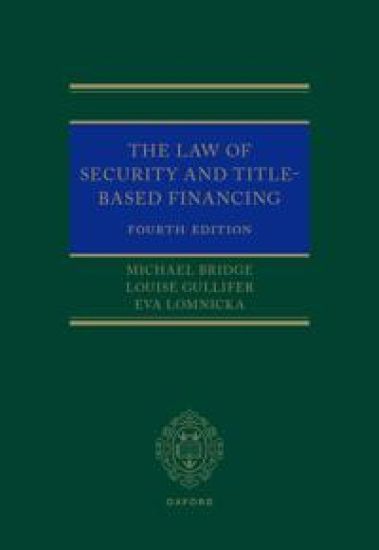
The Law of Security and Title-Based Financing

The Law of Security and Title-Based Financing

Michael Bridge; Louise Gullifer; Eva Lomnicka

Oxford University Press
2024
sidottu
Personal property security is an important subject in commercial practice as it is the key to much of the law of banking and sale. This book examines traditional methods of securing debts (such as mortgages, charges and pledges as well as so-called 'quasi-security') on property other than land, describing how these are created, how they must be registered (or otherwise 'perfected') if they are to be valid, the rights and duties of the parties and how the security is enforced if the debt is not paid. This fourth edition has been updated to incorporate recent political and legal developments, including Brexit. The 'Edinburgh Reforms', which have followed the United Kingdom's exit from the European Union, promise a thorough overhaul of the consumer credit regime. The Retained EU Law (Revocation and Reform) Act 2023 potentially affects the interpretation of EU assimilated law, including the Financial Collateral Arrangements (No2) Regulations (FCARs). This edition further assesses the implications of the Business Contract Terms (Assignment of Receivables) Regulations 2018, taking pledges over electronic documents of title in the light of the Electronic Trade Documents Act 2023, the outlawing of 'ipso facto' clauses by the Corporate Insolvency and Governance Act 2020, and the reduced scope of the EU Insolvency Regulation. The treatment of insolvency matters within the framework of the Cape Town Convention is also considered, as are recent cases on pledges of bills of lading when the carrier no longer has possession of the goods, the distinction between fixed and floating charges, equitable liens and the right of appropriation of financial collateral. There is a full discussion of the taking of security over digital assets and the relevance of the FCARs. The only full-length treatment covering both traditional security over personal property and also devices that fulfil a similar economic function, such as retention of title and sales of receivables, The Law of Security and Title-Based Financing is a frequently-cited and indispensable reference work both for practitioners and academics.
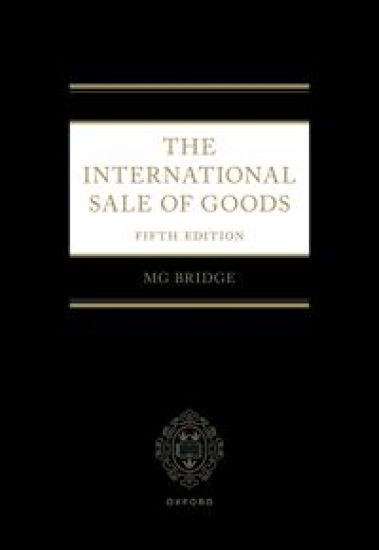
The International Sale of Goods 5e

The International Sale of Goods 5e

Michael Bridge

Oxford University Press
2023
sidottu
The fifth edition of this leading authority continues to provide comprehensive analysis of the law and practice of sale of goods under English and international law. The unique dual coverage of contracts under English law and the UN Convention on the International Sale of Goods (CISG) is of great value to those interested in all types of sale of goods contracts, including the sale of commodities. The detailed commentary provides analysis on decided cases as well as on standard form contracts that represent evolving trade practice. This edition offers updated and essential analysis of the rapidly-evolving law related to the CISG, including an assessment of how specific issues - such as no oral modification clauses - might be addressed under the Convention. In addition, it provides expanded coverage of standard form contracts beyond the dry trades, including developments in electronic documentation and further treatment of notices of appropriation and force majeure. Further, there is a discussion of Incoterms 2020, and an expanded and updated treatment of contractual estoppel, good faith and contractual discretion, contractual termination and damages. As ever, the law is explored in the context of commercial practice making the book an ideal reference source for practitioners, scholars, and postgraduate students.
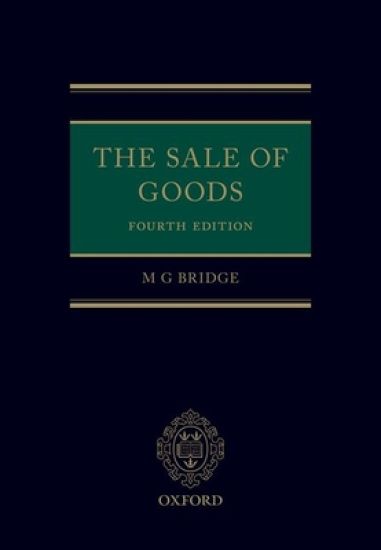
The Sale of Goods

The Sale of Goods

Michael Bridge

Oxford University Press
2019
sidottu
The fourth edition of this established and highly-regarded work is the most systematic study available of the law of sale of goods with reference to UK and Commonwealth authorities and relevant UK and EU legislation. A distinguishing feature of the work is the depth of treatment of problem areas, providing clarity on the law. It provides full coverage of content, interpretation and performance issues relating to sale of goods agreements. The book also addresses the relevant aspects of consumer law, as well as issues such as recoverability of damages, currency and interest. The work has been updated in its fourth edition to cover all recent developments in caselaw, most notably The Supreme Court in PST Energy 7 Shipping LLC v OW Bunker Malta Ltd (The Res Cogitans) [2016] UKSC 23 which has given rise to a new category of contract: the sui generis supply contract, for which no statutory model yet exists. Also examined in depth is the Consumer Rights Act 2015, which has profoundly affected the structure of sales law and, in a number of key instances, has also affected the substance of the law. This work remains the leading work of scholarship and an invaluable reference for all practitioners and scholars working in the field.
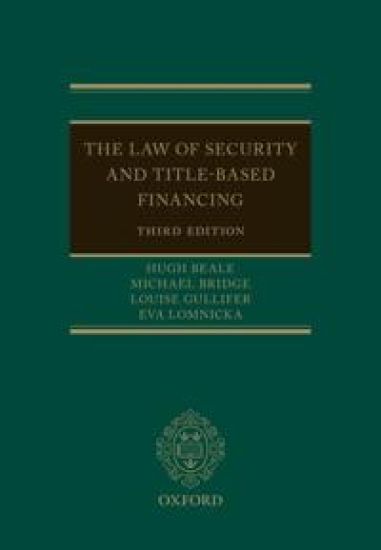
The Law of Security and Title-Based Financing

The Law of Security and Title-Based Financing

Hugh Beale; Michael Bridge; Louise Gullifer; Eva Lomnicka

Oxford University Press
2018
sidottu
Personal property security is an important subject in commercial practice as it is the key to much of the law of banking and sale. This book examines traditional methods of securing debts (such as mortgages, charges and pledges) on property other than land, describing how these are created, how they must be registered (or otherwise 'perfected') if they are to be valid, the rights and duties of the parties and how the security is enforced if the debt is not paid. The third edition has been updated to cover a wealth of cases which have been decided since the last edition. These include new cases on: control of financial collateral, and relief against forfeiture under a financial collateral arrangement; retention of title (including the effect of "extended" clauses); estoppel and the HPI register; availability of set-off against assignee; a number of cases on enforcement of security; equitable liens; solicitor's liens and databases; on priority or purchase money security interests; and the Irish Supreme Court decision on floating charge and crystallisation. The effect of key legislative changes have also been analysed and these include the 2013 amendments to the Companies Act 2006 Part 25, and issues post-ratification relating to the Cape Town Convention. The only full-length treatment covering both traditional security over personal property and also devices that fulfil a similar economic function, such as retention of title and sales of receivables, The Law of Security and Title-Based Financing is a frequently-cited and indispensable reference work both for practitioners and academics.
Personal Property Law

Personal Property Law

Michael Bridge

Oxford University Press
2015
sidottu
What type of right is a property right? How are items of property classified for legal purposes? In this revised edition of Personal Property Law, Michael Bridge provides answers to these fundamental questions of property law. His critical analysis includes new material on insolvency, in particular the anti-deprivation principle and the pari passu rule, as well as comprehensive accounts of recent case law (OBG v Allan, Yearworth, and Datastream,) and statutory developments. Widely considered to be the best short introduction to English personal property law, Bridge constructs an authoritative and systematic summary of this complex field for readers approaching the subject for the first time. It focuses on the acquisition, loss, transfer, and protection of interests in personal property law, and specific topics include: ownership and possession; treatment of the separate contributions of the common law and equity to modern personal property law; discussion of modes of transfer; the means of protecting property interests; the resolution of disputes concerning title to personal property; the grant of security interests, and the issues arising out of the transformation and mixing of tangible personal property.
Personal Property Law

Personal Property Law

Michael Bridge

Oxford University Press
2015
nidottu
What type of right is a property right? How are items of property classified for legal purposes? In this revised edition of Personal Property Law, Michael Bridge provides answers to these fundamental questions of property law. His critical analysis includes new material on insolvency, in particular the anti-deprivation principle and the pari passu rule, as well as comprehensive accounts of recent case law (OBG v Allan, Yearworth, and Datastream,) and statutory developments. Widely considered to be the best short introduction to English personal property law, Bridge constructs an authoritative and systematic summary of this complex field for readers approaching the subject for the first time. It focuses on the acquisition, loss, transfer, and protection of interests in personal property law, and specific topics include: ownership and possession; treatment of the separate contributions of the common law and equity to modern personal property law; discussion of modes of transfer; the means of protecting property interests; the resolution of disputes concerning title to personal property; the grant of security interests, and the issues arising out of the transformation and mixing of tangible personal property.
The Sale of Goods

The Sale of Goods

Michael Bridge

Oxford University Press
2014
sidottu
This book provides a systematic analysis of the law of sale of goods with reference to UK and Commonwealth authorities and relevant UK and EU legislation. With particular clarity of expression the work covers fully content, interpretation, and performance issues relating to sale of goods agreements. Aspects of consumer law are dealt with where relevant as are issues such as recoverability of damages, currency and interest. Since the last edition there has been a substantial flow of new case law which include the following selected group: Yearworth (on body fluids); Gammasonics (software); VFS Financial Services and Welcome Financial Services (on Part III of the Hire Purchase Act); Great Elephant (on a seller's s 12 liability); Force India Formula One (s.12 and recovery of money on a failure of consideration); The Mercini Lady (on risk and durability); damages decisions in the wake of The Achilleas; Kulkarni and Wincanton (on the passing of property); Samarenko (on making time of the essence); Brewer (description); McDonald (on examination and satisfactory quality); Lowe (Part 5A of the Sale of Goods Act); case law under the Consumer Protection from Unfair Trading Regulations 2008. All of these, and others, are given full treatment in this new edition. There is also a full treatment of the 2008 regulations on cancellation of contracts. The second edition also includes extended analysis of proprietary rights in bulk goods, and of fitness and quality of goods in relation to compliance with public standards. The material on consumer protection measures has been expanded in relation to liabilities of the seller and third parties. Additional material also deals with changes to the Consumer Credit Act 1974, the definition of exclusion clauses, Part III of the Hire Purchase Act 1964, time of the essence, concurrent contractual duties and suspension, waiver and election, description and general contract law, and misrepresentation and insolvency. This book provides detailed and clear treatment of problem areas and offers new lines of argument and ideas to those interpreting the law and presenting a case. This is a leading work of scholarship and an invaluable reference for all lawyers and scholars working in the field.
International Sale of Goods in the Conflict of Laws

International Sale of Goods in the Conflict of Laws

James Fawcett; Jonathan Harris; Michael Bridge

Oxford University Press
2005
sidottu
This book is the first one in English to focus in depth upon the private international law problems raised by the sale of goods. It begins with the substantive law and practice, and uses this as the basis for a comparative and critical discussion of the private international law issues. Examples of the typical obligations of the buyer and seller are also provided. International Sale of Goods in the Conflict of Laws is a strong new addition to the Oxford Private International Law Series and covers everything from torts to e-commerce. Contracts of sale with a cross-border element are an everyday occurrence and one which is becoming ever more common with the advent of modern communications technology. For example, where, for jurisdictional purposes, is the place or performance of the obligation to pay for goods? Where software is sold over the Internet, is this a sale of goods contract and, if so, where are the goods delivered? Foreign judgments as to title raise complex questions as to enforcement, recognition and res judicata. As regards choice of law, sales-specific problems arise to a large extent from the interaction of contractual obligations and title matters which are central to the sale contract and the complex characterisation questions which ensue. They arise from the enactment in many countries of the Vienna Convention, from the complex inter-relationship between buyer, seller and third parties and from sales-specific domestic legislation which may be mandatory irrespective of the applicable law. The book is concerned not only with contractual disputes that can arise out of the international sale of goods but also with torts, such as conversion and negligent misstatement, that can arise out of this type of contract. Restitutionary and proprietary claims can also arise. Special attention is paid to both the jurisdictional and choice of law problems that occur in cases of business to business e-commerce.
Personal Property Law

Personal Property Law

Michael Bridge

Blackstone Press Ltd
1996
nidottu
Providing a definition of personal property law, the author demonstrates why an understanding of the principles of personal property is important. In defining the various types, he discusses the common law interests (ownership and possession) and in the process deals with the proprietary characteristic of bailment. There is also an outline discussion of equitable interests.;Michael Bridge describes the means by which the common law protects interests in personal property, and discusssses the ways in which interests are conveyed at common law. He examines the rule of "nemo dat quod non habet" with its various exceptions, and in treating the assignment of choices in action compares it with negotiability. Finally, there is an introduction to security over personal property in the form of lien, pledge, charge and mortgage. Important changes since the first edition include the Sale of Goods (Amendment) Act 1995 and the Treasure Act 1996.