Kirjojen hintavertailu – 12 859 828 kirjaa ja 27 kauppaa

Kirjailija

Michael Brie

Kirjat ja teokset yhdessä paikassa: 16 kirjaa, julkaisuja vuosilta 2005–2025, suosituimpiin kuuluu Rosa Luxemburg. Vertaile teosten hintoja ja tarkista saatavuus suomalaisista kirjakaupoista.

16 kirjaa

Kirjojen julkaisuvuodet: 2005–2025.

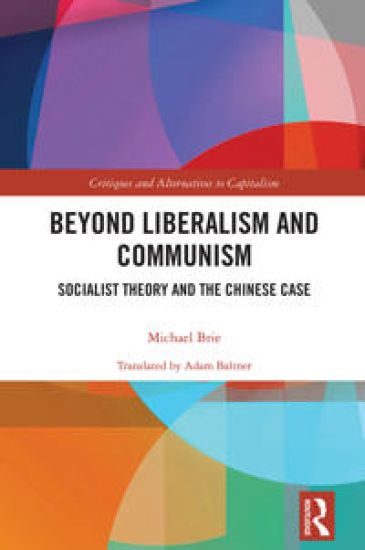
Beyond Liberalism and Communism

Beyond Liberalism and Communism

Michael Brie

TAYLOR FRANCIS LTD
2025
nidottu
Beyond Liberalism and Communism: Socialist Theory and the Chinese Case presents a new conceptual framework of socialism and applies it to the study of socialist development in China, shedding new light on modern China and signposting novel directions in socialist thought. Based on a Marxian-Polanyian approach, the book develops a new conceptual framework of socialism by taking the liberal and the communist challenges seriously. In doing so, Brie develops a liberal and a communist formula of socialism based upon two owners of socialist property (the individuals and the society), different forms of possession (public, common, associative, and individual) meditating the interests of the two opposite owners, and democracy as an expression of the will of the many and of all together in common. This formula is then applied to socialist development in China, analysing its booming centrally directed economy and the political ways to safeguard democracy as the rule of, for, and by the people under the Chinese Communist Party. With an analysis of the means by which China has pursued a unique form of socialist development, Beyond Liberalism and Communism: Socialist Theory and the Chinese Case will appeal to scholars of modern China, political theory, political sociology, and socialist thought.
Beyond Liberalism and Communism

Beyond Liberalism and Communism

Michael Brie

TAYLOR FRANCIS LTD
2024
sidottu
Beyond Liberalism and Communism: Socialist Theory and the Chinese Case presents a new conceptual framework of socialism and applies it to the study of socialist development in China, shedding new light on modern China and signposting novel directions in socialist thought. Based on a Marxian-Polanyian approach, the book develops a new conceptual framework of socialism by taking the liberal and the communist challenges seriously. In doing so, Brie develops a liberal and a communist formula of socialism based upon two owners of socialist property (the individuals and the society), different forms of possession (public, common, associative, and individual) meditating the interests of the two opposite owners, and democracy as an expression of the will of the many and of all together in common. This formula is then applied to socialist development in China, analysing its booming centrally directed economy and the political ways to safeguard democracy as the rule of, for, and by the people under the Chinese Communist Party. With an analysis of the means by which China has pursued a unique form of socialist development, Beyond Liberalism and Communism: Socialist Theory and the Chinese Case will appeal to scholars of modern China, political theory, political sociology, and socialist thought.
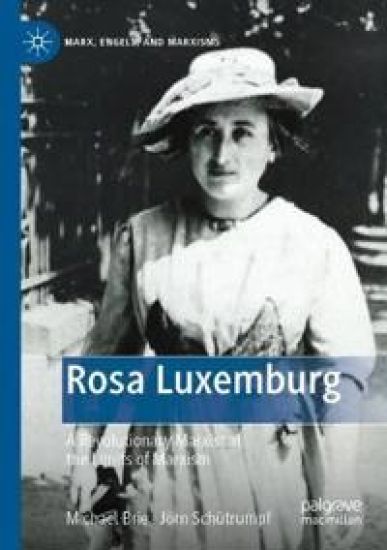
Rosa Luxemburg

Rosa Luxemburg

Michael Brie; Jörn Schütrumpf

Springer Nature Switzerland AG
2022
nidottu
This book analyses the development of Rosa Luxemburg (1871–1919) as an outstanding Marxist thinker and socialist politician in the era of imperialism and revolution. Identifying the driving force behind Luxemburg’s development as the deep unity between her passionate, emphatic life and her political and theoretical work, the authors retrace the inner dynamics of its different stages while highlighting the deep rupture caused by the experience of the Russian Revolution. On the basis of new publications of her Polish works and other writings, Luxemburg's strategic approaches are located in an Eastern European context. The authors discuss Luxemburg’s unique analyses of the first experiments in socialist participation in government, of the first Russian revolution and of the forms of accumulation of capital to outline the foundations of her novel understanding of both democratic-socialist revolution and of a society that would point beyond social democracy as well as Bolshevism –a vision that will gain new significance in the twenty first century. This book looks upon the lasting heritage of Rosa Luxemburg as the groundbreaking thinker of the unity between democracy and socialism.
Rosa Luxemburg

Rosa Luxemburg

Michael Brie; Jörn Schütrumpf

Palgrave MacMillan
2021
sidottu
This book analyses the development of Rosa Luxemburg (1871–1919) as an outstanding Marxist thinker and socialist politician in the era of imperialism and revolution. Identifying the driving force behind Luxemburg’s development as the deep unity between her passionate, emphatic life and her political and theoretical work, the authors retrace the inner dynamics of its different stages while highlighting the deep rupture caused by the experience of the Russian Revolution. On the basis of new publications of her Polish works and other writings, Luxemburg's strategic approaches are located in an Eastern European context. The authors discuss Luxemburg’s unique analyses of the first experiments in socialist participation in government, of the first Russian revolution and of the forms of accumulation of capital to outline the foundations of her novel understanding of both democratic-socialist revolution and of a society that would point beyond social democracy as well as Bolshevism –a vision that will gain new significance in the twenty first century. This book looks upon the lasting heritage of Rosa Luxemburg as the groundbreaking thinker of the unity between democracy and socialism.
Rediscovering Lenin

Rediscovering Lenin

Michael Brie

Springer Nature Switzerland AG
2020
nidottu
Translated from the original German Lenin Neuentdecken and available in English for the first time, this volume rediscovers Lenin as a strategic socialist thinker through close examination of his collected works and correspondence. Brie opens with an analysis of Lenin's theoretical development between 1914 and 1917, in preparation for his critical decision to dissolve the Constituent Assembly in January 1918 in a struggle for power. This led from the dialectics of revolutionary practice and social analysis to a new understanding of socialism, which is compared and contrasted to the alternative Marxist ideas and conceptions of the state posited by Karl Kautsky and Rosa Luxemburg. Rediscovering Lenin then moves to 1921, when Lenin begins a new stage of his theoretical development concerned with resolving the reversal of the revolution’s aims and its results. This process remains unfinished, and the questions raised a hundred years ago remain: How can one intervene successfully and responsibly in social and political crises? What role do social science theories, ideological frameworks, and other practices play in transforming the economic, political and cultural power structures of a society? Brie concludes with a retrospective on the ideas developed by Marx and in the Second International, and their impact on Lenin’s strategic thinking. Placing Lenin's writing itself in the foreground and arguing from inside his own self-learning, Rediscovering Lenin focuses on the reflective relationship between ideology, theory, and practice. ?
Rediscovering Lenin

Rediscovering Lenin

Michael Brie

Springer Nature Switzerland AG
2019
sidottu
Translated from the original German Lenin Neuentdecken and available in English for the first time, this volume rediscovers Lenin as a strategic socialist thinker through close examination of his collected works and correspondence. Brie opens with an analysis of Lenin's theoretical development between 1914 and 1917, in preparation for his critical decision to dissolve the Constituent Assembly in January 1918 in a struggle for power. This led from the dialectics of revolutionary practice and social analysis to a new understanding of socialism, which is compared and contrasted to the alternative Marxist ideas and conceptions of the state posited by Karl Kautsky and Rosa Luxemburg. Rediscovering Lenin then moves to 1921, when Lenin begins a new stage of his theoretical development concerned with resolving the reversal of the revolution’s aims and its results. This process remains unfinished, and the questions raised a hundred years ago remain: How can one intervene successfully and responsibly in social and political crises? What role do social science theories, ideological frameworks, and other practices play in transforming the economic, political and cultural power structures of a society? Brie concludes with a retrospective on the ideas developed by Marx and in the Second International, and their impact on Lenin’s strategic thinking. Placing Lenin's writing itself in the foreground and arguing from inside his own self-learning, Rediscovering Lenin focuses on the reflective relationship between ideology, theory, and practice. ?
Karl Polanyi In Dialogue

Karl Polanyi In Dialogue

Michael Brie

Black Rose Books
2017
nidottu
The contemporary left fights its political battles on various fronts: protesting the crippling structural inequalities that sustain neoliberal economic policy; developing sustainable, community-based alternatives to the consumerism and short-termism that exacerbate the environmental crisis; and advocating for the cultural recognition, emancipation and celebration of the diversity and pluralism of human identity. But despite this versatility the left appears to be in worldwide retreat whilst an aggressive new 'Alt-Right' is taking to the streets and internet, regurgitating a regressive and patriarchal vision of society that has already won startling political victories in the US and Europe. Amid the vertiginous tension of such a crisis Michael Brie argues for an urgent theoretical and practical reorganisation of the left. Developing the work of philosopher and social theorist Karl Polanyi, Brie advocates an alliance of socialist liberals and libertarian 'commonists' that unites contemporary campaigns for recognition, difference and human dignity with more traditional struggles for social welfare and economic democracy. Starting from Nancy Fraser's critical reappraisal of Polanyi in her article "A Triple Movement? Parsing the Politics of Crisis after Polanyi" (included), Brie powerfully reinterprets Polanyi's thought for present times, developing concrete proposals for a Polanyian political response to neoliberalism, an ascendant authoritarian right and the ongoing threat of global ecological disaster. Also included are two articles by Polanyi translated into English for the first time and Kari Polanyi-Levitt's Rosa Luxemburg lecture "From the Great Transformation to the Great Financialisation". Michael Brie is a philosopher and political scientist and senior fellow of the Institute for Critical Social Analysis at the Rosa Luxemburg Foundation in Berlin. His research interests include the history and theory of socialism and state socialism, perspectives on 'solidarity' in community and society, and the socio-ecological transformation of society under capitalism. He is chief editor of the series Contributions to Critical Transformation Research and co-editor with Claus Thomasberger of Karl Polanyi's Vision of a Socialist Transformation (Black Rose Books, 2017). Nancy Fraser is the Henry and Louise A. Loeb Professor of Philosophy and Politics at the New School for Social Research in New York. Her research interests include social and political theory, feminist theory and contemporary French and German thought. Her most recent publications are Fortunes of Feminism: From State-Managed Capitalism to Neoliberal Crisis (Verso, 2013) and Scales of Justice: Reimagining Political Space in a Globalizing World (Polity, 2008).

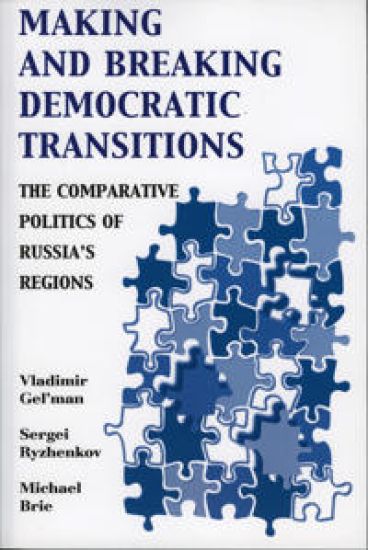
Making and Breaking Democratic Transitions

Making and Breaking Democratic Transitions

Vladimir Gel'man; Sergei Ryzhenkov; Michael Brie; Vladimir Avdonin; Boris Ovchinnikov

Rowman Littlefield Publishers
2005
nidottu
Focusing on the vastly different outcomes of post-Soviet regime transitions, this study explores why some societies have become more democratic and some have not. Based on in-depth comparative analyses, the book assesses political developments in six of Russia's regions (Saratov, Nizhnii Novgorod, Volgograd, Ryazan', Ul'yanovsk, and Tver' oblasts) since 1988. The authors consider the influence of Soviet governance systems on the emergence of cleavages and new actors in the post-Soviet period. They also analyze the impact of institutional changes on regional regimes and the success or failure of formal institutions as a framework for political competitiveness. Placing their detailed field data within the larger comparative and theoretical context of political transitions, the authors are able to explain the mixed outcomes of post-communist regime change in Russia and other post-Soviet nations. With its innovative model of path-contingent democratization and its new typology of political regimes and regime transitions, this book will be essential reading for all scholars of democracy.