

Kirjailija
Michael Cole
Kirjat ja teokset yhdessä paikassa: 70 kirjaa, julkaisuja vuosilta 1981–2026, suosituimpiin kuuluu From Stop Sign to Steel Doors. Vertaile teosten hintoja ja tarkista saatavuus suomalaisista kirjakaupoista.
70 kirjaa
Kirjojen julkaisuvuodet: 1981–2026.

Horace the Hopper
Michael Cole; Grant E. Fetters
Createspace Independent Publishing Platform
2010
nidottu

The Ecology of Human Development
Urie Bronfenbrenner; Michael Cole
Harvard University Press
2006
nidottu
Halvin toimitettuna 44,50 €
Here is a book that challenges the very basis of the way psychologists have studied child development. According to Urie Bronfenbrenner, one of the world’s foremost developmental psychologists, laboratory studies of the child’s behavior sacrifice too much in order to gain experimental control and analytic rigor. Laboratory observations, he argues, too often lead to “the science of the strange behavior of children in strange situations with strange adults for the briefest possible periods of time.” To understand the way children actually develop, Bronfenbrenner believes that it will be necessary to observe their behavior in natural settings, while they are interacting with familiar adults over prolonged periods of time. This book offers an important blueprint for constructing such a new and ecologically valid psychology of development. The blueprint includes a complete conceptual framework for analysing the layers of the environment that have a formative influence on the child. This framework is applied to a variety of settings in which children commonly develop, ranging from the pediatric ward to daycare, school, and various family configurations. The result is a rich set of hypotheses about the developmental consequences of various types of environments. Where current research bears on these hypotheses, Bronfenbrenner marshals the data to show how an ecological theory can be tested. Where no relevant data exist, he suggests new and interesting ecological experiments that might be undertaken to resolve current unknowns. Bronfenbrenner’s groundbreaking program for reform in developmental psychology is certain to be controversial. His argument flies in the face of standard psychological procedures and challenges psychology to become more relevant to the ways in which children actually develop. It is a challenge psychology can ill-afford to ignore.

The Autobiography of Alexander Luria
Michael Cole; Karl Levitin; Alexander R. Luria
Psychology Press
2005
nidottu
Alexander Luria was one of the most influential psychologists of the 20th century. His official autobiography was written as a citizen of the Soviet Union, and while it provides a compelling story of his lifelong devotion to developing a comprehensive theory of the biological and cultural foundations of human nature, it is conspicuous for the absence of information about the social context of his work and his personal struggles to be a decent person in indecent times. The current "dialogic autobiography" brings the vitality of Luria's ideas back to life. Michael Cole and Karl Levitin, both of whom knew Luria well and have written about his life and work, have written a carefully researched introduction and epilogue to the original autobiography. They provide readers, for the first time, with information about the social and personal contexts of Luria's remarkable achievements. Their account is supplemented by downloadable resources with reminiscences of leading psychologists from around the world who knew and worked with Luria. At last, Luria's life and science are brought together in a single volume. The book will appeal to psychologists, neuropsychologists, and other scientists interested in Luria's life achievements.
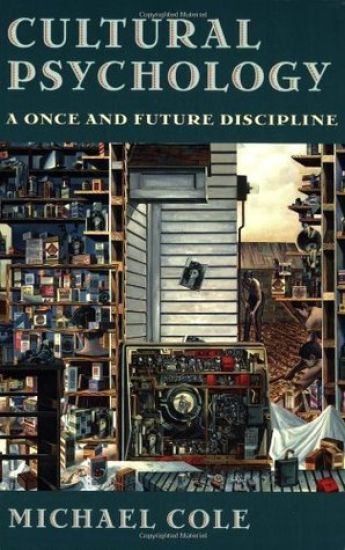
The distinguished psychologist Michael Cole, known for his pioneering work in literacy, cognition, and human development, offers a multifaceted account of what cultural psychology is, what it has been, and what it can be. A rare synthesis of the theory and empirical work shaping the field, this book will become a major foundation for the emerging discipline.
The Construction Zone
Denis Newman; Peg Griffin; Michael Cole
Cambridge University Press
1989
pokkari
In its description of several years of painstaking classroom observations and carefully crafted experimental interventions, the ‘construction zone’ makes clear the cleavage lines between the everyday requirements of classroom teaching and the practice of experimental psychologists. The best intentions of researchers to improve education are often undermined by such differences. The ‘construction zone’ is the shared psychological space within which teachers construct environments for their students’ intellectual development and students construct deeper understandings of the cultural heritage embodied in the curriculum. The core of the book is a set of analyses of children’s developmental changes during classroom lessons and individual tutorials designed to teach basic concepts in such diverse areas as natural science, social studies, and arithmetic. Fusing techniques currently in wide use in microsociology, experimental psychology, and ethnographic studies of the classroom, the authors offer a compelling vision of intellectual development as a process of joint constructive interaction mediated by cultural artifacts. Their approach makes it possible to retain the strength of a developmental perspective which treats intellectual change as a constructive process in the spirit of Piaget, while making it clear that developmental change is simultaneously a social process of cultural transformation as emphasized by Vygotsky and his students.
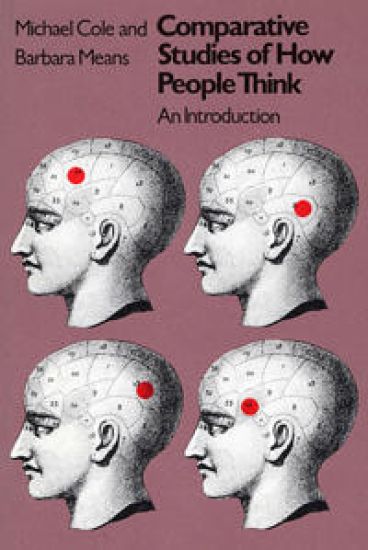
Comparative Studies of How People Think
Michael Cole; Barbara Means
Harvard University Press
1986
nidottu
The psychology of thinking has traditionally been in the business of making comparisons between different groups of people. On the whole, these comparisons have rendered a substantial body of knowledge; but all too often, they have suffered the pitfalls of faulty organizational logic and unfounded or invidious conclusions. In this extraordinarily clear and critical introduction, Michael Cole and Barbara Means out the problems involved in comparing how people think. They show, for example, how variables confounded with the constitution of two groups can lead to the wrong interpretation of group differences. More subtly, they demonstrate how cognitive differences between groups can destroy the equivalence of the tests used to make comparisons. They also discuss the unfortunate way that observed differences between groups have led to prejudicial interpretations in which mental differences are transformed into mental deficits. Cole and Means illustrate all these problems with a rich variety of examples drawn from the research literature in comparative cognition. Because they use real examples. Cole and Means offer much more than the usual banal remedies for improving research design. Instead of merely telling the student to run the right control groups, for example, they show how theory enters into the selection of appropriate controls and how atheoretic comparative work can easily run amok. It is a rare event when seasoned researchers take time to tell the novice how to avoid the problems of previous research. Comparative Studies of How People Think provides just such an event.
Alexander Romanovich Luria, one of the most influential psychologists of the twentieth century, is best known for his pioneering work on the development of language and thought, mental retardation, and the cortical organization of higher mental processes. Virtually unnoticed has been his major contribution to the understanding of cultural differences in thinking. In the early 1930s young Luria set out with a group of Russian psychologists for the steppes of central Asia. Their mission: to study the impact of the socialist revolution on an ancient Islamic cotton-growing culture and, no less, to establish guidelines for a viable Marxist psychology. Lev Vygotsky, Luria's great teacher and friend, was convinced that variations in the mental development of children must be understood as a process including historically determined cultural factors. Guided by this conviction, Luria and his colleagues studied perception, abstraction, reasoning, and imagination among several remote groups of Uzbeks and Kirghiz—from cloistered illiterate women to slightly educated new friends of the central government. The original hypothesis was abundantly supported by the data: the very structure of the human cognitive process differs according to the ways in which social groups live out their various realities. People whose lives are dominated by concrete, practical activities have a different method of thinking from people whose lives require abstract, verbal, and theoretical approaches to reality. For Luria the legitimacy of treating human consciousness as a product of social history legitimized the Marxian dialectic of social development. For psychology in general, the research in Uzbekistan, its rich collection of data and the penetrating observations Luria drew from it, have cast new light on the workings of cognitive activity. The parallels between individual and social development are still being explored by researchers today. Beyond its historical and theoretical significance, this book represents a revolution in method. Much as Piaget introduced the clinical method into the study of children's mental activities, Luria pioneered his own version of the clinical technique for use in cross-cultural work. Had this text been available, the recent history of cognitive psychology and of anthropological study might well have been very different. As it is, we are only now catching up with Luria's procedures.


Understand History's Most Enigmatic Serial KillerIn December of 1968, a serial killer began orchestrating a campaign of terror in the San Francisco Bay Area. Not satisfied with the simple act of murder, he taunted law enforcement and the public by writing letters to local newspapers. Through often cryptic and bizarre content-including four ciphers, three of which have never been solved-the psychopath played a twisted game. Reporters dubbed the man the "Cipher Killer," but the murderer chose a different name for himself: the Zodiac. Eventually, he would claim to have murdered thirty-seven. Law enforcement, however, could only account for five. In 1971, authenticated communications with the Zodiac ceased. The elusive fugitive resurfaced briefly three years later, sending a small number of communiqu s, before disappearing for good. What started out with shocking abruptness slowly dissolved into mysterious uncertainty. To this day, the Zodiac's true identity remains one of the twentieth century's greatest mysteries... In Volume 1 of The Zodiac Revisited, Michael reviews the facts of the case, building a foundation for the analysis that follows in Volumes 2 and 3.