Kirjojen hintavertailu – 12 859 828 kirjaa ja 27 kauppaa

Kirjailija

Michael Curtis

Kirjat ja teokset yhdessä paikassa: 59 kirjaa, julkaisuja vuosilta 1976–2025, suosituimpiin kuuluu How to Write Adventure Modules That Don't Suck. Vertaile teosten hintoja ja tarkista saatavuus suomalaisista kirjakaupoista.

59 kirjaa

Kirjojen julkaisuvuodet: 1976–2025.

Classical Architecture and Monuments of Washington, D.C.: A History & Guide
Classical design formed our nation's capital. The soaring Washington Monument, the columns of the Lincoln Memorial and the spectacular dome of the Capitol Building speak to the founders' comprehensive vision of our federal city. Learn about the L'Enfant and McMillan plans for Washington, D. C., and how those designs are reflected in two hundred years of monuments, museums and representative government. View the statues of our Founding Fathers with the eye of a sculptor and gain insight into the criticism and controversies of modern additions to Washington's monumental structure. Author Michael Curtis guides this tour of the heart of the District of Columbia.
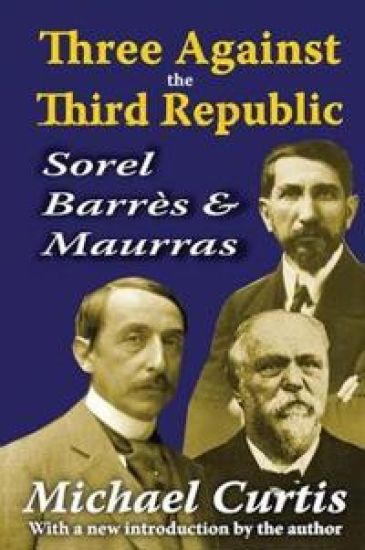
Three Against the Third Republic

Three Against the Third Republic

Michael Curtis

Routledge
2017
sidottu
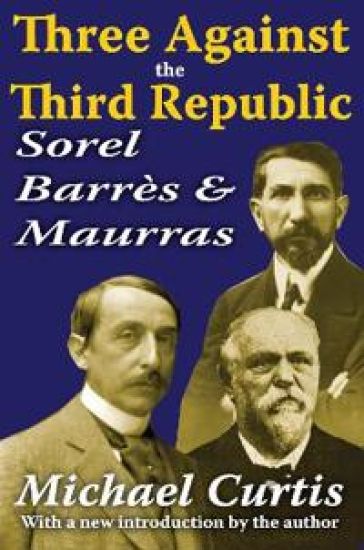
The Third Republic of France was characterized by weak and short-term governments. This book is a study of three writers, Georges Sorel, Maurice Barres, and Charles Maurras, their writings in the years between 1885 and 1914, and their reactions to the deficiencies they saw in the Third Republic and in the system of French democracy. The study begins in 1885 with the appearance of certain new political factors. It ends in 1914 because the three writers had by this time completed their original contributions to the thought of the country, even if not their total impact on France. A relative position of each of these figures in the French political spectrum is deduced from a combination of attitudes toward a number of issues. These include the extent of economic and social reform, centralization of the power of the state, the nature of the parliamentary system, the desirability of political parties, the relation of Church and State, the responsibility of authority, the use of force or coercion, and national power versus international collaboration. Their views span the political spectrum. Sorel, Barres, and Maurras are important not only because they provided the chief ideological weapons for the attack on the regime but also, in a wider context, because they contribute significantly to understanding of a later period of European political history. In their contemporary significance, all three illustrated the various attitudes of the conservative, the .reactionary, and the moralist. The names and parties may have changed but the same ideas continue to impact French politics and western ideology today. This is a key book for an epoch whose importance lingers in current discourse.
Jews, Antisemitism, and the Middle East
Will animosity towards Jews and the State of Israel never end? This book ventures to rectify the misrepresentations, propaganda, obsessions, and falsifications widely disseminated in the media and public discourse, explaining the motivations behind them. The issues Michael Curtis scrutinizes are complicated and controversial, sometimes even baffling, but he reviews them in as objective and rigorous a manner as possible. Curtis divides his arguments into five key areas: political correctness and the obsessive attack on Israel; the surprising and disturbing rise of antisemitism; the Arab world and the Islamist threat; the Palestinian narrative; and the Israeli/Palestinian conflict. The first section focuses on the censorious attitude toward Israel taken by many in the international community. A second section consists of essays on the increase of contemporary antisemitism in Arab and Muslim countries as well as European democracies. In the third section, the author addresses changes in the Arab world, the threat of Iranian ambitions, the new alliance of Sunni Islamist states, and the growing strength and danger of Islamic fundamentalism and extremist behavior. His fourth section, on the Palestinian Narrative, details the acceptance by many critics of Israel and the international media of the Palestinian narrative of victimhood. Finally, the section on the Israeli Palestinian conflict details the continuing struggle within the Middle East between Israelis and Palestinians. This book is a must read for historians, political scientists, Jewish studies scholars, and all those interested in one of the most volatile and controversial regions in the world today.
Three Against the Third Republic

Three Against the Third Republic

Michael Curtis

Princeton University Press
2016
sidottu
This volume is a comparative study of the political thought of three writers who, between 1885 and 1914, were leaders in the counterrevolutionary movement in France. Maurice Barres was a nationalistic conservative; Charles Maurras, a classic reactionary; and Georges Sorel, a moralist and syndicalist. Different though the three men were in their conception of political order, they were in common opposed to liberal democracy as a system of government and to most of the ideology and institutions of the Third Republic. Because of their impact on the generation that guided France before World War I, and because many of their attitudes foreshadow later totalitarian programs, Sorel, Barres and Maurras have a significant place in any assessment of modern European political history. Originally published in 1959. The Princeton Legacy Library uses the latest print-on-demand technology to again make available previously out-of-print books from the distinguished backlist of Princeton University Press. These editions preserve the original texts of these important books while presenting them in durable paperback and hardcover editions. The goal of the Princeton Legacy Library is to vastly increase access to the rich scholarly heritage found in the thousands of books published by Princeton University Press since its founding in 1905.
Three Against the Third Republic

Three Against the Third Republic

Michael Curtis

Princeton University Press
2015
pokkari
This volume is a comparative study of the political thought of three writers who, between 1885 and 1914, were leaders in the counterrevolutionary movement in France. Maurice Barres was a nationalistic conservative; Charles Maurras, a classic reactionary; and Georges Sorel, a moralist and syndicalist. Different though the three men were in their conception of political order, they were in common opposed to liberal democracy as a system of government and to most of the ideology and institutions of the Third Republic. Because of their impact on the generation that guided France before World War I, and because many of their attitudes foreshadow later totalitarian programs, Sorel, Barres and Maurras have a significant place in any assessment of modern European political history. Originally published in 1959. The Princeton Legacy Library uses the latest print-on-demand technology to again make available previously out-of-print books from the distinguished backlist of Princeton University Press. These editions preserve the original texts of these important books while presenting them in durable paperback and hardcover editions. The goal of the Princeton Legacy Library is to vastly increase access to the rich scholarly heritage found in the thousands of books published by Princeton University Press since its founding in 1905.
Jews, Antisemitism, and the Middle East

Jews, Antisemitism, and the Middle East

Michael Curtis

AldineTransaction
2013
sidottu
Will animosity towards Jews and the State of Israel never end? This book ventures to rectify the misrepresentations, propaganda, obsessions, and falsifications widely disseminated in the media and public discourse, explaining the motivations behind them. The issues Michael Curtis scrutinizes are complicated and controversial, sometimes even baffling, but he reviews them in as objective and rigorous a manner as possible. Curtis divides his arguments into five key areas: political correctness and the obsessive attack on Israel; the surprising and disturbing rise of antisemitism; the Arab world and the Islamist threat; the Palestinian narrative; and the Israeli/Palestinian conflict. The first section focuses on the censorious attitude toward Israel taken by many in the international community. A second section consists of essays on the increase of contemporary antisemitism in Arab and Muslim countries as well as European democracies. In the third section, the author addresses changes in the Arab world, the threat of Iranian ambitions, the new alliance of Sunni Islamist states, and the growing strength and danger of Islamic fundamentalism and extremist behavior. His fourth section, on the Palestinian Narrative, details the acceptance by many critics of Israel and the international media of the Palestinian narrative of victimhood. Finally, the section on the Israeli–Palestinian conflict details the continuing struggle within the Middle East between Israelis and Palestinians. This book is a must read for historians, political scientists, Jewish studies scholars, and all those interested in one of the most volatile and controversial regions in the world today.
Simulation in Aviation Training

Simulation in Aviation Training

Florian Jentsch; Michael Curtis

Ashgate Publishing Limited
2011
sidottu
Simulations have been a fixture of aviation training for many years. Advances in simulator technology now enable modern flight simulation to mimic very closely the look and feel of real world flight operations. In spite of this, responsible researchers, trainers, and simulation developers should look beyond mere simulator fidelity to produce meaningful training outcomes. Optimal simulation training development can unquestionably benefit from knowledge and understanding of past, present, and future research in this topic area. As a result, this volume of key writings is invaluable as a reference, to help guide exploration of critical research in the field. By providing a mix of classic articles that stand the test of time, and recent writings that illuminate current issues, this volume informs a broad range of topics relevant to simulation training in aviation.
Three Against the Third Republic

Three Against the Third Republic

Michael Curtis

AldineTransaction
2010
nidottu
The Third Republic of France was characterized by weak and short-term governments. This book is a study of three writers, Georges Sorel, Maurice Barres, and Charles Maurras, their writings in the years between 1885 and 1914, and their reactions to the deficiencies they saw in the Third Republic and in the system of French democracy. The study begins in 1885 with the appearance of certain new political factors. It ends in 1914 because the three writers had by this time completed their original contributions to the thought of the country, even if not their total impact on France. A relative position of each of these figures in the French political spectrum is deduced from a combination of attitudes toward a number of issues. These include the extent of economic and social reform, centralization of the power of the state, the nature of the parliamentary system, the desirability of political parties, the relation of Church and State, the responsibility of authority, the use of force or coercion, and national power versus international collaboration. Their views span the political spectrum. Sorel, Barres, and Maurras are important not only because they provided the chief ideological weapons for the attack on the regime but also, in a wider context, because they contribute significantly to understanding of a later period of European political history. In their contemporary significance, all three illustrated the various attitudes of the conservative, the .reactionary, and the moralist. The names and parties may have changed but the same ideas continue to impact French politics and western ideology today. This is a key book for an epoch whose importance lingers in current discourse.
Orientalism and Islam

Orientalism and Islam

Michael Curtis

Cambridge University Press
2009
sidottu
Through an historical analysis of the theme of Oriental despotism, Michael Curtis reveals the complex positive and negative interaction between Europe and the Orient. The book also criticizes the misconception that the Orient was the constant victim of Western imperialism and the view that Westerners cannot comment objectively on Eastern and Muslim societies. The book views the European concept of Oriental despotism as based not on arbitrary prejudicial observation, but rather on perceptions of real processes and behavior in Eastern systems of government. Curtis considers how the concept developed and was expressed in the context of Western political thought and intellectual history, and of the changing realities in the Middle East and India. The book includes discussion of the observations of Western travelers in Muslim countries and analysis of the reflections of seven major thinkers: Montesquieu, Edmund Burke, Tocqueville, James and John Stuart Mill, Karl Marx, and Max Weber.
Orientalism and Islam

Orientalism and Islam

Michael Curtis

Cambridge University Press
2009
pokkari
Through an historical analysis of the theme of Oriental despotism, Michael Curtis reveals the complex positive and negative interaction between Europe and the Orient. The book also criticizes the misconception that the Orient was the constant victim of Western imperialism and the view that Westerners cannot comment objectively on Eastern and Muslim societies. The book views the European concept of Oriental despotism as based not on arbitrary prejudicial observation, but rather on perceptions of real processes and behavior in Eastern systems of government. Curtis considers how the concept developed and was expressed in the context of Western political thought and intellectual history, and of the changing realities in the Middle East and India. The book includes discussion of the observations of Western travelers in Muslim countries and analysis of the reflections of seven major thinkers: Montesquieu, Edmund Burke, Tocqueville, James and John Stuart Mill, Karl Marx, and Max Weber.
Great Political Theories V.2: A Comprehensive Selection of the Crucial Ideas in Political Philosophy from the French Revolution to Modern Times
This carefully selected compilation of the significant writings of the great political philosophers, scientists, and thinkers has long been an invaluable guide to the general reader as well as to the serious student of history, political science, and government. Such essential forces as Revolution, Idealism, and Nationalism are examined in detail and expounded by their leading exponents. Professor Curtis has written running commentary that places the extracts and their authors in the sequence of modern history.
Great Political Theories, Volume 1: A Comprehensive Selection of the Crucial Ideas in Political Philosophy from the Greeks to the Enlightenment
Volume 1 of the classic anthology of political thought: a comprehensive selection of the crucial ideas in political philosophy from Plato and Aristotle to Locke and MontesquieuAs an introduction to political theory and science, this standout collection of writings by the great philosophers is a must for readers of philosophy. It also forms a basic textbook for students of government and political theory. Such fundamental concepts as Democracy, the Rule of Law, Justice, Natural Rights, Sovereignty, Citizenship, Power, the State, Revolution, Liberty, Reason, Materialism, Toleration, and the Place of Religion in Society are traced from their origins, through their development and changing patterns, to show how they guide political thinking and institutions today. Among the authors in this volume: Sophocles, Plato, Artistotle, Seneca, Marcus Aurelius, Cicero, St. Augustine, Aquinas, Machiavelli, Martin Luther, Calvin, Hobbes, Spinoza, Locke, and Montesquieu.
The Middle East

The Middle East

Michael Curtis

Transaction Publishers
1986
sidottu
The Middle East provides a thematic analysis of major forces and trends in contemporary Middle East and a thorough examination of individual countries in the region. This comprehensive anthology, the first in more than two decades, explores the political environment, religious and ethnic factors, economic factors, the Arab world, the Palestinians and the territories, Israel, the role of the superpowers, and the Middle East's relationship with the rest of the world. Every informed reader will want to consult The Middle East to understand this important and complex area of the world. Contents (partial): William L. Cleveland, "Sources of Arab Nationalism"; Carl Leiden, "Arab Nationalism Today"; Opoku Agyeman, "Pan-Africanism versus Pan-Arabism"; Elbani Hermassi, "The Maghrib and the Middle East Conflict"; Lenore G. Martin, "Boundary Disputes in the Persian Gulf"; Bernard Lewis, "The Return of Islam"; Daniel Pipes, "Understanding Islam in Politics"; Emanuel Gutmann, "Religion and Its Role in National Integration in Israel"; George Moutafakis, "Minorities in the Modern Middle East Societies"; Stuart E. Colie, "The Shiites and the Lebanese Tragedy"; Kenneth J. Arrow, "Energy"; Fred M. Gottheil, "Saudi Arabian Economic Power"; Eliyahu Kanovsky, "Arab Oil Power"; Victor T. Le Vine, "The Arab World in the 1980s"; Bernard Lewis, "Islamic Political Movements"; Raymond N. Habiby and Fariborz Ghavidel, "Khumayni's Islamic Republic"; James P. Jankowski, "Nationalism in Twentieth Century Egypt"; Sheikh R. Ali, "The Iran-Iraq War"; Raymond N. Habiby, "Quadhafi's New Islamic Scientific Socialist Society"; Moshe Aumann, "Land Ownership in Palestine"; Fred M. Gottheil, "Arab Immigration into Pre-State Israel"; Yehoshua Porat, "The Palestinian-Arab Nationalist Movement"; Yonah Alexander, "The Nature of the PLO"; Sammy Smooha and John E. Hofrnan, "Arab-Jewish Coexistence in Israel"; Michael Curtis, "The Evolution of Israeli Politics"; Aaron S. Klieman, "Zionist Diplomacy and Israeli Foreign Policy"; Jay Adams, "Assessing Israel as a 'Strategist Asset'"; Saul B. Cohen, "Jerusalem's Unity and West Bank Autonomy"; Meron Benvenisti, "Postive Thinking in Jerusalem"; Steven L. Spiegel, "Recent American Policy in the Middle East"; Alan Dowty, "U. S. Decision-Making in Middle East Crises"; Michael Curtis, "American Interest and the Middle East"; Aaron Wildavsky, "American's National Interest in Israel"; Adam M. Garfinkle, "U. S. Policy in the Near Term"; James R. Kurth, "U. S. Policy and the West Bank"; Alvin Z. Rubinstein, "The Soviet Union's Imperial Policy in the Middle East"; Michael Curtis, "Africa, Israel, and the Middle East"; Victor T. Le Vine, "The Arabs and Africa"; W. Howard Wriggins, "South Asia and the Gulf"; Roy Licklide, "Arab Oil and Japanese Foreign Policy"; Linda B. Miller, "Western Europe and the Middle East"; Dan V. Segre, "Israel and the Third World."