Kirjojen hintavertailu – 12 903 725 kirjaa ja 27 kauppaa

Kirjailija

Michael D. Kennedy

Kirjat ja teokset yhdessä paikassa: 6 kirjaa, julkaisuja vuosilta 1991–2014, suosituimpiin kuuluu Introducing Geographic Information Systems with ArcGIS. Vertaile teosten hintoja ja tarkista saatavuus suomalaisista kirjakaupoista.

6 kirjaa

Kirjojen julkaisuvuodet: 1991–2014.

Globalizing Knowledge

Globalizing Knowledge

Michael D. Kennedy

Stanford University Press
2014
pokkari
Heralding a push for higher education to adopt a more global perspective, the term "globalizing knowledge" is today a popular catchphrase among academics and their circles. The complications and consequences of this desire for greater worldliness, however, are rarely considered critically. In this groundbreaking cultural-political sociology of knowledge and change, Michael D. Kennedy rearticulates questions, approaches, and case studies to clarify intellectuals' and institutions' responsibilities in a world defined by transformation and crisis. Globalizing Knowledge introduces the stakes of globalizing knowledge before examining how intellectuals and their institutions and networks shape and are shaped by globalization and world-historical events from 2001 through the uprisings of 2011–13. But Kennedy is not only concerned with elaborating how wisdom is maintained and transmitted, he also asks how we can recognize both interconnectedness and inequalities, and possibilities for more knowledgeable change within and beyond academic circles. Subsequent chapters are devoted to issues of public engagement, the importance of recognizing difference and the local's implication in the global, and the specific ways in which knowledge, images, and symbols are shared globally. Kennedy considers numerous case studies, from historical happenings in Poland, Kosova, Ukraine, and Afghanistan, to today's energy crisis, Pussy Riot, the Occupy Movement, and beyond, to illuminate how knowledge functions and might be used to affect good in the world.
Globalizing Knowledge

Globalizing Knowledge

Michael D. Kennedy

Stanford University Press
2014
sidottu
Heralding a push for higher education to adopt a more global perspective, the term "globalizing knowledge" is today a popular catchphrase among academics and their circles. The complications and consequences of this desire for greater worldliness, however, are rarely considered critically. In this groundbreaking cultural-political sociology of knowledge and change, Michael D. Kennedy rearticulates questions, approaches, and case studies to clarify intellectuals' and institutions' responsibilities in a world defined by transformation and crisis. Globalizing Knowledge introduces the stakes of globalizing knowledge before examining how intellectuals and their institutions and networks shape and are shaped by globalization and world-historical events from 2001 through the uprisings of 2011–13. But Kennedy is not only concerned with elaborating how wisdom is maintained and transmitted, he also asks how we can recognize both interconnectedness and inequalities, and possibilities for more knowledgeable change within and beyond academic circles. Subsequent chapters are devoted to issues of public engagement, the importance of recognizing difference and the local's implication in the global, and the specific ways in which knowledge, images, and symbols are shared globally. Kennedy considers numerous case studies, from historical happenings in Poland, Kosova, Ukraine, and Afghanistan, to today's energy crisis, Pussy Riot, the Occupy Movement, and beyond, to illuminate how knowledge functions and might be used to affect good in the world.

Introducing Geographic Information Systems with ArcGIS

Introducing Geographic Information Systems with ArcGIS

Michael D. Kennedy; Jack Dangermond; Michael F. Goodchild

John Wiley Sons Inc
2013
muu
An integrated approach that combines essential GIS background with a practical workbook on applying the principles in ArcGIS 10.0 and 10.1 Introducing Geographic Information Systems with ArcGISintegrates a broad introduction to GIS with a software-specific workbook for Esri's ArcGIS. Where most courses make do using two separate texts, one covering GIS and another the software, this book enables students and instructors to use a single text with an integrated approach covering both in one volume with a common vocabulary and instructional style. This revised edition focuses on the latest software updates—ArcGIS 10.0 and 10.1. In addition to its already successful coverage, the book allows students to experience publishing maps on the Internet through new exercises, and introduces the idea of programming in the language Esri has chosen for applications (i.e., Python). A DVD is packaged with the book, as in prior editions, containing data for working out all of the exercises. This complete, user-friendly coursebook: Is updated for the latest ArcGIS releases—ArcGIS 10.0 and 10.1Introduces the central concepts of GIS and topics needed to understand spatial information analysisProvides a considerable ability to operate important tools in ArcGISDemonstrates new capabilities of ArcGIS 10.0 and 10.1Provides a basis for the advanced study of GIS and the study of the newly emerging field of GIScience Introducing Geographic Information Systems with ArcGIS, Third Edition is the ideal guide for undergraduate students taking courses such as Introduction to GIS, Fundamentals of GIS, and Introduction to ArcGIS Desktop. It is also an important guide for professionals looking to update their skills for ArcGIS 10.0 and 10.1.
Professionals, Power and Solidarity in Poland

Professionals, Power and Solidarity in Poland

Michael D. Kennedy

Cambridge University Press
2008
pokkari
The Solidarity movement of the early 1980s not only triggered a transformation in Polish society, it forced a fundamental reconsideration of the nature of socialism throughout the Soviet Union and Eastern Europe. Seen as one of the most important social movements of the twentieth century, Michael Kennedy develops a theoretical conception of Soviet-type societies by analysing Solidarity's significance. He explains the background to the nature of the conflict between Solidarity and the authorities and considers the implications of Solidarity's struggle for the theory of the Soviet-type system's reproduction and transformation. Then, the internal constitution of Solidarity in terms of gender and, in particular, cross-class alliances is examined, which is followed by the implications of his analysis both for understanding perestroika in the Soviet Union and more generally for reformulating a critical sociology of Soviet-type societies.
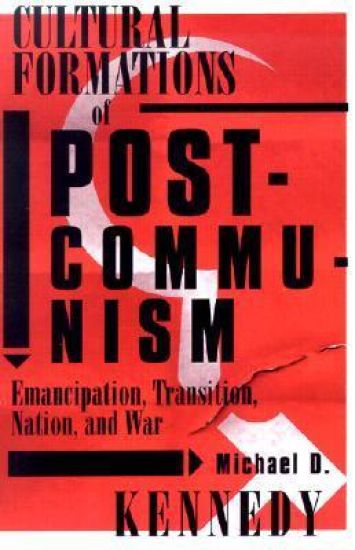
Cultural Formations Of Postcommunism

Cultural Formations Of Postcommunism

Michael D. Kennedy

University of Minnesota Press
2002
nidottu
A powerful exposition of how culture shapes social and political change." Transition" is the name typically given to the time of radical change following the fall of communism, connoting a shift from planned to market economy, from dictatorship to democracy. Transition is also, in Michael Kennedy’s analysis, a culture in its own right-with its own contentions, repressions, and unrealized potentials. By elaborating transition as a culture of power and viewing it in its complex relation to emancipation, nationalism, and war, Kennedy’s book clarifies the transformations of postcommunism as well as, more generally, the ways in which culture articulates social change. This ambitious work is, in effect, a nuanced critical-cultural sociology of change. Kennedy examines transition culture’s historical foundation by looking at the relationship among perestroika, Poland, and Hungary, and considers its structure and practice in the following decade across fields and nations. His wide-ranging analysis-of the artifacts of transition culture’s proponents, of interviews with providers and recipients of technical assistance in business across Eastern Europe, and of focus groups assessing the successes and failures of social change in Estonia and Ukraine-suggests a transition culture deeply implicated in nationalism. But this association, Kennedy contends, is not necessarily antithetical to transition’s emancipation. By reconsidering transition culture’s relationship to the Wars of Yugoslav Succession and communism’s negotiated collapse in Poland and Hungary, he shows how transition might be reconceived in terms of solidarity, freedom, and peace. Distinguished by its focus on culture, not only within particular nations but in the transnational community organized around transition, this book will help reframe the debate about postcommunist social change.
Professionals, Power and Solidarity in Poland

Professionals, Power and Solidarity in Poland

Michael D. Kennedy

Cambridge University Press
1991
sidottu
The Solidarity movement of the early 1980s not only triggered a transformation in Polish society, it forced a fundamental reconsideration of the nature of socialism throughout the Soviet Union and Eastern Europe. Seen as one of the most important social movements of the twentieth century, Michael Kennedy develops a theoretical conception of Soviet-type societies by analysing Solidarity's significance. He explains the background to the nature of the conflict between Solidarity and the authorities and considers the implications of Solidarity's struggle for the theory of the Soviet-type system's reproduction and transformation. Then, the internal constitution of Solidarity in terms of gender and, in particular, cross-class alliances is examined, which is followed by the implications of his analysis both for understanding perestroika in the Soviet Union and more generally for reformulating a critical sociology of Soviet-type societies.