Kirjojen hintavertailu – 12 859 818 kirjaa ja 27 kauppaa

Kirjailija

Michael Dumper

Kirjat ja teokset yhdessä paikassa: 6 kirjaa, julkaisuja vuosilta 1997–2020, suosituimpiin kuuluu Jerusalem Unbound. Vertaile teosten hintoja ja tarkista saatavuus suomalaisista kirjakaupoista.

6 kirjaa

Kirjojen julkaisuvuodet: 1997–2020.

Power, Piety, and People

Power, Piety, and People

Michael Dumper

Columbia University Press
2020
sidottu
Conflicts in cities that have particular religious significance often become intense, protracted, and violent. Why are holy cities so frequently contested, and how can these conflicts be mediated and resolved? In Power, Piety, and People, Michael Dumper explores the causes and consequences of contemporary conflicts in holy cities. He explains how common features of holy cities, such as powerful and autonomous religious hierarchies, income from religious endowments, the presence of sacred sites, and the performance of ritual activities that affect other communities, can combine to create tension. Power, Piety, and People offers five case studies of important disputes, beginning with Jerusalem, often seen as the paradigmatic example of a holy city in conflict. Dumper also discusses Córdoba, where the Islamic history of its Mosque-Cathedral poses challenges to the control exercised by the Roman Catholic Church; Banaras, where competing Muslim and Hindu claims to sacred sites threaten the fragile equilibrium that exists in the city; Lhasa, where the Communist Party of China severely restricts the ancient practice of Tibetan Buddhism; and George Town in Malaysia, a rare example of a city with many different religious communities whose leaders have successfully managed intergroup conflicts. Applying the lessons drawn from these cities to a broader global urban landscape, this book offers scholars and policy makers new insights into a pervasive category of conflict that often appears intractable.
Power, Piety, and People

Power, Piety, and People

Michael Dumper

Columbia University Press
2020
pokkari
Conflicts in cities that have particular religious significance often become intense, protracted, and violent. Why are holy cities so frequently contested, and how can these conflicts be mediated and resolved? In Power, Piety, and People, Michael Dumper explores the causes and consequences of contemporary conflicts in holy cities. He explains how common features of holy cities, such as powerful and autonomous religious hierarchies, income from religious endowments, the presence of sacred sites, and the performance of ritual activities that affect other communities, can combine to create tension. Power, Piety, and People offers five case studies of important disputes, beginning with Jerusalem, often seen as the paradigmatic example of a holy city in conflict. Dumper also discusses Córdoba, where the Islamic history of its Mosque-Cathedral poses challenges to the control exercised by the Roman Catholic Church; Banaras, where competing Muslim and Hindu claims to sacred sites threaten the fragile equilibrium that exists in the city; Lhasa, where the Communist Party of China severely restricts the ancient practice of Tibetan Buddhism; and George Town in Malaysia, a rare example of a city with many different religious communities whose leaders have successfully managed intergroup conflicts. Applying the lessons drawn from these cities to a broader global urban landscape, this book offers scholars and policy makers new insights into a pervasive category of conflict that often appears intractable.
Jerusalem Unbound

Jerusalem Unbound

Michael Dumper

Columbia University Press
2014
sidottu
Jerusalem's formal political borders reveal neither the dynamics of power in the city nor the underlying factors that make an agreement between Israel and the Palestinians so difficult. The lines delineating Israeli authority are frequently different from those delineating segregated housing or areas of uneven service provision or parallel national electoral districts of competing educational jurisdictions. In particular, the city's large number of holy sites and restricted religious compounds create enclaves that continually threaten to undermine the Israeli state's authority and control over the city. This lack of congruity between political control and the actual spatial organization and everyday use of the city leaves many areas of occupied East Jerusalem in a kind of twilight zone where citizenship, property rights, and the enforcement of the rule of law are ambiguously applied. Michael Dumper plots a history of Jerusalem that examines this intersecting and multileveled matrix and, in so doing, is able to portray the constraints on Israeli control over the city and the resilience of Palestinian enclaves after forty-five years of Israeli occupation. Adding to this complex mix is the role of numerous external influences-religious, political, financial, and cultural-so that the city is also a crucible for broader contestation. While the Palestinians may not return to their previous preeminence in the city, neither will Israel be able to assert a total and irreversible dominance. His conclusion is that the city will not only have to be shared but that the sharing will be based upon these many borders and the interplay between history, geography, and religion.
The Struggle for Jerusalem's Holy Places

The Struggle for Jerusalem's Holy Places

Wendy Pullan; Maximilian Sternberg; Lefkos Kyriacou; Craig Larkin; Michael Dumper

Routledge
2013
sidottu
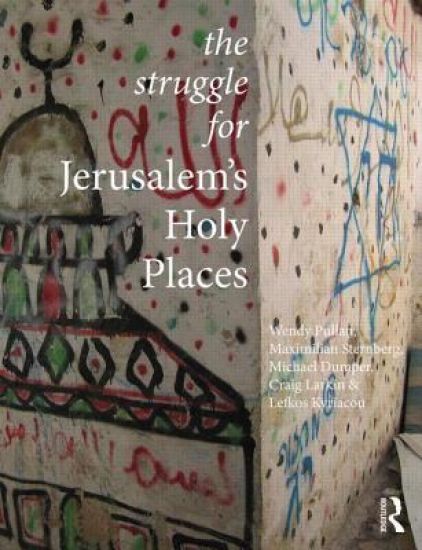
The Struggle for Jerusalem’s Holy Places investigates the role of architecture and urban identity in relation to the political economy of the city and its wider state context seen through the lens of the holy places. Reflecting the broad disciplinary backgrounds of the authors, this book provides perspectives from architecture, urbanism, and politics, and provides in-depth investigations of historical, ethnographic and policy-related case studies. The research is substantiated by fieldwork carried out in Jerusalem over the past ten years as part of the ESRC Large Grants project ‘Conflict in Cities’. By analysing new dynamics of radicalisation through land seizure, the politicisation of parklands and tourism, the strategic manipulation of archaeological and historical narratives and material culture, and through examination of general appropriation of Jerusalem’s varied rituals, memories and symbolism for factional uses, the book reveals how possibilities of co- existence are seriously threatened in Jerusalem. Shedding new light on the key role played by everyday urban life and its spatial settings for any future political agreements about the city and its religious sites, this book is a useful reference work for students and scholars of Middle East Studies, Architecture, Religion and Urban Studies.
The Struggle for Jerusalem's Holy Places

The Struggle for Jerusalem's Holy Places

Wendy Pullan; Maximilian Sternberg; Lefkos Kyriacou; Craig Larkin; Michael Dumper

Routledge
2013
nidottu
The Struggle for Jerusalem’s Holy Places investigates the role of architecture and urban identity in relation to the political economy of the city and its wider state context seen through the lens of the holy places. Reflecting the broad disciplinary backgrounds of the authors, this book provides perspectives from architecture, urbanism, and politics, and provides in-depth investigations of historical, ethnographic and policy-related case studies. The research is substantiated by fieldwork carried out in Jerusalem over the past ten years as part of the ESRC Large Grants project ‘Conflict in Cities’. By analysing new dynamics of radicalisation through land seizure, the politicisation of parklands and tourism, the strategic manipulation of archaeological and historical narratives and material culture, and through examination of general appropriation of Jerusalem’s varied rituals, memories and symbolism for factional uses, the book reveals how possibilities of co- existence are seriously threatened in Jerusalem. Shedding new light on the key role played by everyday urban life and its spatial settings for any future political agreements about the city and its religious sites, this book is a useful reference work for students and scholars of Middle East Studies, Architecture, Religion and Urban Studies.