Kirjojen hintavertailu – 12 903 725 kirjaa ja 27 kauppaa

Kirjailija

Michael Eldred

Kirjat ja teokset yhdessä paikassa: 15 kirjaa, julkaisuja vuosilta 2009–2024, suosituimpiin kuuluu Critique of Competitive Freedom and the Bourgeois-Democratic State: Outline of a Form-Analytic Extension of Marx's Uncompleted System. Vertaile teosten hintoja ja tarkista saatavuus suomalaisista kirjakaupoista.

15 kirjaa

Kirjojen julkaisuvuodet: 2009–2024.

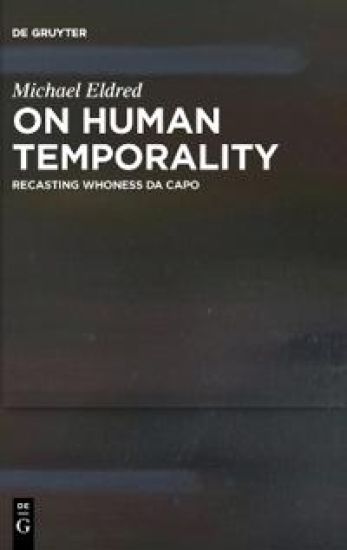
On Human Temporality

On Human Temporality

Michael Eldred

De Gruyter
2024
sidottu
Eldred offers a remedy to the consequences of ancient Greek misconceptions of time that are also entrenched in today’s mathematized physics. Here time is spatialized as the one-dimensionally linear ‘arrow of time’ for the sake of predicting and controlling movement. But such spatialized time distorts the phenomenon of time itself. An alternative, hermeneutic-phenomenological path begins with a pre-spatial concept of time that is genuinely three-dimensional. This paves the way for recasting who we are as humans in belonging, first of all, to the free openness of 3D-temporality. This belonging enables temporally 3D-vision of the psyche that empowers us to see movement at all and reconcile its inherent contradictoriness. We are then also able to conceive ourselves no longer merely as internally cogitating, self-conscious subjects, but as engaged existentially in temporally 3D-interplay, mutually estimating and esteeming who we are. This unpredictable interplay is constrained, however, by being played out in the sociating medium of thingified value, the accumulative movement of thingified value having gained the upper hand in dictating our life-movements as well as our interplay with the earth.
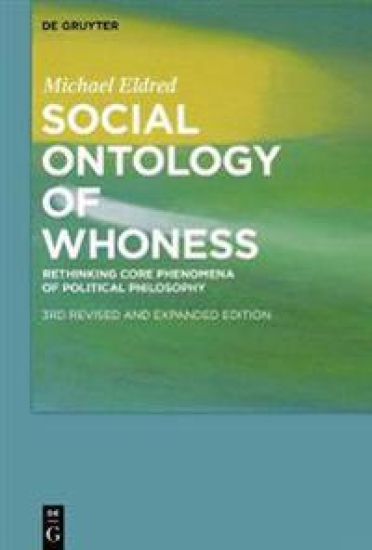
Social Ontology of Whoness

Social Ontology of Whoness

Michael Eldred

De Gruyter
2021
isokokoinen pokkari
How are core social phenomena to be understood as modes of being? This book offers an alternative approach to social ontology. Recent interest in social ontology on the part of mainstream philosophy and the social sciences presupposes from the outset that the human being can be cast as a conscious subject whose intentionality can be collective. By contrast, the present study insistently poses the crucial question of who the human being is and how they sociate as whos. Such whoness is a clean-cut departure from the venerable tradition of questioning whatness (quidditas, essence) in philosophical thinking. Casting human being hermeneutically as whoness opens up new insights into how human beings sociate in interplays of mutual estimation that are simultaneously social power plays. Hitherto, the ontology of social power in all its various guises, has only ever been implicit. This book makes it explicit. The kind of social power prevalent in capitalist societies is that of the reified value embodied in commodities, money, capital, &c. Reified value itself is constituted through an interplay of mutual estimation among things that reflects back on the power interplay among whos. In this way a new critique of capitalism becomes possible.
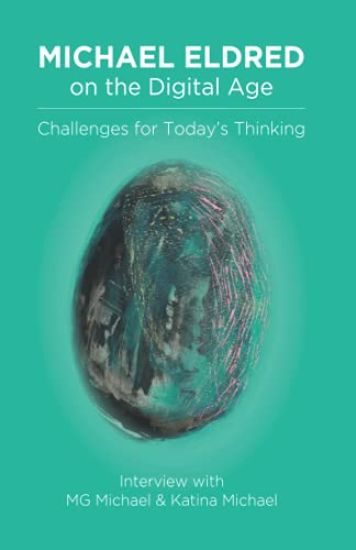
Michael Eldred on the Digital Age

Michael Eldred on the Digital Age

Michael Eldred

Mk Press, Wollongong, Nsw, Australia
2021
pokkari
This little book takes on a series of questions posed by M. G. Michael and Katina Michael. The responses are not conclusive, but rather intended to make the profound challenges presented by the Digital Age visible. These include: How does consciousness differ from psyche? What is the relationship between Artificial Intelligence and the mind? How are visions of transhumanism to be assessed? Why is it important to distinguish between 'what' and 'who'? Who are we to become in the cyberworld? How do the cyberworld and the gainful game of capitalism intermesh? Are ubiquitous surveillance, berveillance and the loss of privacy inevitable in the Digital Age? Are questions of ethics questions of power? It is commonplace to say that today we are living in the Digital Age. This period is characterized by the advent of the cyberworld that is populated by bit-strings of data being processed by algorithms. Algorithms themselves are also nothing other than bit-strings composed of binary digits, i.e., zeroes and ones. The result is a third bit-string that triggers an effect either within the cyberworld or outside, in our old, familiar, physical world. The effect could be to send off an e-mail from one electronic server to the digital address of another, a receiving electronic server. Or it could be the command to launch a deadly missile into the sky. The elementary processing unit at the very core of the cyberworld is the Universal Turing Machine that has algorithms copulate with digital data to produce effective offspring. Such a machine does not exist anywhere as a real, physical thing but is 'merely' an idea, a mathematical idea that has turned out to be immensely powerful. This idea of a cyberworld inhabited by Universal Turing Machines has materialized within a very few decades to make a digital world with which we have to contend every day. For the algorithms now rule our lives. They enable us to do many things, and prevent us just as much from doing other things. Wrongly coded algorithms can wreak havoc in people's lives. Other algorithms enable life-saving surgery to be performed with hitherto unknown precision. So is it just a matter of weighing up the pros and cons of what the cyberworld has to offer us? Or are we challenged to think more deeply about just what this cyberworld is and what is driving it? Techniques and technologies have been known for millennia all over the world, but the idea of what technology is was interrogated by Greek philosophy. The very conception of what is understood in the West as knowledge is tied to and intimately interwoven with how the Greeks understood technology, the art of making things: A skilful power, the know-how, acts upon material to produce an effect. Technology is effective This is seemingly a trivial observation hardly worth mentioning. But what seems trivial is the hallmark of philosophical questions that open up abysses for the mind to fathom. What lies hidden behind the idea of effective knowledge is the unbounded will to power over every conceivable kind of movement and change. Is the cyberworld that is today increasingly encroaching upon and becoming a surrogate for the physical world in countless ways the consummation of this absolute, effective will to power over movement? Are the algorithms the digital encoding of an understanding of one sort of movement that is outsourced from our mind to the cyberworld to produce effects, to steer movements, for better or for worse? Are the algorithms the digitization of our logical understanding in which the logos itself has been encoded as a digital bit-string and now operates autonomously out there in the cyberworld, only seemingly still under our control?
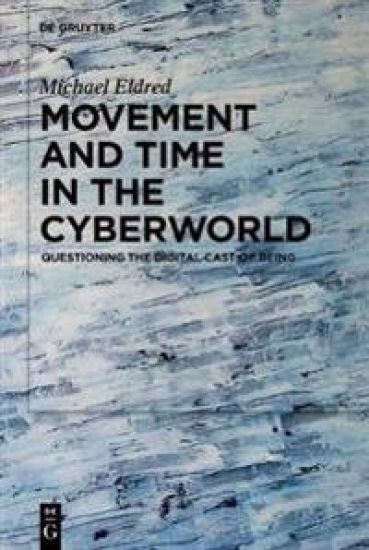
Movement and Time in the Cyberworld

Movement and Time in the Cyberworld

Michael Eldred

De Gruyter
2019
sidottu
The cyberworld fast rolling in and impacting every aspect of human living on the globe today presents an enormous challenge to humankind. It is taken up by the media following current events through to all kinds of natural- and social-scientific discourses. Digitized technoscience develops at a breakneck pace in all areas accompanied by sociological analysis. What is missing is a philosophical response genuinely posing the basic ontological question: What is a digital being's peculiar mode of being? The present study offers a digital ontology that analyzes the dissolution of beings into bit-strings, driven by mathematized science. The mathematization of knowledge reaches back to Pythagoras, Plato and Aristotle, and continues with Descartes, Galileo, Newton, Leibniz. Western knowledge from its inception has always been driven by an unbridled will to efficient-causal power over all kinds of movement and change. This historical trajectory culminates in the universal Turing machine that enables efficient, automated, algorithmic control over the movement of digital beings through the cyberworld. The book fills in the ontological foundations underpinning this brave new cyberworld and interrogates them, especially by questioning the millennia-old conception of 1D-linear time. An alternative ontology of movement arises, based on a radically alternative conception of 3D-time.
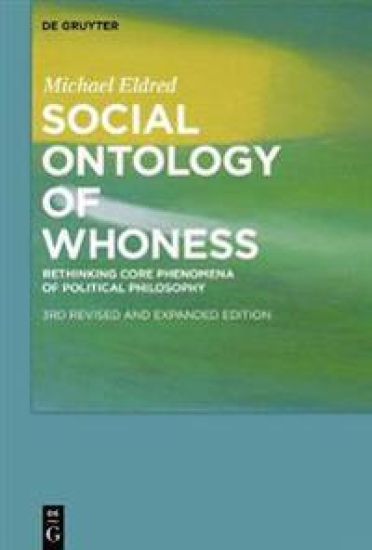
Social Ontology of Whoness

Social Ontology of Whoness

Michael Eldred

De Gruyter
2018
sidottu
How are core social phenomena to be understood as modes of being? This book offers an alternative approach to social ontology. Recent interest in social ontology on the part of mainstream philosophy and the social sciences presupposes from the outset that the human being can be cast as a conscious subject whose intentionality can be collective. By contrast, the present study insistently poses the crucial question of who the human being is and how they sociate as whos. Such whoness is a clean-cut departure from the venerable tradition of questioning whatness (quidditas, essence) in philosophical thinking. Casting human being hermeneutically as whoness opens up new insights into how human beings sociate in interplays of mutual estimation that are simultaneously social power plays. Hitherto, the ontology of social power in all its various guises, has only ever been implicit. This book makes it explicit. The kind of social power prevalent in capitalist societies is that of the reified value embodied in commodities, money, capital, & co. Reified value itself is constituted through an interplay of mutual estimation among things that reflects back on the power interplay among whos. In this way a new critique of capitalism becomes possible.
Entständigung: Philosophische Aufsätze

Entständigung: Philosophische Aufsätze

Michael Eldred

Createspace Independent Publishing Platform
2015
nidottu
Der Titel Entst ndigung soll anzeigen, da in unserer Zeit berall die Vollendung und die Grenzen des abendl ndischen Logos - was er an Seiendem, Mensch und Welt in Bewegung gesetzt und zu Stande gebracht hat - zumindest f r das ph nomenologisch-hermeneutische Denken sichtbar geworden sind. Diese Aufs tze von den sp ten 1980er und fr hen 1990er Jahren legen die Grundlage f r das, was sp ter kommt. Die Auseinandersetzungen mit Aristoteles und Heidegger stehen im Zentrum, wobei unter dem Titel Der Mann ein erster Versuch einer Ph nomenologie des Werseins, der den Hintergrund f r diese Arbeiten bildete, damals bereits vorlag. Die beiden letzten Aufs tze stellten sich mit der Zeit als die ersten in einer Reihe heraus, die sich von verschiedenen Ans tzen her dem Ph nomen Musik n hert. All diese unerl lichen Erkundungen zahlten sich sp ter aus; diese Grundsteine, weiter bearbeitet, gedreht und elaboriert, fanden ihren jeweiligen Platz im sp teren Denken des Autors. R ckblickend ist zu sehen, wie langsam das Denken sich ent-wickelt. Oft ist es blo ein einziges neues Wort, das - nun als Begriff verwendet - den Blick auf das betreffende Ph nomen verschiebt und es so in einem anderen, reicheren und klareren Licht erscheinen l t.
Kapital und Technik: Marx und Heidegger

Kapital und Technik: Marx und Heidegger

Michael Eldred

Createspace Independent Publishing Platform
2015
nidottu
Heidegger und Marx in der ganzen Radikalit t ihres jeweiligen Denkens zusammenzuf hren, hei t, den Versuch zu unternehmen, welches Licht das Genie des einen Philosophen auf die jeweiligen blinden Flecken des anderen wirft, insbesondere im Hinblick auf die Fragen: Was ist Technik? Was ist Kapital? Heidegger geht auf die Suche nach dem Wesen der Technik, wobei er dieses letztendlich im Begriff des Ge-Stells artikuliert. Das Ge-Stell ist die geschichtlich-hermeneutische Konstellation des Seins ALS welches das Seiende im Ganzen im vollendeten technologischen Zeitalter sich pr sentiert. Bei dieser Wesensbestimmung der Technik geht Heidegger irrigerweise so vor, da er Marxens Wesensbestimmung des Kapitals unter das Paradigma der Produktion subsumiert. Marx jedoch denkt das Wesen des Kapitals ALS den sich vermehrenden Kreislauf des verdinglichten Werts, wobei der Wert ein Ph nomen ist, das in erster Linie mit dem Tausch und nicht mit der Produktion zu tun hat. Der Wert ist eine geschichtliche Weise der Vergesellschaftung, der durch das Wechselspiel des gegenseitigen Wertsch tzens auf allerlei Arten von M rkten zustandekommt. Diese Gedankenlinie f hrt letztlich zur Wesensbestimmung des Kapitals als diejenige geschichtlich-hermeneutische Konstellation des Seins, in der das Seiende im Ganzen sich berall allen Spielern im Gewinn-Spiel ALS wertvoll pr sentiert. Aufgabe wird es dann zu durchdenken, wie sich diese beiden Konstellationen des Seins - das Ge-Stell und das Gewinn-Spiel - im Ge-Griff verzahnen. Erst so kann die geschichtliche Lage in unserem Zeitalter klar ans Licht kommen, damit diejenigen, die dieses Zeitalter durchleben und -leiden - wir -, eine unerl liche sozio-ontologische Orientierung gewinnen.
The Land of Matta: A philosophical, quantum-mechanical phantasy

The Land of Matta: A philosophical, quantum-mechanical phantasy

Michael Eldred

Createspace Independent Publishing Platform
2015
nidottu
A fantasy in the sense of Alice in Wonderland, but not for children. It's cock-and-bull like Tristram Shandy, but without the digressions. It's satire in the tradition of Gulliver's Travels, but the satire is on modern science. The humour is British, like the Goons or Monty Python. The protagonists are two young students, Phi and Psi, finding their way in life. In Book I, In Quest of Mu, they go in search, in search of the ancient Mu, a philosophical refugee from Athens to Upper Matta. Mu himself is on a philosophical quest to answer his guiding question, Why is there movement at all, rather than standstill? In Book II, The Way Back to Anaxaton, the main character turns out to be the mysterious Willy P., the power behind the scenes. Matta stands for 'mathematics', but there are no formulae, only a more or less playful, historical treatment of maths along with a couple of Greek symbols. The quantum mechanics is accurate, but blown up to fantastic proportions with fun-loving, unbridled literary licence. This makes it look superficially like sci-fi, but it's subtler. The philosophical strand is substantial, but presented narratively and playfully camouflaged. The presentation is tongue-in-cheek, so the reader constantly has to decide at each point whether it's serious sense or straight-faced nonsense. Usually it's both. It has some quasi-Platonic dialogue, and the whole is borne by philosophical questions subversively at work in the background. Its companion philosophical volume is A Question of Time: An Alternative Cast of Mind (2015).
Social Ontology

Social Ontology

Michael Eldred

De Gruyter
2013
sidottu
Freedom, value, power, justice, government, legitimacy are major themes of the present inquiry. It explores the ontological structure of human beings associating with one another, the basic phenomenon of society. We human beings strive to become who we are in an ongoing power interplay with each other. Thinkers called as witnesses include Plato, Aristotle, Anaximander, Protagoras, Hobbes, Locke, Adam Smith, Hegel, Marx, Schopenhauer, Heidegger, Schumpeter, Hayek, Schmitt, Ernst Jünger, et al.
Digital Whoness

Digital Whoness

Rafael Capurro; Michael Eldred; Daniel Nagel

De Gruyter
2012
sidottu
The first aim is to provide well-articulated concepts by thinking through elementary phenomena of today’s world, focusing on privacy and the digital, to clarify who we are in the cyberworld — hence a phenomenology of digital whoness. The second aim is to engage critically, hermeneutically with older and current literature on privacy, including in today’s emerging cyberworld. Phenomenological results include concepts of i) self-identity through interplay with the world, ii) personal privacy in contradistinction to the privacy of private property, iii) the cyberworld as an artificial, digital dimension in order to discuss iv) what freedom in the cyberworld can mean, whilst not neglecting v) intercultural aspects and vi) the EU context.
The Digital Cast of Being

The Digital Cast of Being

Michael Eldred

De Gruyter
2009
sidottu
We live today surrounded by countless digital gadgets and navigate through cyberspace as if it were the most natural thing in the world. This digital cast of being, however, comes from a long history of philosophical and mathematical thinking in which the Western will to productive power over movement has attained its consummation. This study traces the digital dissolution of beings from the Pythagoreans, Plato and Aristotle's ontology via Cartesian mathematical science through to our digitized economy and telecommunications. With an appendix reinterpreting quantum mechanical indeterminacy phenomenologically.