Kirjojen hintavertailu – 12 903 725 kirjaa ja 27 kauppaa

Kirjailija

Michael Epperson

Kirjat ja teokset yhdessä paikassa: 4 kirjaa, julkaisuja vuosilta 2004–2015, suosituimpiin kuuluu Foundations of Relational Realism. Vertaile teosten hintoja ja tarkista saatavuus suomalaisista kirjakaupoista.

4 kirjaa

Kirjojen julkaisuvuodet: 2004–2015.

Foundations of Relational Realism

Foundations of Relational Realism

Michael Epperson; Elias Zafiris

Lexington Books
2015
nidottu
If there is a central conceptual framework that has reliably borne the weight of modern physics as it ascends into the twenty-first century, it is the framework of quantum mechanics. Because of its enduring stability in experimental application, physics has today reached heights that not only inspire wonder, but arguably exceed the limits of intuitive vision, if not intuitive comprehension. For many physicists and philosophers, however, the currently fashionable tendency toward exotic interpretation of the theoretical formalism is recognized not as a mark of ascent for the tower of physics, but rather an indicator of sway—one that must be dampened rather than encouraged if practical progress is to continue. In this unique two-part volume, designed to be comprehensible to both specialists and non-specialists, the authors chart out a pathway forward by identifying the central deficiency in most interpretations of quantum mechanics: That in its conventional, metrical depiction of extension, inherited from the Enlightenment, objects are characterized as fundamental to relations—i.e., such that relations presuppose objects but objects do not presuppose relations. The authors, by contrast, argue that quantum mechanics exemplifies the fact that physical extensiveness is fundamentally topological rather than metrical, with its proper logico-mathematical framework being category theoretic rather than set theoretic. By this thesis, extensiveness fundamentally entails not only relations of objects, but also relations of relations. Thus, the fundamental quanta of quantum physics are properly defined as units of logico-physical relation rather than merely units of physical relata as is the current convention. Objects are always understood as relata, and likewise relations are always understood objectively. In this way, objects and relations are coherently defined as mutually implicative. The conventional notion of a history as “a story about fundamental objects” is thereby reversed, such that the classical “objects” become the story by which we understand physical systems that are fundamentally histories of quantum events. These are just a few of the novel critical claims explored in this volume—claims whose exemplification in quantum mechanics will, the authors argue, serve more broadly as foundational principles for the philosophy of nature as it evolves through the twenty-first century and beyond.
Foundations of Relational Realism

Foundations of Relational Realism

Michael Epperson; Elias Zafiris

Lexington Books
2013
sidottu
If there is a central conceptual framework that has reliably borne the weight of modern physics as it ascends into the twenty-first century, it is the framework of quantum mechanics. Because of its enduring stability in experimental application, physics has today reached heights that not only inspire wonder, but arguably exceed the limits of intuitive vision, if not intuitive comprehension. For many physicists and philosophers, however, the currently fashionable tendency toward exotic interpretation of the theoretical formalism is recognized not as a mark of ascent for the tower of physics, but rather an indicator of sway—one that must be dampened rather than encouraged if practical progress is to continue. In this unique two-part volume, designed to be comprehensible to both specialists and non-specialists, the authors chart out a pathway forward by identifying the central deficiency in most interpretations of quantum mechanics: That in its conventional, metrical depiction of extension, inherited from the Enlightenment, objects are characterized as fundamental to relations—i.e., such that relations presuppose objects but objects do not presuppose relations. The authors, by contrast, argue that quantum mechanics exemplifies the fact that physical extensiveness is fundamentally topological rather than metrical, with its proper logico-mathematical framework being category theoretic rather than set theoretic. By this thesis, extensiveness fundamentally entails not only relations of objects, but also relations of relations. Thus, the fundamental quanta of quantum physics are properly defined as units of logico-physical relation rather than merely units of physical relata as is the current convention. Objects are always understood as relata, and likewise relations are always understood objectively. In this way, objects and relations are coherently defined as mutually implicative. The conventional notion of a history as “a story about fundamental objects” is thereby reversed, such that the classical “objects” become the story by which we understand physical systems that are fundamentally histories of quantum events. These are just a few of the novel critical claims explored in this volume—claims whose exemplification in quantum mechanics will, the authors argue, serve more broadly as foundational principles for the philosophy of nature as it evolves through the twenty-first century and beyond.
Quantum Mechanics and the Philosophy of Alfred North Whitehead
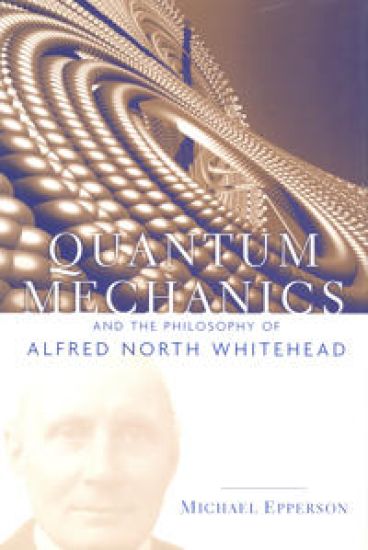
In Process and Reality and other works, Alfred North Whitehead struggled to come to terms with the impact the new science of quantum mechanics would have on metaphysics. This ambitious book is the first extended analysis of the intricate relationships between relativity theory, quantum mechanics, and Whitehead's cosmology. Michael Epperson illuminates the intersection of science and philosophy in Whitehead's work-and details Whitehead's attempts to fashion an ontology coherent with quantum anomalies. Including a nonspecialist introduction to quantum mechanics, Epperson adds an essential new dimension to our understanding of Whitehead-and of the constantly enriching encounter between science and philosophy in our century. Quantum Mechanics and the Philosophy of Alfred North Whitehead is available from the publisher on an open-access basis.
Quantum Mechanics and the Philosophy of Alfred North Whitehead
In Process and Reality and other works, Alfred North Whitehead struggled to come to terms with the impact the new science of quantum mechanics would have on metaphysics. This ambitious book is the first extended analysis of the intricate relationships between relativity theory, quantum mechanics, and Whitehead's cosmology. Michael Epperson illuminates the intersection of science and philosophy in Whitehead's work-and details Whitehead's attempts to fashion an ontology coherent with quantum anomalies. Including a nonspecialist introduction to quantum mechanics, Epperson adds an essential new dimension to our understanding of Whitehead-and of the constantly enriching encounter between science and philosophy in our century. Quantum Mechanics and the Philosophy of Alfred North Whitehead is available from the publisher on an open-access basis.