
Kirjailija
Michael Greenberg
Kirjat ja teokset yhdessä paikassa: 24 kirjaa, julkaisuja vuosilta 2004–2026, suosituimpiin kuuluu Beg, Borrow, Steal. Vertaile teosten hintoja ja tarkista saatavuus suomalaisista kirjakaupoista.
24 kirjaa
Kirjojen julkaisuvuodet: 2004–2026.
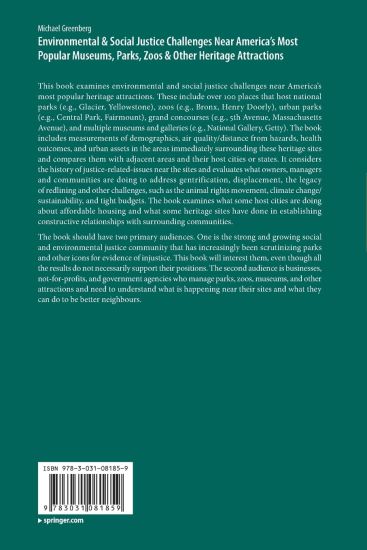
Environmental & Social Justice Challenges Near America’s Most Popular Museums, Parks, Zoos & Other Heritage Attractions
Michael Greenberg
Springer International Publishing AG
2023
nidottu
This book examines environmental and social justice challenges near America's most popular heritage attractions. These include over 100 places that host national parks (e.g., Glacier, Yellowstone), zoos (e.g., Bronx, Henry Doorly), urban parks (e.g., Central Park, Fairmount), grand concourses (e.g., 5th Avenue, Massachusetts Avenue), and multiple museums and galleries (e.g., National Gallery, Getty). The book includes measurements of demographics, air quality/distance from hazards, health outcomes, and urban assets in the areas immediately surrounding these heritage sites and compares them with adjacent areas and their host cities or states. It considers the history of justice-related-issues near the sites and evaluates what owners, managers and communities are doing to address gentrification, displacement, the legacy of redlining and other challenges, such as the animal rights movement, climate change/sustainability, and tight budgets. The book examines what some host cities are doing about affordable housing and what some heritage sites have done in establishing constructive relationships with surrounding communities. The book should have two primary audiences. One is the strong and growing social and environmental justice community that has increasingly been scrutinizing parks and other icons for evidence of injustice. This book will interest them, even though all the results do not necessarily support their positions. The second audience is businesses, not-for-profits, and government agencies who manage parks, zoos, museums, and other attractions and need to understand what is happening near their sites and what they can do to be better neighbours.
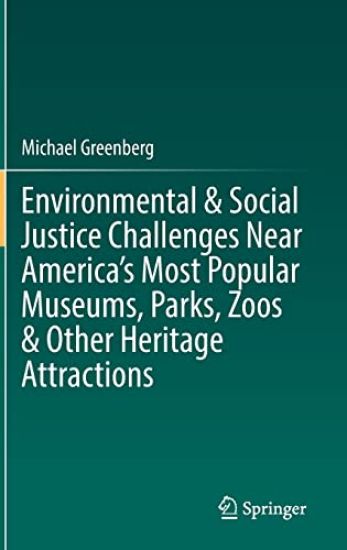
Environmental & Social Justice Challenges Near America’s Most Popular Museums, Parks, Zoos & Other Heritage Attractions
Michael Greenberg
Springer International Publishing AG
2022
sidottu
This book examines environmental and social justice challenges near America's most popular heritage attractions. These include over 100 places that host national parks (e.g., Glacier, Yellowstone), zoos (e.g., Bronx, Henry Doorly), urban parks (e.g., Central Park, Fairmount), grand concourses (e.g., 5th Avenue, Massachusetts Avenue), and multiple museums and galleries (e.g., National Gallery, Getty). The book includes measurements of demographics, air quality/distance from hazards, health outcomes, and urban assets in the areas immediately surrounding these heritage sites and compares them with adjacent areas and their host cities or states. It considers the history of justice-related-issues near the sites and evaluates what owners, managers and communities are doing to address gentrification, displacement, the legacy of redlining and other challenges, such as the animal rights movement, climate change/sustainability, and tight budgets. The book examines what some host cities are doing about affordable housing and what some heritage sites have done in establishing constructive relationships with surrounding communities. The book should have two primary audiences. One is the strong and growing social and environmental justice community that has increasingly been scrutinizing parks and other icons for evidence of injustice. This book will interest them, even though all the results do not necessarily support their positions. The second audience is businesses, not-for-profits, and government agencies who manage parks, zoos, museums, and other attractions and need to understand what is happening near their sites and what they can do to be better neighbours.

As the systematic murder of six million Jews by Nazi Germany and its collaborators was taking place, Jewish soldiers in the United States Army participated in guarding, healing, and reeducating of some of the four hundred thousand German prisoners of war (PW) held in camps scattered across the United States. History has paid little attention to the participation of Jewish GIs at these camps and the role they played in preparing PWs to return and participate in a postwar democratic Germany. Very little is known about the experiences of these Jewish soldiers that prepared them to go face-to-face with German PWs, some of which were hardened Nazi party members. In addition, little is known about how the tour of duty in these camps affected the GIs' postwar lives. It was fifty years after the German PWs returned home that I found an unexpected gift my late parents left me that became a portal to discover stories of individual Jewish men whose deeds should inspire future generations on confronting anti-Semitism and racism. These men did not feel sorry for themselves being assigned to PW camps, did not request transfers, and embraced the change and focused on the things they could control. They viewed their roles not as custodians or babysitters of prisoners but as role models of Jewish men who were fit, trim, educated, held rank, and wanted to do more than just "ride out the war" in the zone of the interior. Their stories are about affecting positive change in the PWs' thinking and behaviors. Their mission of tikkun olam-"repair of the world¬"-is the subject of this book. How, where, and when they started and completed this mission is unique to each Jewish GI despite them having common basic training in Jewish upbringing and values. It is hoped that this book will inspire other Jewish soldiers who served at PW camps or their family members knowledgeable about their service to step forward and share their experiences. This could lead to a future updated edition of this book.
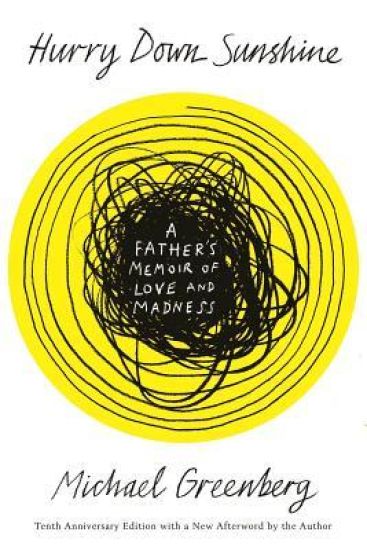
Hurry Down Sunshine: A Father's Memoir of Love and Madness
Michael Greenberg
Other Press (NY)
2018
nidottu
"Hurry Down Sunshine is about tenacity and tenderness...but mostly it's about love." --OPRAH WINFREY AN AMAZON BEST BOOK OF THE MONTH PICK This international bestseller is an extraordinary family story and an exceptionally powerful memoir about coping withbipolar disorder, now with a new afterword for the ten-year anniversary edition. Michael Greenberg recounts in vivid detail the remarkable summer when, at the age of fifteen, his daughter was struck mad. It begins with Sally's sudden visionary crack-up on the streets of Greenwich Village, and continues, among other places, in the out-of-time world of a Manhattan psychiatric ward during the city's sweltering summer. It is a tale of a family broken open, then painstakingly, movingly stitched together again. Greenberg's unforgettable cast of characters includes an unconventional psychiatrist, an Orthodox Jewish patient, a manic Classics professor, a movie producer, and a landlord with literary aspirations. Unsentimental, nuanced, and deeply humane, Hurry Down Sunshine is essential reading in the literature of affliction with such classics as Girl, Interrupted and An Unquiet Mind.
Risk analysis is not a narrowly defined set of applications. Rather, it is widely used to assess and manage a plethora of hazards that threaten dire implications. However, too few people actually understand what risk analysis can help us accomplish and, even among experts, knowledge is often limited to one or two applications. Explaining Risk Analysis frames risk analysis as a holistic planning process aimed at making better risk-informed decisions and emphasizing the connections between the parts. This framework requires an understanding of basic terms, including explanations of why there is no universal agreement about what risk means, much less risk assessment, risk management and risk analysis. Drawing on a wide range of case studies, the book illustrates the ways in which risk analysis can help lead to better decisions in a variety of scenarios, including the destruction of chemical weapons, management of nuclear waste and the response to passenger rail threats. The book demonstrates how the risk analysis process and the data, models and processes used in risk analysis will clarify, rather than obfuscate, decision-makers’ options. This book will be of great interest to students and scholars of risk assessment, risk management, public health, environmental science, environmental economics and environmental psychology.
Risk analysis is not a narrowly defined set of applications. Rather, it is widely used to assess and manage a plethora of hazards that threaten dire implications. However, too few people actually understand what risk analysis can help us accomplish and, even among experts, knowledge is often limited to one or two applications. Explaining Risk Analysis frames risk analysis as a holistic planning process aimed at making better risk-informed decisions and emphasizing the connections between the parts. This framework requires an understanding of basic terms, including explanations of why there is no universal agreement about what risk means, much less risk assessment, risk management and risk analysis. Drawing on a wide range of case studies, the book illustrates the ways in which risk analysis can help lead to better decisions in a variety of scenarios, including the destruction of chemical weapons, management of nuclear waste and the response to passenger rail threats. The book demonstrates how the risk analysis process and the data, models and processes used in risk analysis will clarify, rather than obfuscate, decision-makers’ options. This book will be of great interest to students and scholars of risk assessment, risk management, public health, environmental science, environmental economics and environmental psychology.
Nuclear Waste Management, Nuclear Power, and Energy Choices
Michael Greenberg
Springer London Ltd
2014
nidottu
Hundreds of studies have investigated public perceptions and preferences about nuclear power, waste management, and technology. However there is clear lack of uniformity in the style, aims and methods applied. Consequently, the body of results is inconsistent and it is difficult to isolate relevant patterns or interpretations. Nuclear Waste Management, Nuclear Power and Energy Choices: Public Preferences, Perceptions and Trust presents a theoretical base for public reactions then classifies and reviews the large body of surveys carried out over the past decade. Particular focus is placed on residents within 50 miles US nuclear waste facilities due to the disproportionate presence of nuclear factors in their lives such as the legacy of nuclear waste disposal and job dependency. The motivations and reasons for their views such as fear, attraction to the economic benefits, trust of site managers and federal agencies, cultural views, personal history, and demographic attributes of the people are also considered to provide a balanced and detailed overview. Nuclear Waste Management, Nuclear Power and Energy Choices: Public Preferences, Perceptions and Trust includes a comprehensive treatment of the theories and literature, and most important is grounded in surveys in 2005, 2008, 2009, 2010, and 2011 which includes questions considering the impact of Fukushima on US public opinion. By including real life data alongside the analysis, Nuclear Waste Management, Nuclear Power, and Energy Choices: Public Preferences, Perceptions and Trust provides a relevant and concise reference for nuclear industry professionals. It also acts a resource for students and researchers studying nuclear-related topics including political, social and environmental factors. Particular focus is placed on residents within 50 miles US nuclear waste facilities due to the disproportionate presence of nuclear factors in their lives such as the legacy of nuclear waste disposal and job dependency. The motivations and reasons for their views such as fear, attraction to the economic benefits, trust of site managers and federal agencies, cultural views, personal history, and demographic attributes of the people are also considered to provide a balanced and detailed overview. Nuclear Waste Management, Nuclear Power and Energy Choices: Public Preferences, Perceptions and Trust includes a comprehensive treatment of the theories and literature, and most important is grounded in surveys in 2005, 2008, 2009, 2010, and 2011 which includes questions considering the impact of Fukushima on US public opinion. By including real life data alongside the analysis, Nuclear Waste Management, Nuclear Power, and Energy Choices: Public Preferences, Perceptions and Trust provides a relevant and concise reference for nuclear industry professionals. It also acts a resource for students and researchers studying nuclear-related topics including political, social and environmental factors. Particular focus is placed on residents within 50 miles US nuclear waste facilities due to the disproportionate presence of nuclear factors in their lives such as the legacy of nuclear waste disposal and job dependency. The motivations and reasons for their views such as fear, attraction to the economic benefits, trust of site managers and federal agencies, cultural views, personal history, and demographic attributes of the people are also considered to provide a balanced and detailed overview. Nuclear Waste Management, Nuclear Power and Energy Choices: PublicPreferences, Perceptions and Trust includes a comprehensive treatment of the theories and literature, and most important is grounded in surveys in 2005, 2008, 2009, 2010, and 2011 which includes questions considering the impact of Fukushima on US public opinion. By including real life data alongside the analysis, Nuclear Waste Management, Nuclear Power, and Energy Choices: Public Preferences, Perceptions and Trust provides a relevant and concise reference for nuclear industry professionals. It also acts a resource for students and researchers studying nuclear-related topics including political, social and environmental factors. By including real life data alongside the analysis, Nuclear Waste Management, Nuclear Power, and Energy Choices: Public Preferences, Perceptions and Trust provides a relevant and concise reference for nuclear industry professionals. It also acts a resource for students and researchers studying nuclear-related topics including political, social and environmental factors. By including real life data alongside the analysis, Nuclear Waste Management, Nuclear Power, and Energy Choices: Public Preferences, Perceptions and Trust provides a relevant and concise reference for nuclear industry professionals. It also acts a resource for students and researchers studying nuclear-related topics including political, social and environmental factors.
Foundations of Applied Mathematics
Kevin J Mitchell; Michael Greenberg
Dover Publications Inc.
2014
nidottu
A longtime classic text in applied mathematics, this volume also serves as a reference for undergraduate and graduate students of engineering. Topics include real variable theory, complex variables, linear analysis, partial and ordinary differential equations, and other subjects. Answers to selected exercises are provided, along with Fourier and Laplace transformation tables and useful formulas. 1978 edition.
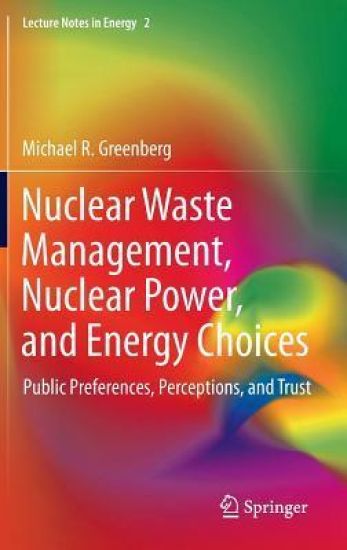
Nuclear Waste Management, Nuclear Power, and Energy Choices
Michael Greenberg
Springer London Ltd
2012
sidottu
Hundreds of studies have investigated public perceptions and preferences about nuclear power, waste management, and technology. However there is clear lack of uniformity in the style, aims and methods applied. Consequently, the body of results is inconsistent and it is difficult to isolate relevant patterns or interpretations. Nuclear Waste Management, Nuclear Power and Energy Choices: Public Preferences, Perceptions and Trust presents a theoretical base for public reactions then classifies and reviews the large body of surveys carried out over the past decade. Particular focus is placed on residents within 50 miles US nuclear waste facilities due to the disproportionate presence of nuclear factors in their lives such as the legacy of nuclear waste disposal and job dependency. The motivations and reasons for their views such as fear, attraction to the economic benefits, trust of site managers and federal agencies, cultural views, personal history, and demographic attributes of the people are also considered to provide a balanced and detailed overview. Nuclear Waste Management, Nuclear Power and Energy Choices: Public Preferences, Perceptions and Trust includes a comprehensive treatment of the theories and literature, and most important is grounded in surveys in 2005, 2008, 2009, 2010, and 2011 which includes questions considering the impact of Fukushima on US public opinion. By including real life data alongside the analysis, Nuclear Waste Management, Nuclear Power, and Energy Choices: Public Preferences, Perceptions and Trust provides a relevant and concise reference for nuclear industry professionals. It also acts a resource for students and researchers studying nuclear-related topics including political, social and environmental factors. Particular focus is placed on residents within 50 miles US nuclear waste facilities due to the disproportionate presence of nuclear factors in their lives such as the legacy of nuclear waste disposal and job dependency. The motivations and reasons for their views such as fear, attraction to the economic benefits, trust of site managers and federal agencies, cultural views, personal history, and demographic attributes of the people are also considered to provide a balanced and detailed overview. Nuclear Waste Management, Nuclear Power and Energy Choices: Public Preferences, Perceptions and Trust includes a comprehensive treatment of the theories and literature, and most important is grounded in surveys in 2005, 2008, 2009, 2010, and 2011 which includes questions considering the impact of Fukushima on US public opinion. By including real life data alongside the analysis, Nuclear Waste Management, Nuclear Power, and Energy Choices: Public Preferences, Perceptions and Trust provides a relevant and concise reference for nuclear industry professionals. It also acts a resource for students and researchers studying nuclear-related topics including political, social and environmental factors. Particular focus is placed on residents within 50 miles US nuclear waste facilities due to the disproportionate presence of nuclear factors in their lives such as the legacy of nuclear waste disposal and job dependency. The motivations and reasons for their views such as fear, attraction to the economic benefits, trust of site managers and federal agencies, cultural views, personal history, and demographic attributes of the people are also considered to provide a balanced and detailed overview. Nuclear Waste Management, Nuclear Power and Energy Choices: PublicPreferences, Perceptions and Trust includes a comprehensive treatment of the theories and literature, and most important is grounded in surveys in 2005, 2008, 2009, 2010, and 2011 which includes questions considering the impact of Fukushima on US public opinion. By including real life data alongside the analysis, Nuclear Waste Management, Nuclear Power, and Energy Choices: Public Preferences, Perceptions and Trust provides a relevant and concise reference for nuclear industry professionals. It also acts a resource for students and researchers studying nuclear-related topics including political, social and environmental factors. By including real life data alongside the analysis, Nuclear Waste Management, Nuclear Power, and Energy Choices: Public Preferences, Perceptions and Trust provides a relevant and concise reference for nuclear industry professionals. It also acts a resource for students and researchers studying nuclear-related topics including political, social and environmental factors. By including real life data alongside the analysis, Nuclear Waste Management, Nuclear Power, and Energy Choices: Public Preferences, Perceptions and Trust provides a relevant and concise reference for nuclear industry professionals. It also acts a resource for students and researchers studying nuclear-related topics including political, social and environmental factors.
This book is about a subject that Michael Greenberg has worked on and lived with for almost forty years. He was brought up in the south Bronx at a time when his neighborhood suffered from terrible air and noise pollution, and domestic waste went untreated into the Hudson River. For him, the National Environmental Policy Act (NEPA) was a blessing. It included an ethical position about the environment, and the law required some level of accountability in the form of an environmental impact statement, or EIS. After forty years of thinking about and working with NEPA and the EIS process, Greenberg decided to conduct his own evaluation from the perspective of a person trained in science who focuses on environmental and environmental health policies. This book of carefully chosen real case studies goes beyond the familiar checklists of what to do, and shows students and practitioners alike what really happens during the creation and implementation of an EIS.
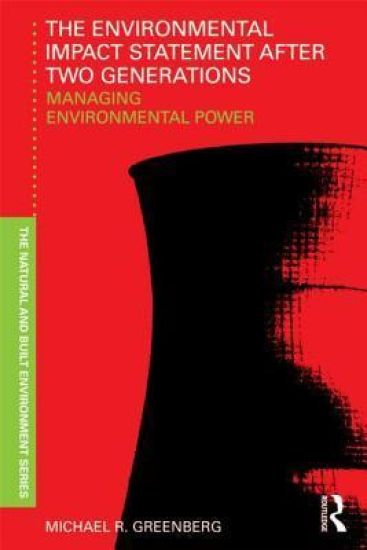
This book is about a subject that Michael Greenberg has worked on and lived with for almost forty years. He was brought up in the south Bronx at a time when his neighborhood suffered from terrible air and noise pollution, and domestic waste went untreated into the Hudson River. For him, the National Environmental Policy Act (NEPA) was a blessing. It included an ethical position about the environment, and the law required some level of accountability in the form of an environmental impact statement, or EIS. After forty years of thinking about and working with NEPA and the EIS process, Greenberg decided to conduct his own evaluation from the perspective of a person trained in science who focuses on environmental and environmental health policies. This book of carefully chosen real case studies goes beyond the familiar checklists of what to do, and shows students and practitioners alike what really happens during the creation and implementation of an EIS.
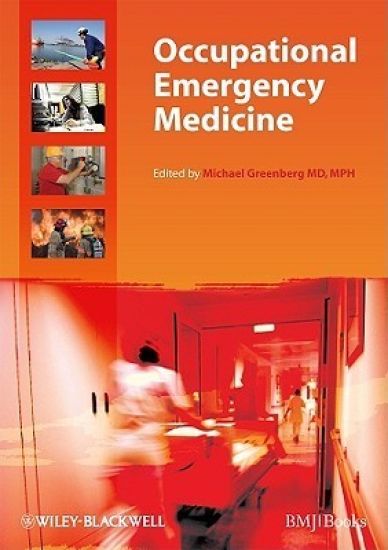
Occupational Emergency Medicine
Michael Greenberg
Wiley-Blackwell (an imprint of John Wiley Sons Ltd)
2011
nidottu
With a large proportion of emergency admissions due to occupational health problems, the effect this can have on your practice cannot be ignored. Owing to the shortage of occupational physicians and limited worker access to health care, the diagnosis and treatment of occupational diseases rely increasingly on the emergency physician. Apart from extra paperwork, owing to the extra legal and administrative regulations, a lack of knowledge of occupational medicine can risk a missed diagnosis. This burden of work means occupational disorders impact the whole of the emergency department. Michael Greenberg addresses your questions and concerns about the management of these patients: from triage to discharge, and beyondfor all work-place injuries or disorders, whether office-based, agricultural or industrialand their employment regulations Occupational Emergency Medicine is an essential reference for emergency physicians and trainees, featuring comprehensive information on legal issues involving the physician, and advice on managing occupational health admissions.
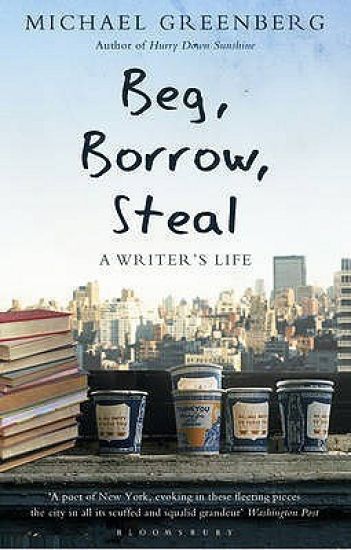
An unusual and captivating memoir by the acclaimed author of Hurry Down Sunshine‘Michael Greenberg, a native New Yorker, loves the city as a child loves a parent, and in its honour he has put together a collection of tightly written, incisive chapters, each another tessera or tile in a big mosaic ... Michael Greenberg is an acute observer' New York Times‘They are short snapshots of memoir, beautifully observed ... This is the perfect bedside book split, as it is, into neat insomniac chunks' Scott PackIn Beg, Borrow, Steal Michael Greenberg regales us with his wry and vivid take on the life of a writer of little means trying to practise his craft or simply stay alive. He finds himself doctoring doomed movie scripts; selling cosmetics from an ironing board in front of a women's department store; writing about golf, a game he has never played; and botching his debut as a waiter in a posh restaurant. Central characters include Michael's father, whose prediction that Michael's ‘scribbling' wouldn't get him on the subway almost came true; his artistic first wife, whom he met in a Greenwich Village high school; and their son who grew up on the Lower East Side, fluent in the language of the street. Then there are Greenberg's unexpected encounters: a Holocaust survivor who, on his deathbed, tries to leave Michael his fortune; a repentant communist who confesses his sins; a man who becomes a woman; a Chilean film-maker in search of his past; and rats who behave like humans and cease to live underground. Hilarious and bittersweet, Greenberg's stories invite us into a world where the familial, the literary, the tragic and the mundane not only speak to one another, but deeply enjoy the exchange.
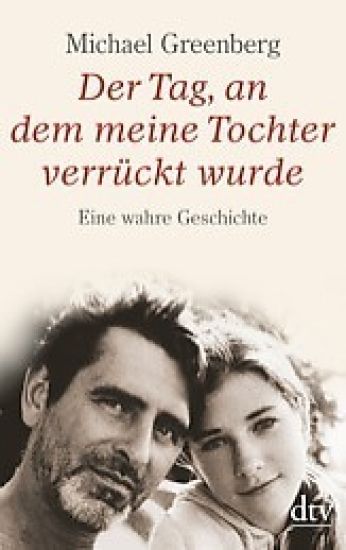
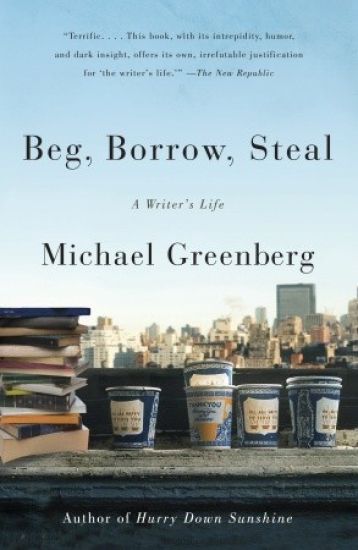
Michael Greenberg entertainingly chronicles the hardships, delights, and moral dilemmas of being a writer and a New Yorker in this "darkly comic" essay collection (The New York Review of Books). To eke out a living, Greenberg doctors doomed movie scripts, peddles cosmetics on the street, and waits tables at a posh restaurant, all while raising his son on the Lower East Side. Along the way, he meets a host of fascinating city characters, including a Holocaust survivor, a repentant communist, and rats who behave like humans. Hilarious and bittersweet, Greenberg's stories invite us into a world where the familial, the literary, the tragic, and the mundane not only speak to one another, but deeply enjoy the exchange.
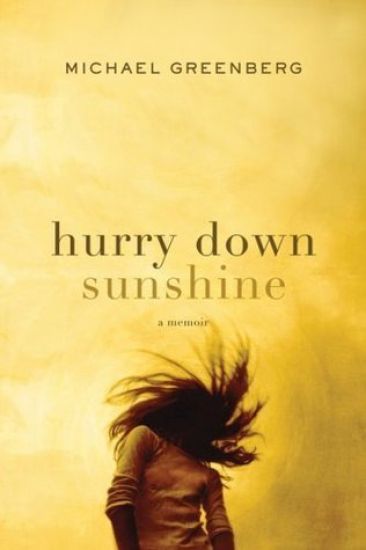
One summer evening Michael Greenberg's daughter Sally was brought home by the police after rushing into a busy road in Greenwich Village, convinced she could halt the oncoming traffic. The mania had come over her abruptly: her habit of poring obsessively over poems late into the night or listening to music on her battered walkman for hours could be considered 'normal' teenage behaviour, and yet it was a clue to the internal tumult that was about to overwhelm her. Now her behaviour had moved from the realm of the adolescent and eccentric to the acutely unstable, and she needed professional help. And so just a few days later Michael found himself in the surreal world of a Manhattan psychiatric ward during the city's most sweltering months. Confused, anxious, looking for answers, he asked himself whether he was to blame. Perhaps this illness had been Sally's genetic inheritance. Perhaps, as a writer, he hadn't been able to provide the secure and stable home she needed. Sally's mother had left some time ago, finding life in the city suffocating, and his new wife, Pat, had not found it easy building a relationship with his clever, headstrong daughter. But looking around him at the other concerned families in the waiting room, he began to realise that the answers to his questions were not so simple. Touching, memorable and unsentimental, Hurry Down Sunshine is partly an insightful exploration of what mental illness has come to mean in our culture, and partly a moving memoir about how one family learns to cope with the prejudice and uncertainty that faces those affected by it.
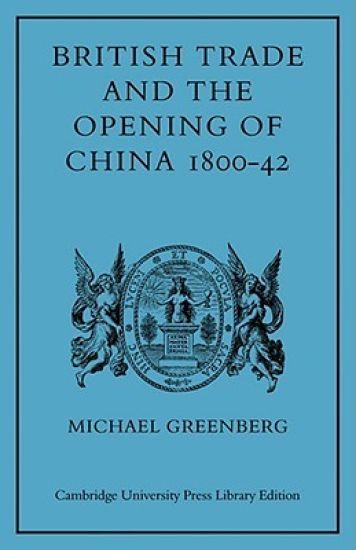
British Trade and the Opening of China 1800–42
Michael Greenberg
Cambridge University Press
2008
pokkari
An account of the activities of British merchants in China in the crucial years before the Treaty of Nanking (1842), which transformed the relations between the Celestial Empire and the Western 'barbarians' and placed them upon a footing that was to last for 100 years. Mr Greenberg shows how this change was brought about by the pressures of the expanding British economy of the early nineteenth century. Much of the material is based on the papers of Jardine Matheson and Co., the only firm of pre-treaty days to survive, and the largest of the British firms then established in Canton.
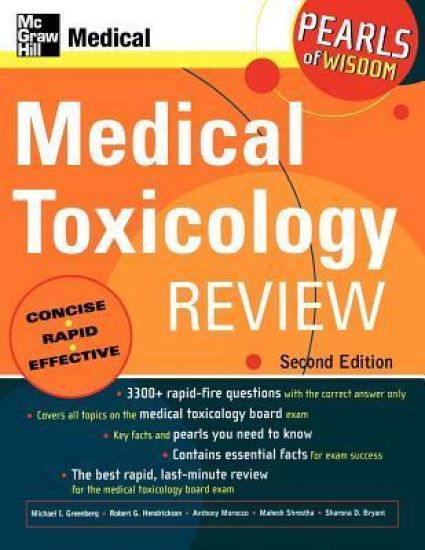
Medical Toxicology Review: Pearls of Wisdom, Second Edition
Michael Greenberg; Robert Hendrickson; Anthony Morocco; Mahesh Shrestha; Sharona Bryant
McGraw Hill Higher Education
2005
nidottu
Publisher's Note: Products purchased from Third Party sellers are not guaranteed by the publisher for quality, authenticity, or access to any online entitlements included with the product. The BEST rapid, last-minute review for the medical toxicology board exam! The Medical Toxicology Review volume in the acclaimed Pearls of Wisdom series is your most effective weapon in preparing for the medical toxicology board exams.3300+ rapid-fire questions cover all topics on the medical toxicology board examPowered with performance-enhancing pearls and other potent learning aidsThis rapid, effective review ensures your best possible performance on the exam in the shortest possible study time. There is no easier or faster way to guarantee that you perform your best! BULL'S-EYE HITS on medical toxicology exam topics--theh meaningful and the frequently testedTOOLS TO IMPRINT YOUR MEMORY--pearls, drills, mnemonics, visual imagery, even humor, and other tested learning aidsRAPID RESULTS--rapid-fire, to-the-point Q&As quickly embed the facts you need to know and enhance quick recallNO CONFUSING WRONG ANSWERS to clutter your memory
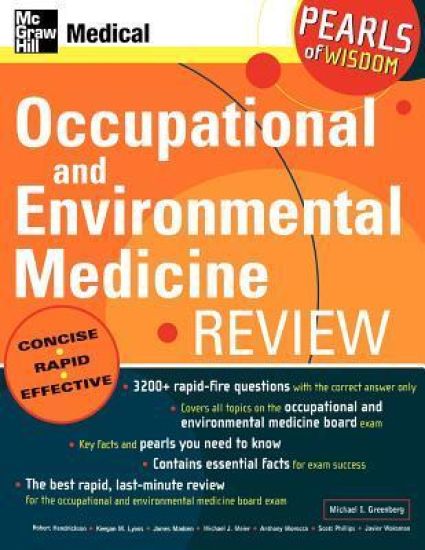
Occupational and Environmental Medicine Review: Pearls of Wisdom
Michael Greenberg
McGraw Hill Higher Education
2005
nidottu
Publisher's Note: Products purchased from Third Party sellers are not guaranteed by the publisher for quality, authenticity, or access to any online entitlements included with the product. Why waste time guessing at what you need to know for the occupational and environmental medicine board exam? Maximize your exam preparation time with this quick-hit question and answer review. The unique question and single-answer format eliminates the guesswork associated with traditional multiple-choice Q&A reviews and reinforces only the correct answers you'll need to know on exam day. Emphasis is placed on distilling key facts and clinical pearls essential for exam success. This high-yield review for the boards is the perfect compliment to larger texts for intense, streamlined review in the days and weeks before your exam.