Kirjojen hintavertailu – 12 859 818 kirjaa ja 27 kauppaa

Kirjailija

Michael J. Green

Kirjat ja teokset yhdessä paikassa: 13 kirjaa, julkaisuja vuosilta 2004–2025, suosituimpiin kuuluu Line of Advantage: Japan's Grand Strategy in the Era of Abe Shinzō. Vertaile teosten hintoja ja tarkista saatavuus suomalaisista kirjakaupoista.

Nimi esiintyy myös muodoissa: Michael J Green

13 kirjaa

Kirjojen julkaisuvuodet: 2004–2025.

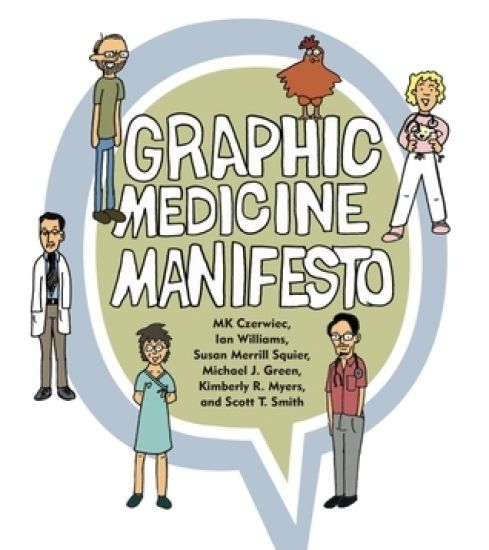
Graphic Medicine Manifesto

Graphic Medicine Manifesto

MK Czerwiec; Ian Williams; Susan Merrill Squier; Michael J. Green; Kimberly R. Myers; Scott T. Smith

Pennsylvania State University Press
2025
pokkari

Halvin toimitettuna 38,30 €

A decade ago, Graphic Medicine Manifesto established a bold new framework for understanding the intersection of comics and healthcare. It was a call to action—an invitation to rethink the ways we engage with medicine, illness, disability, and caregiving through the power of visual storytelling. Now, ten years later, this landmark volume returns in a special anniversary edition that expands and reimagines its mission for a new era. With a new critical preface, this tenth-anniversary edition reflects on Graphic Medicine Manifesto’s legacy and its impact on healthcare, scholarship, and comics. It reaffirms the power of comics to challenge disciplines, amplify marginalized voices, and transform teaching in a range of health fields. Organized into six sections, the introduction explores the manifesto’s origins and ongoing relevance, its role as a radical tool in comics, the power of storytelling in health education, the expanding influence of graphic medicine on disability studies and the humanities, the importance of community and collaboration in breaking disciplinary silos, and the future of the field. Featuring these newly contextualized insights alongside the original essays and visual narratives by Ian Williams, MK Czerwiec, and other leading practitioners, this new edition reaffirms Graphic Medicine Manifesto as an essential text for scholars, healthcare professionals, creators, and anyone engaging with medicine, illness, and caregiving through the power of comics.

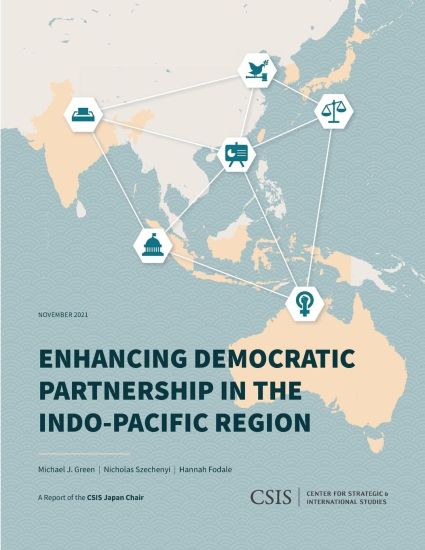
Enhancing Democratic Partnership in the Indo-Pacific Region

Enhancing Democratic Partnership in the Indo-Pacific Region

Michael J. Green; Nicholas Szechenyi; Hannah Fodale

BLOOMSBURY PUBLISHING PLC
2022
nidottu
This study builds on a report CSIS published in 2020 on ways the United States can partner with allies and partners to enhance democratic partnership in the Indo-Pacific region. This follow-on effort includes case studies on the democracy support efforts of Australia, Japan, India, Indonesia, South Korea, and Taiwan; comparisons of democracy support strategies; data on official development assistance (ODA) funding related to democracy broadly defined; and recommendations for ways the United States can coordinate democracy support initiatives in the region with like-minded partners as well as regional networks and institutions.
Asianism and Universalism

Asianism and Universalism

Michael J. Green

Centre for Strategic International Studies,U.S.
2021
nidottu
This collection of essays addresses the interplay of democratic norms and cultural identity within Asia. The overall question for the volume is how the dueling identities of Asianism (regional exceptionalism) and universalism (democratic norms) are shaping state discourse and behavior in Asia. This is based on a dialogue of scholars organized by CSIS to examine national perspectives on Asianism and universalism across the region, as well as the role of regional democracies in developing a common understanding of rules and norms as the foundation for a more stable regional order. The introduction provides context for these normative debates in the region and addresses the potential to prioritize democracy promotion in foreign policy strategy as segue to essays analyzing normative debates in Japan, South Korea, India, Indonesia, and the United States.
Graphic Medicine Manifesto

Graphic Medicine Manifesto

MK Czerwiec; Ian Williams; Susan Merrill Squier; Michael J. Green; Kimberly R. Myers; Scott T. Smith

Pennsylvania State University Press
2015
pokkari

Halvin toimitettuna 37,00 €

This inaugural volume in the Graphic Medicine series establishes the principles of graphic medicine and begins to map the field. The volume combines scholarly essays by members of the editorial team with previously unpublished visual narratives by Ian Williams and MK Czerwiec, and it includes arresting visual work from a wide range of graphic medicine practitioners. The book’s first section, featuring essays by Scott Smith and Susan Squier, argues that as a new area of scholarship, research on graphic medicine has the potential to challenge the conventional boundaries of academic disciplines, raise questions about their foundations, and reinvigorate literary scholarship—and the notion of the literary text—for a broader audience. The second section, incorporating essays by Michael Green and Kimberly Myers, demonstrates that graphic medicine narratives can engage members of the health professions with literary and visual representations and symbolic practices that offer patients, family members, physicians, and other caregivers new ways to experience and work with the complex challenges of the medical experience. The final section, by Ian Williams and MK Czerwiec, focuses on the practice of creating graphic narratives, iconography, drawing as a social practice, and the nature of comics as visual rhetoric. A conclusion (in comics form) testifies to the diverse and growing graphic medicine community. Two valuable bibliographies guide readers to comics and scholarly works relevant to the field.
Assessing the Asia-Pacific Rebalance

Assessing the Asia-Pacific Rebalance

David J. Berteau; Michael J. Green; Zack Cooper

Centre for Strategic International Studies,U.S.
2014
nidottu
This report seeks to clarify the stated objectives of the US rebalance strategy, reviewing regional responses, and assessing the status of the rebalance, which is critical to reinforcing regional stability by strengthening US relationships, presence, and capabilities. The authors evaluate both public statements and visible implementation of the rebalance strategy, as viewed not only from Washington but from regional capitals as well.
Federated Defense in Asia

Federated Defense in Asia

Michael J. Green; Kathleen H. Hicks; Zack Cooper

Centre for Strategic International Studies,U.S.
2014
nidottu
This report is the first regional study in the CSIS Federated Defense series. The Federated Defense Project aims to shift the paradigm with key allies and partners from capacity building to a federated approach that would expand regional security and prosperity by joining regional allies and partners together in the pursuit of shared security objectives across the conflict spectrum. Federated defense should include forward-thinking strategies for how to develop and share capabilities and capacity, thereby more deeply integrating the US military with its allies and partners. In this report, the CSIS project team highlights six potential federated initiatives in the areas of humanitarian assistance and disaster relief, information and intelligence sharing, maritime security, undersea warfare, missile defense, and cyber security. Federated approaches such as these are vital to developing and integrating Asian security capabilities to manage emerging security challenges.
Strategic Japan

Strategic Japan

Michael J. Green; Zack Cooper

Centre for Strategic International Studies,U.S.
2014
sidottu
Is Japan capable of grand strategy when it comes to foreign policy? Modern Japan faces challenges on every front: from a rising China and constrained economic growth at home, to an ever-present threat posed by an increasingly unstable North Korea, to an evolving and complex relationship with the West that for so long has served as the bedrock of Japanese foreign policy. Prime Minister Shinzo Abe has garnered significant attention for his policies undergirding a path of “proactive pacifism” for Japan, but many questions remain unanswered with regard to what Japan’s global role ought to be, what it can be, and what that role’s development would mean for the greater stability of the region and the fate of broader geopolitical alliances across the world. While it is clear that both Japan and its allies would be best served by a clear, comprehensive, and forward-thinking Japanese foreign policy blueprint, but actually developing and implementing such a policy is understandably easier said than done. Fortunately, shaping this new strategy is a generation of Japanese foreign policy experts with eyes toward the future of Japanese power and diplomacy. In Strategic Japan: New Approaches to Foreign Policy and the U. S. Japan Alliance, five preeminent scholars: Yasuhiro Matsuda, Tetsuo Kotani, Hiroyasu Akutsu, Yoshikazu Kobayashi, and Nobuhiro Aizawa discuss Japan’s changing role in the world and the high stakes policy issues affecting Japan, Asia, and the world today. Taken together, these experts’ contributions highlight potential areas for enhanced cooperation between the United States and Japan at a time when the West desperately needs a confident and proactive Japan, and Japan needs sustained American engagement and deterrence in an Asia-Pacific region that will continue to be the site of economic growth and expansion for years to come.
Strategic Japan

Strategic Japan

Michael J. Green; Zack Cooper

Centre for Strategic International Studies,U.S.
2014
nidottu
Is Japan capable of grand strategy when it comes to foreign policy? Modern Japan faces challenges on every front: from a rising China and constrained economic growth at home, to an ever-present threat posed by an increasingly unstable North Korea, to an evolving and complex relationship with the West that for so long has served as the bedrock of Japanese foreign policy. Prime Minister Shinzo Abe has garnered significant attention for his policies undergirding a path of “proactive pacifism” for Japan, but many questions remain unanswered with regard to what Japan’s global role ought to be, what it can be, and what that role’s development would mean for the greater stability of the region and the fate of broader geopolitical alliances across the world. While it is clear that both Japan and its allies would be best served by a clear, comprehensive, and forward-thinking Japanese foreign policy blueprint, but actually developing and implementing such a policy is understandably easier said than done. Fortunately, shaping this new strategy is a generation of Japanese foreign policy experts with eyes toward the future of Japanese power and diplomacy. In Strategic Japan: New Approaches to Foreign Policy and the U. S. Japan Alliance, five preeminent scholars: Yasuhiro Matsuda, Tetsuo Kotani, Hiroyasu Akutsu, Yoshikazu Kobayashi, and Nobuhiro Aizawa discuss Japan’s changing role in the world and the high stakes policy issues affecting Japan, Asia, and the world today. Taken together, these experts’ contributions highlight potential areas for enhanced cooperation between the United States and Japan at a time when the West desperately needs a confident and proactive Japan, and Japan needs sustained American engagement and deterrence in an Asia-Pacific region that will continue to be the site of economic growth and expansion for years to come.
Power and Order in Asia

Power and Order in Asia

Michael J. Green; Nicholas Szechenyi

Centre for Strategic International Studies,U.S.
2014
nidottu
Asia stands out as the world’s most vibrant region, where rivalries and confrontation coincide with increased economic cooperation and community building. How should we interpret these two dynamics, and what are the implications for U. S. policy? With the support of the MacArthur Foundation, Asahi Shimbun, Joongang Ilbo, and China Times, the Center for Strategic and International Studies (CSIS) collaborated with Opinion Dynamics Corporation on a survey of strategic elites in eleven Asia Pacific economies. This report presents key findings on the strategic landscape in Asia with respect to questions of power, norms, and regional institutions.
Crafting Asia Economic Strategy in 2013

Crafting Asia Economic Strategy in 2013

Michael J. Green; Ernest Z. Bower; Victor Cha

Centre for Strategic International Studies,U.S.
2013
nidottu
Economics is critical to Asia-Pacific affairs and to U. S. interests there. The region accounts for roughly half of global GDP and trade and includes some of the world’s fast-growing economies. American growth and jobs increasingly depend on trade and investment with Asia, and many of the rules of the global economic system over the coming decades will be shaped there. Effective U. S. economic policies in the region are thus an essential complement to other dimensions of the rebalancing strategy, reinforcing and being reinforced by the military, diplomatic, and political elements. In an effort to provide practical assistance to U. S. policymakers grappling with these challenges, the CSIS Asia Team prepared short papers on a number of key economies of the Asia region: China, India, Japan, Korea, and the Association of Southeast Asian Nations (ASEAN). These papers, presented here, are intended to offer practical advice to Obama administration policymakers as they set a strategic course for economic relations with these important countries over the next four years.