Kirjojen hintavertailu – 12 903 724 kirjaa ja 27 kauppaa

Kirjailija

Michael L. McKinney

Kirjat ja teokset yhdessä paikassa: 4 kirjaa, julkaisuja vuosilta 2000–2017, suosituimpiin kuuluu Environmental Science. Vertaile teosten hintoja ja tarkista saatavuus suomalaisista kirjakaupoista.

4 kirjaa

Kirjojen julkaisuvuodet: 2000–2017.

Environmental Science: Systems And Solutions

Environmental Science: Systems And Solutions

Michael L. McKinney; Robert M. Schoch; Logan Yonavjak; Grant Mincy

Jones and Bartlett Publishers, Inc
2017
sidottu
What is the “big picture” in environmental science? Our authors know and effectively communicate it in Environmental Science: Systems and Solutions, Sixth Edition. Whether you view the subject through a scientific, social, political, or historical lens, you’ll find the concrete foundations here that work for courses in both environmental science and environmental studies. A systems approach is the connective fabric that makes sense of the wealth of topics and data, which demonstrates how aspects of the natural environment interconnect with each other and with human society. A section on Resource Use and Management introduces the concept of sustainability, and another on Dealing with Environmental Degradation discusses threats to the environment and mitigation strategies. A bonus section available online on Social Solutions to Environmental Concerns, discusses the complex issues impacting the environment and the scientific, technologic, and human behavioral ways to address them. Throughout the text you will find the hard data necessary for a scientific study of the environment and the measured analysis ideal for our time. Combining evidence-based, contemporary information and data with relevant case studies, practical applications, numerous calculations, and modern references, Environmental Science: Systems and Solutions teaches and engages.

Environmental Science

Environmental Science

Michael L. McKinney; Robert Schoch; Logan Yonavjak

Jones and Bartlett Publishers, Inc
2012
sidottu
Updated with the latest data from the field, Environmental Science: Systems and Solutions, Fifth Edition explains the concepts and teaches the skills needed to understand multi-faceted, and often very complex environmental issues. The authors present the arguments, rebuttals, evidence, and counterevidence from many sides of the debate. The Fifth Edition includes new Science in Action boxes which feature cutting-edge case studies and essays, contributed by subject matter experts, that highlight recent and ongoing research within environmental science. With an "Earth as a system" approach the text continues to emphasize Earth's intricate web of interactions among the biosphere, atmosphere, hydrosphere, and lithosphere, and how we are central components in these four spheres. This flexible, unbiased approach highlights: 1. how matter cycles over time through Earth's systems 2. the importance of the input-throughput-output processes that describe the global environment 3. how human activities and consumption modify Earth's systems 4. and the scientific, economic, and policy solutions to environmental problems
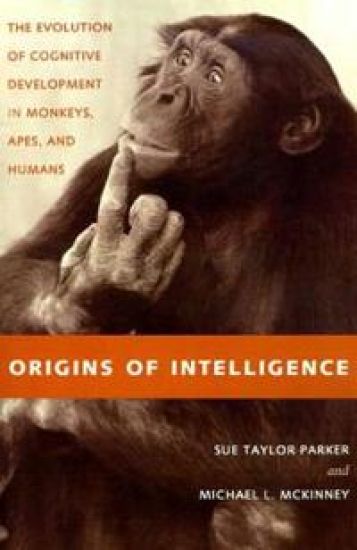
Origins of Intelligence

Origins of Intelligence

Sue Taylor Parker; Michael L. McKinney

Johns Hopkins University Press
2000
pokkari
Since Darwin's time, comparative psychologists have searched for a good way to compare cognition in humans and nonhuman primates. In Origins of Intelligence, Sue Parker and Michael McKinney offer such a framework and make a strong case for using human development theory (both Piagetian and neo-Piagetian) to study the evolution of intelligence across primate species. Their approach is comprehensive, covering a broad range of social, symbolic, physical, and logical domains, which fall under the all-encompassing and much-debated term intelligence. A widely held theory among developmental psychologists and social and biological anthropologists is that cognitive evolution in humans has occurred through juvenilization-the gradual accentuation and lengthening of childhood in the evolutionary process. In this work, however, Parker and McKinney argue instead that new stages were added at the end of cognitive development in our hominid ancestors, coining the term adultification by terminal extension to explain this process. Drawing evidence from scores of studies on monkeys, great apes, and human children, this book provides unique insights into ontogenetic constraints that have interacted with selective forces to shape the evolution of cognitive development in our lineage.