Kirjojen hintavertailu – 12 903 724 kirjaa ja 27 kauppaa

Kirjailija

Michael Loewe

Kirjat ja teokset yhdessä paikassa: 20 kirjaa, julkaisuja vuosilta 2002–2025, suosituimpiin kuuluu Rethinking Recarving. Vertaile teosten hintoja ja tarkista saatavuus suomalaisista kirjakaupoista.

20 kirjaa

Kirjojen julkaisuvuodet: 2002–2025.

Rethinking Recarving

Rethinking Recarving

Cary Y. Liu; Michael Loewe; Lydia Thompson; Zheng Yan; Susan N. Erickson; Klaas Ruitenbeek; Jiang Yingju; Miranda Brown; Michael Nylan; Hsing I-tien; Eileen Hsiang-ling Hsu; Lillian Lan-ying Tseng; Qianshen Bai

Yale University Press
2008
pokkari
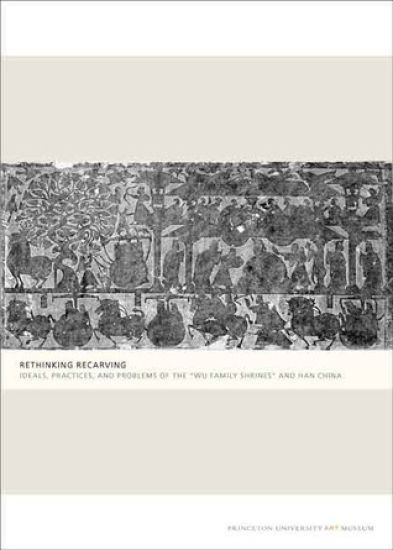
The "Wu Family Shrines" pictorial carvings from Han dynasty China (206 BCE–220 CE) are among the earliest works of Chinese art examined in an international arena. Since the eleventh century, the carvings have been identified by scholars as one of the most valuable and authentic materials for the study of antiquity. This important book presents essays by archaeologists, art and architectural historians, curators, and historians that reexamine the carvings, adding to our understanding of the long cultural history behind them and to our knowledge of Han practices. The authors offer a thorough analysis of surviving physical and visual sources, invoking fresh perspectives from new disciplines. Essays address the ideals, practices, and problems of the "Wu Family Shrines" and Han China; Han funerary art and architecture in Shandong and other regions; architectural functions and carved meanings; Qing Dynasty Reception of the Wu Family Shrines; and more. Distributed for the Princeton University Art Museum
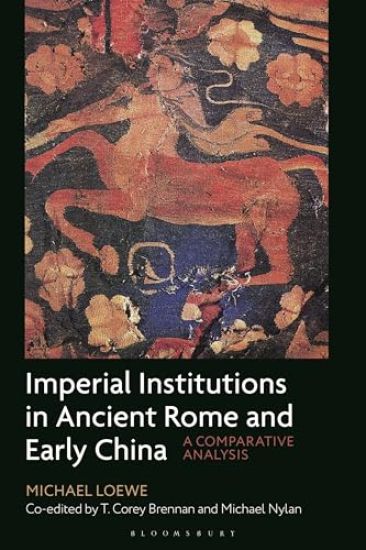
Imperial Institutions in Ancient Rome and Early China

Imperial Institutions in Ancient Rome and Early China

Michael Loewe; Michael Nylan; T. Corey Brennan

BLOOMSBURY PUBLISHING PLC
2025
sidottu
Written by the eminent sinologist Michael Loewe, and edited for publication by T. Corey Brennan and Michael Nylan, this book gives an overview of the considerations and practices of two major world empires that together ruled half of the earth's population in the first centuries BCE: ancient Rome and Han China. Approaching the historical material with a comparative perspective, Loewe examines the strengths and weaknesses, and the successes and failures, which can be seen in the organisation and government of these two political systems. Though each empire was largely ignorant of the other, the problems they faced were similar, given the rudimentary transportation and communication facilities of the time, the high mortality rates and the low levels of literacy. Yet each empire ruled its people in distinctly different ways, with the Roman empire governed largely by military officials, in contrast to the Chinese empire, whose administration was well stocked with roughly 130,000 highly trained professionals. The ten chapters of this book set out to compare the ways that these two contemporary regimes, similar in size and population, sought to control human activities and impose a set of regulated discipline over those who were ruled. Each chapter concerns the degrees and methods of forming a united people; the assumptions that lay behind such attempts; the reliance that imperial authority placed on religious practices; legal impositions and the structure of institutions; and the bases of social cohesion and economic co-operation. The result is an engaging study of two remarkable empires, whose rise and fall are contrasted in a way that deepens our understanding of empire and civilisation.
Imperial Institutions in Ancient Rome and Early China

Imperial Institutions in Ancient Rome and Early China

Michael Loewe; Michael Nylan; T. Corey Brennan

BLOOMSBURY PUBLISHING PLC
2025
nidottu

Halvin toimitettuna 34,40 €

Written by the eminent sinologist Michael Loewe, and edited for publication by T. Corey Brennan and Michael Nylan, this book gives an overview of the considerations and practices of two major world empires that together ruled half of the earth's population in the first centuries BCE: ancient Rome and Han China. Approaching the historical material with a comparative perspective, Loewe examines the strengths and weaknesses, and the successes and failures, which can be seen in the organisation and government of these two political systems. Though each empire was largely ignorant of the other, the problems they faced were similar, given the rudimentary transportation and communication facilities of the time, the high mortality rates and the low levels of literacy. Yet each empire ruled its people in distinctly different ways, with the Roman empire governed largely by military officials, in contrast to the Chinese empire, whose administration was well stocked with roughly 130,000 highly trained professionals. The ten chapters of this book set out to compare the ways that these two contemporary regimes, similar in size and population, sought to control human activities and impose a set of regulated discipline over those who were ruled. Each chapter concerns the degrees and methods of forming a united people; the assumptions that lay behind such attempts; the reliance that imperial authority placed on religious practices; legal impositions and the structure of institutions; and the bases of social cohesion and economic co-operation. The result is an engaging study of two remarkable empires, whose rise and fall are contrasted in a way that deepens our understanding of empire and civilisation.
Ways to Paradise

Ways to Paradise

Michael Loewe

TAYLOR FRANCIS LTD
2024
nidottu
First published in 1979, in Ways to Paradise Michael Loewe, an internationally recognised authority on Han China, assesses a wealth of an archaeological evidence in an attempt to uncover the attitudes of the pre-Buddhist Chinese to matters relating to death and hereafter. Dr Loewe examines in particular three major subjects of Han art and iconography: a recently found silk painting from Central China dating from around 168 BC; the numerous bronze mirrors of the so-called TLV pattern that came into fashion at the beginning of the Christian era, and which are especially rich in cosmological symbolism; and the representations of the Queen Mother of the West which appear as a leading motif of Chinese art from perhaps a century later. These Dr Loewe sets within a framework of contemporary literature and historical incident to create a wonderfully vivid picture of religious life and thought in this early and fascinating period of Chinese history which was to contribute so much to later developments in Far Eastern Philosophy, religion and art.
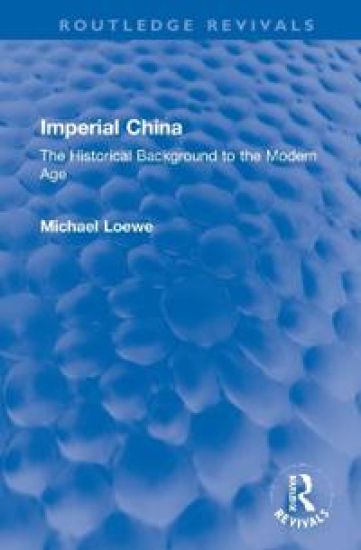
Imperial China

Imperial China

Michael Loewe

TAYLOR FRANCIS LTD
2024
nidottu
First published in 1966, Imperial China sets out to explain China’s past histories to non-specialists. Too often the West has misunderstood the East. China is credited with an excessively long cultural history; with a continuous line of dynastic succession; with uniformly practised institutions; or with intellectual stagnation. Michael Loewe sets out here to dispel some of these misconceptions, and to mark the stages in the evolution of China’s political forms, social organizations and economic progress that can be traced from the days of the first empire (from 221 B. C.) until the dynamic changes of the nineteenth century. He believes that a full understanding of modern China depends on a more than perfunctory glance at her past and has tried to provide the general historical context. The author is well aware that, thanks to the research of the last fifty years, it is now possible and indeed requisite to reach a deeper understanding of China's past. This book will be an essential read for scholars and researchers of Chinese history, Asian history, history in general.
Ways to Paradise

Ways to Paradise

Michael Loewe

TAYLOR FRANCIS LTD
2022
sidottu
First published in 1979, in Ways to Paradise Michael Loewe, an internationally recognised authority on Han China, assesses a wealth of an archaeological evidence in an attempt to uncover the attitudes of the pre-Buddhist Chinese to matters relating to death and hereafter. Dr Loewe examines in particular three major subjects of Han art and iconography: a recently found silk painting from Central China dating from around 168 BC; the numerous bronze mirrors of the so-called TLV pattern that came into fashion at the beginning of the Christian era, and which are especially rich in cosmological symbolism; and the representations of the Queen Mother of the West which appear as a leading motif of Chinese art from perhaps a century later. These Dr Loewe sets within a framework of contemporary literature and historical incident to create a wonderfully vivid picture of religious life and thought in this early and fascinating period of Chinese history which was to contribute so much to later developments in Far Eastern Philosophy, religion and art.
Imperial China

Imperial China

Michael Loewe

TAYLOR FRANCIS LTD
2021
sidottu
First published in 1966, Imperial China sets out to explain China’s past histories to non-specialists. Too often the West has misunderstood the East. China is credited with an excessively long cultural history; with a continuous line of dynastic succession; with uniformly practised institutions; or with intellectual stagnation. Michael Loewe sets out here to dispel some of these misconceptions, and to mark the stages in the evolution of China’s political forms, social organizations and economic progress that can be traced from the days of the first empire (from 221 B. C.) until the dynamic changes of the nineteenth century. He believes that a full understanding of modern China depends on a more than perfunctory glance at her past and has tried to provide the general historical context. The author is well aware that, thanks to the research of the last fifty years, it is now possible and indeed requisite to reach a deeper understanding of China's past. This book will be an essential read for scholars and researchers of Chinese history, Asian history, history in general.
Crisis and Conflict in Han China, 104 BC to AD 9
This book, first published in 1974, studies the historical development of China during the Western Han dynasty (202 BC-AD 9), a time of great intellectual, religious and political change. The struggle between Reformists and Modernists is analysed using texts contemporary to the time, and this struggle was a key point in Chinese history, leading as it did to enormous change, including to economics and foreign policy.
Crisis and Conflict in Han China, 104 BC to AD 9
This book, first published in 1974, studies the historical development of China during the Western Han dynasty (202 BC-AD 9), a time of great intellectual, religious and political change. The struggle between Reformists and Modernists is analysed using texts contemporary to the time, and this struggle was a key point in Chinese history, leading as it did to enormous change, including to economics and foreign policy.
Problems of Han Administration
Michael Loewe calls on literary and material evidence to examine three problems that arose in administering China’s early empires. Religious rites due to an emperor’s predecessors must both pay the correct services to his ancestors and demonstrate his right to succeed to the throne. In practical terms, tax collectors, merchants, farmers and townsmen required the establishment of a standard set of weights and measures that was universally operative and which they could trust. Those who saw reason to criticise the decisions taken by the emperor and his immediate advisors, whether on grounds of moral principles or political expediency, needed opportunities and the means of expressing their views, whether as remonstrants to the throne, by withdrawal from public life or as authors of private writings.
Bing: From Farmer's Son to Magistrate in Han China

Bing: From Farmer's Son to Magistrate in Han China

Michael Loewe

Hackett Publishing Co, Inc
2011
sidottu
Much is known of life during the Han Empire, but the historical evidence remains fragmentary, and nowhere do we find a continuous account of the life of any one individual. In this engaging volume, Michael Loewe mines the written and material records to depict the imagined life of an ordinary person, Bing Wu, from the hardships of his earliest years on a rural farm to his retirement from a respected position in government service. Underlying the tale of Bing is a richly detailed portrait of life during the Han--the arduous tasks of the conscript laborer; military service on the defense lines of the north; the travels of a merchant; the grueling conditions in an iron foundry; the construction of tombs; preparations for entering the civil service; the duties of a junior clerk and the governing of a commandery. Along the way, we are introduced to the operation of a crossbow; methods of telling time; the practice of writing; the rituals of divination; the ceremony of a state occasion, laws and the harsh consequences of breaking them; the workings of the central government and much more. Included are a concise introduction, explanatory endnotes to each chapter, a selection of illustrations, a map of the Han Empire, notes for further reading and an essay by Loewe entitled, "A Brief History of the Han Empire."
Dong Zhongshu, a ‘Confucian’ Heritage and the Chunqiu fanlu
Intellectual developments of the Western Han dynasty (202 BCE – 9 CE) have been studied hitherto on the assumptions that a system described as ‘Confucianism’ acquired paramount importance and that Dong Zhongshu (ca. 198 to ca. 107 BCE) had been responsible for formulating its principles. In challenging these assumptions, this book examines Dong’ career and reputation, and his supposed authorship of the Chunqiu fanlu, for long subject to question. It is concluded that while some parts of that text may well represent the teachings that Dong Zhongshu promoted, some may perhaps date from as late as 79 CE; still others bear an affinity to writings which, banned as being suspect or potentially subversive, survive in no more than fragmentary form.
Divination, Mythology and Monarchy in Han China

Divination, Mythology and Monarchy in Han China

Michael Loewe

Cambridge University Press
2008
pokkari
Chinese empires were established by force of arms, but sustained by religious rites and intellectual theory. The four centuries from 206 BC to AD 220 witnessed major changes in the state cults and the concepts of monarchy, while various techniques of divination were used to forecast the future or to solve immediate problems. Michael Loewe examines these changes and the links between religion and statecraft. While both mythology and the traditions nurtured by the learned affected the concept and practice of monarchy throughout the period, the political and social weaknesses of the last century of Han rule bring into question the success that was achieved by the imperial ideal. Nevertheless, that ideal and its institutions were of prime importance for the understanding of Han times and for the influence they exercised on China's later dynasties.
Government of the Qin and Han Empires

Government of the Qin and Han Empires

Michael Loewe

Hackett Publishing Co, Inc
2006
pokkari
Provides an overview of the government of the early empires of China. This work discusses topics such as: the seat of supreme authority; the structure of central government; provincial and local government; the armed forces; officials; government communications; laws of the empire; control of the people and the land; and, problems and weaknesses.
Faith, Myth, and Reason in Han China

Faith, Myth, and Reason in Han China

Michael Loewe

Hackett Publishing Co, Inc
2005
sidottu
In his classic study of the cultural history of Han China, Michael Loewe uses both archaeological discoveries and written records to sketch the conceptual background of various artifacts of the Han period, and shows how ancient Chinese thought is as much informed by mythology as it is dependent on reason. Originally published as Chinese Ideas of Life and Death: Faith, Myth and Reason in the Han Period (202 BC-AD 220), this edition includes a new Preface that discusses relevant discoveries made since the first publication and an updated list of other works on relevant topics.
Everyday Life in Early Imperial China

Everyday Life in Early Imperial China

Michael Loewe

Hackett Publishing Co, Inc
2005
sidottu
In this lively and accessible account, with illustrations on nearly every page, Michael Loewe gives us a vivid picture of the lives of peasants working the land, the lives of town inhabitants, and the elaborate hierarchy of institutions and civil servants that sustained the vast imperial government. In a new Preface and an updated Bibliography, Loewe calls our attention to the significance of scholarly research and discoveries since the original publication of his classic work.
Records of Han Administration

Records of Han Administration

Michael Loewe

RoutledgeCurzon
2002
muu
The first volume is a survey and discussion of the inscriptions on about 700 wooden strips found in the excavations at Edsen-gol, being records of the official Han administration concerned largely with military organisation. The second volume sets out the evidence itself.