Kirjojen hintavertailu – 12 903 725 kirjaa ja 27 kauppaa
Kirjailija
Michael P. Johnson
Kirjat ja teokset yhdessä paikassa: 11 kirjaa, julkaisuja vuosilta 1999–2022, suosituimpiin kuuluu A Typology of Domestic Violence. Vertaile teosten hintoja ja tarkista saatavuus suomalaisista kirjakaupoista.
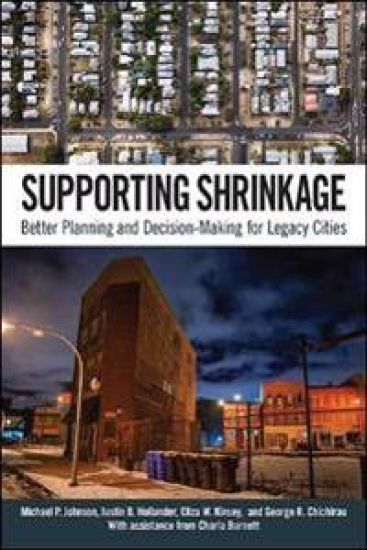
Demonstrates how residents can play a leading role in the positive transformation of their communities in the face of economic and population decline. Supporting Shrinkage describes a new approach to citizen-engaged, community-focused planning methods and technologies for cities and regions facing decline, disinvestment, shrinkage, and social and physical distress. The volume evaluates the benefits and costs of a wide range of analytic approaches for designing policy and planning interventions for shrinking cities and distressed communities. These include collaborative planning, social media, civic technology, game design, analytics, decision modeling and decision support, and spatial analysis. The authors present case studies of three US cities addressing shrinkage and decline, with a focus on issues of social justice, democratization of knowledge, and local empowerment. Proposed as a solution is an approach that puts community engagement and empowerment at the center, combined with data and technology innovations. The authors argue that decisions informed by qualitative and quantitative data and analytic methods, implemented through accessible and affordable technologies, and based on notions of social impact and social justice, can enable residents to play a leading role in the positive transformation of shrinking cities and distressed communities.
What does karate have to do with PTSD, and how does a veteran recover after military experience? How does karate help an aging karateka prepare for that very last dan exam? This book is the well-told story of a senior karateka's journey through fifty-one years of karate. Johnson Sensei tells us how karate became a tool to help him mend soul and psyche as a young man dealing with the aftermath of military experience. He also describes how karate became a way of living in his later years. Weaving through the decades with stirring, provocative, and engrossing true stories, you will experience Johnson's journey through the earliest days of triggers and unidentified symptoms, memories, and the role that karate has played in transforming anger and suffering into acceptance and peace of mind. Karateka will appreciate the stories of earlier days in karate, learning from the masters, karate politics, and survival. Michael Johnson, PhD, a veteran, a survivor of post traumatic stress disorder, a licensed psychotherapist, and a practitioner of karate for over fifty years, uses engaging personal stories that serve veterans of any age as well as new and experienced practitioners of karate.
Demonstrates how residents can play a leading role in the positive transformation of their communities in the face of economic and population decline. Supporting Shrinkage describes a new approach to citizen-engaged, community-focused planning methods and technologies for cities and regions facing decline, disinvestment, shrinkage, and social and physical distress. The volume evaluates the benefits and costs of a wide range of analytic approaches for designing policy and planning interventions for shrinking cities and distressed communities. These include collaborative planning, social media, civic technology, game design, analytics, decision modeling and decision support, and spatial analysis. The authors present case studies of three US cities addressing shrinkage and decline, with a focus on issues of social justice, democratization of knowledge, and local empowerment. Proposed as a solution is an approach that puts community engagement and empowerment at the center, combined with data and technology innovations. The authors argue that decisions informed by qualitative and quantitative data and analytic methods, implemented through accessible and affordable technologies, and based on notions of social impact and social justice, can enable residents to play a leading role in the positive transformation of shrinking cities and distressed communities.
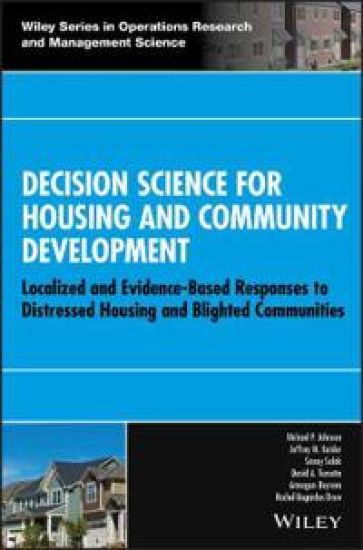
A multidisciplinary approach to problem-solving in community-based organizations using decision models and operations research applications A comprehensive treatment of public-sector operations research and management science, Decision Science for Housing and Community Development: Localized and Evidence-Based Responses to Distressed Housing and Blighted Communities addresses critical problems in urban housing and community development through a diverse set of decision models and applications. The book represents a bridge between theory and practice and is a source of collaboration between decision and data scientists and planners, advocates, and community practitioners. The book is motivated by the needs of community-based organizations to respond to neighborhood economic and social distress, represented by foreclosed, abandoned, and blighted housing, through community organizing, service provision, and local development. The book emphasizes analytic approaches that increase the ability of local practitioners to act quickly, thoughtfully, and effectively. By doing so, practitioners can design and implement responses that reflect stakeholder values associated with healthy and sustainable communities; that benefit from increased organizational capacity for evidence-based responses; and that result in solutions that represent improvements over the status quo according to multiple social outcome measures. Featuring quantitative and qualitative analytic methods as well as prescriptive and exploratory decision modeling, the book also includes: Discussions of the principles of decision theory and descriptive analysis to describe ways to identify and quantify values and objectives for community developmentMathematical programming applications for real-world problem solving in foreclosed housing acquisition and redevelopmentApplications of case studies and community-engaged research principles to analytics and decision modeling Decision Science for Housing and Community Development: Localized and Evidence-Based Responses to Distressed Housing and Blighted Communities is an ideal textbook for upper-undergraduate and graduate-level courses in decision models and applications; humanitarian logistics; nonprofit operations management; urban operations research; public economics; performance management; urban studies; public policy; urban and regional planning; and systems design and optimization. The book is also an excellent reference for academics, researchers, and practitioners in operations research, management science, operations management, systems engineering, policy analysis, city planning, and data analytics.
This collection offers students the essential Lincoln in a brief and accessible format. From famous documents like the Lincoln-Douglas debates and the second inaugural address to crucial memoranda and letters, it reveals the development of Lincoln's views on all the critical issues of the day.
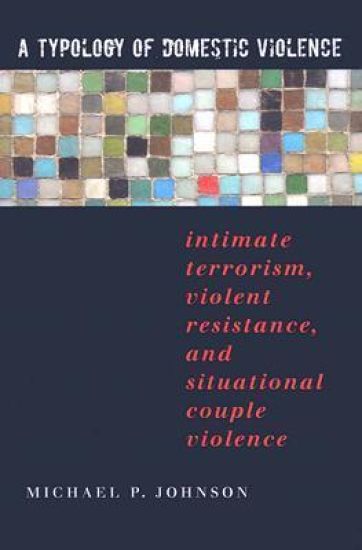
Domestic violence, a serious and far-reaching social problem, has generated two key debates among researchers. The first debate is about gender and domestic violence. Some scholars argue that domestic violence is primarily male-perpetrated, others that women are as violent as men in intimate relationships. Johnson's response to this debate - and the central theme of this book - is that there is more than one type of intimate partner violence. Some studies address the type of violence that is perpetrated primarily by men, while others are getting at the kind of violence that women are involved in as well. Because there has been no theoretical framework delineating types of domestic violence, researchers have easily misread one another's studies. The second major debate involves how many women are abused each year by their partners. Estimates range from two to six million. Johnson's response once again comes from this book's central theme. If there is more than one type of intimate partner violence, then the numbers depend on what type you're talking about. Johnson argues that domestic violence is not a unitary phenomenon. Instead, he delineates three major, dramatically different, forms of partner violence: intimate terrorism, violent resistance, and situational couple violence. He roots the conceptual distinctions among the forms of violence in an analysis of the role of power and control in relationship violence and shows that the failure to make these basic distinctions among types of partner violence has produced a research literature that is plagued by both overgeneralizations and ostensibly contradictory findings. This volume begins the work of theorizing forms of domestic violence, a crucial first step to a better understanding of these phenomena among scholars, social scientists, policy makers, and service providers. It reassesses thirty years of domestic violence research and demonstrates three forms of partner violence, distinctive in their origins, effects, and treatments.
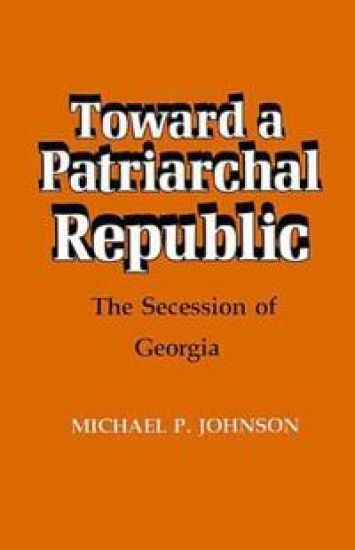
Traditionally, the secession of the states in the lower South has been viewed as an irrational response to Lincoln's election or as a rational response to the genuine threat a Republican president posed to the geographical expansion of slavery. Both views emphasize the fundamental importance of relations between the federal government and the southern states, but overlook the degree to which secession was a response to a crisis within the South. Johnson argues that secession was a double revolution -- for home rule and for those who ruled at home -- brought about by an internal crisis in southern society. He portrays secession as the culmination of the long-developing tension between slavery on one side and the institutional and ideological consequences of the American Revolution on the other. This tension was masked during the antebellum years by the conflicting social, political, sectional, and national loyalties of many southerners. Lincoln's election forced southerners to choose among their loyalties, and their choice revealed a South that was divided along lines coinciding roughly with an interest in slavery and the established order. Starting with a thorough analysis of election data and integrating quantitative with more traditional literary sources, Johnson goes beyond the act of secession itself to examine what the secessionists said and did after they left the Union. Although this book is a close study of secession in Georgia, it has implications for the rest of the lower South. The result is a new thesis that presents secession as the response to a more complex set of motivations than has been recognized.