Kirjojen hintavertailu – 12 866 807 kirjaa ja 27 kauppaa
Kirjailija
Michael P. Zuckert
Kirjat ja teokset yhdessä paikassa: 10 kirjaa, julkaisuja vuosilta 1997–2026, suosituimpiin kuuluu The Walter Berns Constitution Day Lectures: 2011-24. Vertaile teosten hintoja ja tarkista saatavuus suomalaisista kirjakaupoista.
James W Ceasar; Liz Cheney; Christopher Demuth; Philip Hamburger; Leon R Kass; Brett M Kavanaugh; Yuval Levin; Wilfred M McClay; Michael W McConnell; Michael B Mukasey; Jeremy a Rabkin; Neomi Rao; Diana Schaub; James R Stoner; Catherine H Zuckert; Michael P Zuckert
In September 2011, AEI honored longtime AEI colleague Walter Berns with a panel dedicated to discussing his scholarship on the Constitution and the republican polity it supports. At this event, former AEI President Arthur C. Brooks announced that henceforth, AEI's annual Constitution Day celebration would be named in honor of Walter. This volume is a collection of the 13 Walter Berns Constitution Day Lectures given since 2012. Walter's own work ranged widely, addressing issues on such diverse topics as civil and religious liberties, free speech, capital punishment, political philosophy, political science, presidential selection, and patriotism. It's fitting that the lectures named after him cover an equally broad array of topics related to the Constitution and the American republic.
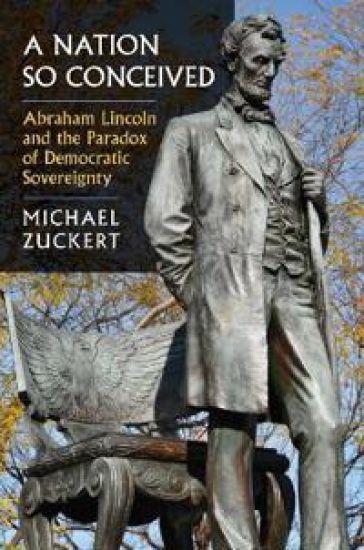
The culmination of years of work on Abraham Lincoln’s political thought, Michael P. Zuckert’s A Nation So Conceived argues for a coherent center to Lincoln’s political ideology, a core idea that unifies his thought and thus illuminates his deeds as a political actor. That core idea is captured in the term “democratic sovereignty.” Zuckert provides invaluable guidance to understanding both Lincoln and the politics of the United States between 1845 and Lincoln’s death in 1865 by focusing on roughly a dozen speeches that Lincoln made during his career. This reader-friendly chronological organization is motivated by Zuckert’s emphasis on Lincoln as a practical politician who was always fully aware of the political context of the moment within which he was speaking. According to Lincoln’s speech at Gettysburg, America was new precisely because it was born in dedication to the first premise of the theory of democratic sovereignty: that all men are created equal. Lincoln’s thought consisted in an ever-deepening meditation on the grounds and implications of that proposition, both in its constructive and in its destructive potential. The goodness of the American regime is derived from that ground and the chief dangers to the regime emanate from the same soil. Covering all significant speeches and writings of Lincoln both in his pre-presidential and presidential days, A Nation So Conceived is devoted to exploring the paradoxical duality of “created equal.” In a nearly comprehensive study of Lincoln’s thought, Zuckert uses lessons he learned from decades of teaching to reveal how Lincoln understood both its truth and its pathological consequences while offering an assessment of his aims and achievements as a statesman.
The culmination of years of work on Abraham Lincoln’s political thought, Michael Zuckert’s A Nation So Conceived argues for a coherent center to Lincoln’s political ideology, a core idea that unifies his thought and thus illuminates his deeds as a political actor. That core idea is captured in the term “democratic sovereignty.” Zuckert provides invaluable guidance to understanding both Lincoln and the politics of the United States between 1845 and Lincoln’s death in 1865 by focusing on roughly a dozen speeches that Lincoln made during his career. This reader-friendly chronological organization is motivated by Zuckert’s emphasis on Lincoln as a practical politician who was always fully aware of the political context of the moment within which he was speaking. According to Lincoln’s speech at Gettysburg, America was new precisely because it was born in dedication to the first premise of the theory of democratic sovereignty: that all men are created equal. Lincoln’s thought consisted in an ever-deepening meditation on the grounds and implications of that proposition, both in its constructive and in its destructive potential. The goodness of the American regime is derived from that ground and the chief dangers to the regime emanate from the same soil. Covering all significant speeches and writings of Lincoln both in his pre-presidential and presidential days, A Nation So Conceived is devoted to exploring the paradoxical duality of “created equal.” In a nearly comprehensive study of Lincoln’s thought, Zuckert uses lessons he learned from decades of teaching to reveal how Lincoln understood both its truth and its pathological consequences while offering an assessment of his aims and achievements as a statesman.
Leo Strauss and his alleged political influence regarding the Iraq War have in recent years been the subject of significant media attention, including stories in the Wall Street Journal and New York Times. Time magazine even called him one of the most influential men in American politics. With The Truth about Leo Strauss, Michael and Catherine Zuckert challenged the many claims and speculations about this notoriously complex thinker. Now, with Leo Strauss and the Problem of Political Philosophy, they turn their attention to a searching and more comprehensive interpretation of Strauss's thought as a whole, using the many manifestations of the problem of political philosophy as their touchstone.
Leo Strauss and his alleged political influence regarding the Iraq War have in recent years been the subject of significant media attention, including stories in the Wall Street Journal and New York Times. Time even called him "one of the most influential men in American politics." With The Truth about Leo Strauss, Michael P. and Catherine H. Zuckert challenged the many claims about this notoriously complex thinker. Now, with Leo Strauss and the Problem of Political Philosophy, they turn their attention to a more comprehensive interpretation of Strauss' thought as a whole. For Strauss, political philosophy presented a "problem" to which there have been a variety of solutions proposed over the course of Western history. Strauss' work, they show, revolved around recovering - and restoring-political philosophy to its original Socratic form. Since positivism and historicism represented two intellectual currents that undermined the possibility of a Socratic political philosophy, the first part of the book is devoted to Strauss' critique of these two positions. Then the authors explore Strauss' interpretation of both ancient and modern canonical political philosophers, including Plato, Aristotle, Machiavelli, and Locke. Strauss' often-unconventional readings of these philosophers, they argue, pointed to solutions to the problem of political philosophy. Finally, the authors examine Strauss' thought in the context of the twentieth century, when his chief interlocutors were Schmitt, Husserl, Heidegger, and Nietzsche. The book ultimately shows Strauss' writings as an attempt to reveal how characteristics of ancient and modern thought derive from different modes of solving the problem of political philosophy and why he considered the ancient solution superior.
Is Leo Strauss truly an intellectual forebear of neoconservatism and a powerful force in shaping Bush administration foreign policy? "The Truth about Leo Strauss" puts this question to rest, revealing for the first time how the popular media came to perpetuate an oversimplified view of a complex and wide-ranging philosopher. In doing so, it corrects our perception of Strauss, providing the best general introduction available to the political thought of this misunderstood figure. Catherine and Michael Zuckert - both former students of Strauss - guide readers here to a nuanced understanding of how Strauss' political thought fits into his broader philosophy. Challenging the idea that Strauss was an inflexible conservative who followed in the foot-steps of Nietzsche, Heidegger, and Carl Schmitt, the Zuckerts contend that Strauss' signature idea was the need for a return to the ancients. Through their work, they conclude that Strauss was a sober defender of liberal democracy, aware of both its strengths and its weaknesses. Balanced and accessible, "The Truth about Leo Strauss" is a must-read for anyone who wants to more fully comprehend this enigmatic philosopher and his much-disputed legacy.
In this volume, prominent political theorist Michael Zuckert presents an important and pathbreaking set of meditations on the thought of John Locke. In more than a dozen provocative essays, many appearing in print for the first time. Zuckert explores the complexity of Locke's engagement with his philosophical and theological predecessors, his profound influence on later liberal thinkers, and his amazing success in transforming the political understanding of the Anglo-American world. At the same time, he also demonstrates Locke's continuing relevance in current debates involving such prominent thinkers as Rawls and MacIntyre. Zuckert's careful reconsideration of Locke's role as ""launcher"" of liberalism involves a sustained engagement with the hermeneutical issues surrounding Locke, an innovator who faced special rhetorical needs in addressing his contemporaries and the future. It also involves highlighting the novelty of Locke's position by examining his stance toward the philosophical and religious traditions in place when he wrote. Zuckert argues that neither of the dominant ways of understanding Locke's relations to his predecessors and contemporaries is adequate; he is not well seen as a follower of any orthodoxy nor of any anti-orthodoxy of his day, either philosophical or theological. He found a path to innovation that was philosophically radical but which was also able to connect with prevailing and accepted traditions. This path allowed him to exercise a practical influence in history rarely, if ever, matched by any other philosopher. Zuckert illustrates that influence by showing how William Blackstone used Lockean philosophy to reshape the common law and how the Americans of the eighteenth century used Lockean philosophy to reshape Whig political thought. Zuckert argues that Locke's philosophy has continuing philosophic and political force, a proposition he demonstrates by arguing that Locke presents a form of political philosophy superior to that of the liberal theorists of our day and that he has solid rejoinders to contemporary critics of liberalism.
In The Natural Rights Republic, renowned political theorist Michael P. Zuckert examines the natural rights philosophy as expressed in sources like the Declaration of Independence and aims to counter contemporary confusion by offering an insightful study of the concept that dominated the mindset of the founding generation of the United States.