Kirjojen hintavertailu – 12 903 733 kirjaa ja 27 kauppaa

Kirjailija

Michael R. Reich

Kirjat ja teokset yhdessä paikassa: 6 kirjaa, julkaisuja vuosilta 2009–2019, suosituimpiin kuuluu Getting Health Reform Right, Anniversary Edition. Vertaile teosten hintoja ja tarkista saatavuus suomalaisista kirjakaupoista.

6 kirjaa

Kirjojen julkaisuvuodet: 2009–2019.

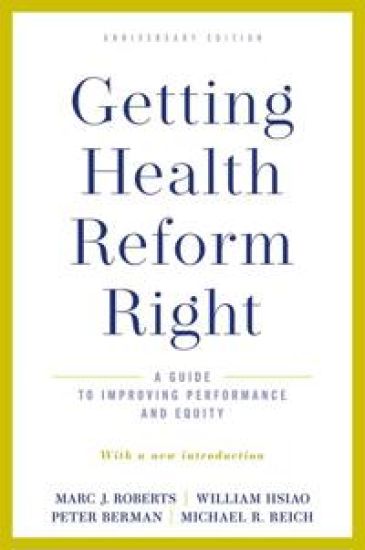
Getting Health Reform Right, Anniversary Edition

Getting Health Reform Right, Anniversary Edition

Marc J. Roberts; William Hsiao; Peter Berman; Michael R. Reich

Oxford University Press Inc
2019
nidottu
THE FOUNDATIONAL WORK IN HEALTH REFORM, CELEBRATING 15 YEARS OF INFLUENCE Featuring a new introduction by the authors Getting Health Reform Right is the world's leading text for understanding and managing health systems and their reform. Its simple, analytical model allows readers to design their own approach to improve health-system performance based on three outcomes of greatest importance (health status, citizen satisfaction, and financial risk protection), with step-by-step instructions for defining problems, diagnosing causes, devising solutions, and implementing changes. "Rapidly assumed the status of a classic and proved an inspiration to a generation of students and policymakers. It is as relevant today as when it was first published." -Peter C. Smith, Emeritus Professor of Health Policy, Imperial College Business School, London "Has become the mainstay of health-system reform conversations among policymakers in India. Its unique and accessible framing, which goes beyond abstract ideas, has resonated strongly in debates over how to improve health system performance." -Nachiket Mor, former Director, Bill and Melinda Gates Foundation, India
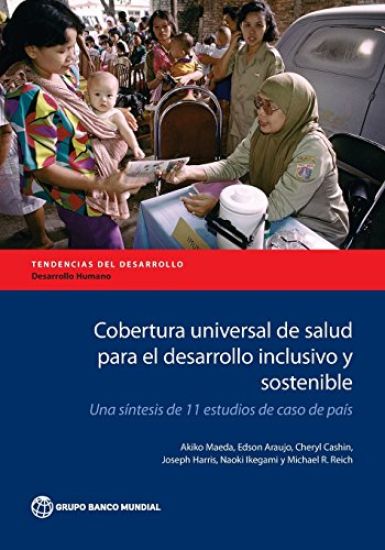
Cobertura Universal de Salud para el Desarrollo Inclusivo y Sostenible

Cobertura Universal de Salud para el Desarrollo Inclusivo y Sostenible

Akiko Maeda; Edson Araujo; Cheryl Cashin; Joseph Harris; Naoki Ikegami; Michael R. Reich

World Bank Publications
2015
nidottu
Los fines de la cobertura universal de salud son asegurar que toda la poblacion pueda acceder a servicios de salud de calidad. Parses que han logrado la cobertura universal de salud estan demostrando c6mo estos programas pueden servir como mecanismos esenciales de mejora de la salud.
Une Couverture Sanitaire Universelle Pour Un Développement Durable Inclusif

Une Couverture Sanitaire Universelle Pour Un Développement Durable Inclusif

Akiko Maeda; Edson Araujo; Cheryl Cashin; Joseph Harris; Naoki Ikegami; Michael R. Reich

World Bank Publications
2015
nidottu
La couverture sanitaire universelle pour un développement durable inclusif synthétise les expériences de 11 pays ? Bangladesh, Brésil, Éthiopie, France, Ghana, Indonésie, Japon, Pérou, Thaïlande, Turquie et Vietnam - dans la mise en ?uvre de politiques et de stratégies d'atteinte et de maintien de la CSU.
Governing Health Systems

Governing Health Systems

Michael R. Reich; Keizo Takemi

Bibliomotion, Incorporated
2015
sidottu
Governing Health Systems: For Nations and Communities Around the World examines the complex relationships between governance and performance in community and national health systems. Each chapter provides an in-depth case study, using both qualitative and quantitative methods, on health systems in many countries, including Uganda, Ghana, India, Zambia, Japan, Nigeria, Indonesia, Brazil, Palestine, and South Korea. The chapters were written by former Takemi Fellows, who were mid-career research fellows at the Harvard T. H. Chan School of Public Health, and their colleagues. This case study approach yields important findings as well as contextual insights about the challenges and accomplishments in addressing governance issues in national and community health systems around the world. Health policymakers around the world are struggling to address the multiple challenges of governing health systems. These challenges also represent important themes for the research mission of the Takemi Program in International Health at the Harvard T. H. Chan School of Public Health. This book is based on the program’s thirtieth anniversary symposium held in October 2013 at Harvard. The studies presented in this book—deep examinations of illustrative examples of health system governance for communities and nations—contribute to our knowledge about global health and assist policymakers in dealing with the complex practical problems of health systems. In short, this book addresses central questions about governing health systems—and why governance matters.
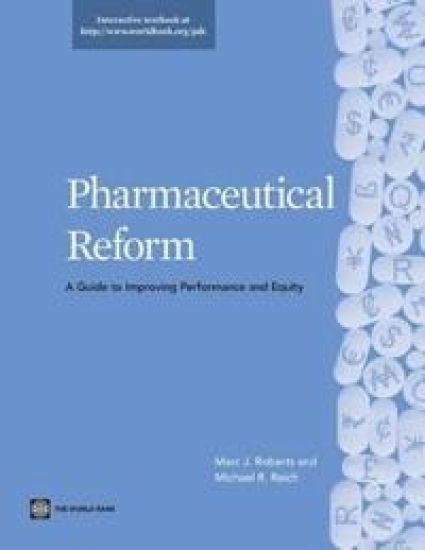
Pharmaceutical Reform

Pharmaceutical Reform

Marc J. Roberts; Michael R. Reich

World Bank Publications
2011
nidottu
This book applies an established analytical framework for health sector reform (Getting Health Reform Right, Oxford, 2004) to the performance problems of the pharmaceutical sector. The book is divided into three sections. The first section presents the basic ideas for analysis. It begins by insisting that reform start with a clear understanding of the performance deficiencies of the current system. Like all priority setting in the public sector, this 'definition of the problem' involves both ethical choices and political processes. Early chapters explain the foundations of these ideas and apply them to the pharmaceutical sector. The relationship of ultimate outcomes (like health status or risk protection) to classic health systems concepts like efficiency, access and quality is also explored. The last chapter in the first part is devoted to 'diagnosis' - explaining how to move from the definition of a problem to an understanding of how the functioning of the system produces the undesirable outcomes in question. The second part of the book devotes one chapter to each of five 'control knobs': finance, payment, organization, regulation and persuasion. These are sets of potential interventions that governments can use to improve pharmaceutical sector performance. Each chapter presents basic concepts and discusses examples of reform options. Throughout we provide 'conditional guidance' - avoiding the approach of a 'one size fits all' model of 'best practices' in these five arenas for reform. Instead we stress the need for local knowledge of political systems, administrative capacities, community values and market conditions in order to design pharmaceutical sector policies appropriate to a country’s particular circumstances. The last part of the book is a set of teaching cases. Each is preceded by questions and is followed by a brief note on the lessons to be learned. The goal is to help readers develop the skills they need to deal effectively with pharmaceutical sector reform problems in their own countries.
Access

Access

Laura J. Frost; Michael R. Reich; Tadataka Yamada

Harvard Center for Population and Development Studies
2009
nidottu
Many people in developing countries lack access to health technologies, even basic ones. Why do these problems in access persist? What can be done to improve access to good health technologies, especially for poor people in poor countries? This book answers those questions by developing a comprehensive analytical framework for access and examining six case studies to explain why some health technologies achieved more access than others. The technologies include praziquantel (for the treatment of schistosomiasis), hepatitis B vaccine, malaria rapid diagnostic tests, vaccine vial monitors for temperature exposure, the Norplant implant contraceptive, and female condoms. Based on research studies commissioned by the Bill & Melinda Gates Foundation to better understand the development, adoption, and uptake of health technologies in poor countries, the book concludes with specific lessons on strategies to improve access. These lessons will be of keen interest to students of health and development, public health professionals, and health technology developers—all who seek to improve access to health technologies in poor countries.