Kirjojen hintavertailu – 12 903 725 kirjaa ja 27 kauppaa

Kirjailija

Michael Ruse

Kirjat ja teokset yhdessä paikassa: 51 kirjaa, julkaisuja vuosilta 1979–2024, suosituimpiin kuuluu Darwin and Design. Vertaile teosten hintoja ja tarkista saatavuus suomalaisista kirjakaupoista.

51 kirjaa

Kirjojen julkaisuvuodet: 1979–2024.

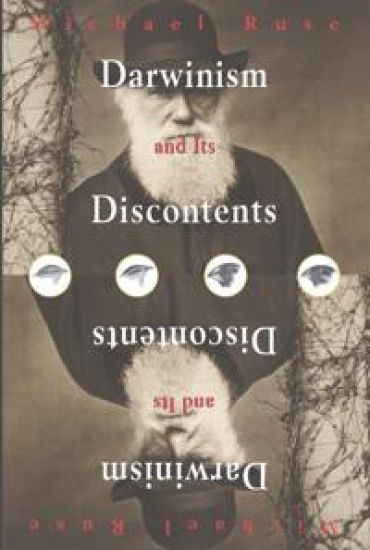
Darwinism and its Discontents

Darwinism and its Discontents

Michael Ruse

Cambridge University Press
2008
pokkari
Presenting an ardent defence of Charles Darwin's theory of evolution, this book offers a clear and comprehensive exposition of Darwin's thinking. Michael Ruse brings the story up to date, examining the origins of life, the fossil record, and the mechanism of natural selection. Rival theories are explored, from punctuated equilibrium to human evolution (including the recently found 'hobbits', Homo floresiensis). The philosophical and religious implications of Darwinism are discussed, including a discussion of Creationism and its modern day offshoot, Intelligent Design Theory. Ruse draws upon the most recent discoveries, writing with a minimum of jargon in order to appeal to all readers, from professional biologists to those concerned that Darwinism is a naturalistic religion that is forced on school children despite their own Christian convictions. Openly revealing his own beliefs, Ruse presents readers with all the information and critical tools they need to make an informed decision on evolutionary theory.
Charles Darwin

Charles Darwin

Michael Ruse

Wiley-Blackwell (an imprint of John Wiley Sons Ltd)
2008
sidottu
The definitive work on the philosophical nature and impact of the theories of Charles Darwin, written by a well-known authority on the history and philosophy of Darwinism. Broadly explores the theories of Charles Darwin and Darwin studiesIncorporates much information about modern BiologyOffers a comprehensive discussion of Darwinism and Christianity – including Creationism – by one of the leading authorities in the fieldWritten in clear, concise, user-friendly language supplemented with quality illustrationsExamines the status of evolutionary theory as a genuine theory and its implications for philosophy, epistemology and ethicsProvides a strong understanding of the philosophical nature and impact of Darwin's thoughtHolds wide appeal for general audiences outside the world of academic philosophyStrongly supports Darwinism and fully explores modern naturalistic explanations of religion
The Evolution-Creation Struggle

The Evolution-Creation Struggle

Michael Ruse

Harvard University Press
2006
nidottu
Creation versus evolution: What seems like a cultural crisis of our day, played out in courtrooms and classrooms across the county, is in fact part of a larger story reaching back through the centuries. The views of both evolutionists and creationists originated as inventions of the Enlightenment--two opposed but closely related responses to a loss of religious faith in the Western world. In his latest book, Michael Ruse, a preeminent authority on Darwinian evolutionary thought and a leading participant in the ongoing debate, uncovers surprising similarities between evolutionist and creationist thinking. Exploring the underlying philosophical commitments of evolutionists, he reveals that those most hostile to religion are just as evangelical as their fundamentalist opponents. But more crucially, and reaching beyond the biblical issues at stake, he demonstrates that these two diametrically opposed ideologies have, since the Enlightenment, engaged in a struggle for the privilege of defining human origins, moral values, and the nature of reality. Highlighting modern-day partisans as divergent as Richard Dawkins and Left Behind authors Tim LaHaye and Jerry B. Jenkins, Ruse's bracing book takes on the assumptions of controversialists of every stripe and belief and offers to all a new and productive way of understanding this unifying, if often bitter, quest.
Darwinism and its Discontents

Darwinism and its Discontents

Michael Ruse

Cambridge University Press
2006
sidottu
Presenting an ardent defence of Charles Darwin's theory of evolution, this book offers a clear and comprehensive exposition of Darwin's thinking. Michael Ruse brings the story up to date, examining the origins of life, the fossil record, and the mechanism of natural selection. Rival theories are explored, from punctuated equilibrium to human evolution (including the recently found 'hobbits', Homo floresiensis). The philosophical and religious implications of Darwinism are discussed, including a discussion of Creationism and its modern day offshoot, Intelligent Design Theory. Ruse draws upon the most recent discoveries, writing with a minimum of jargon in order to appeal to all readers, from professional biologists to those concerned that Darwinism is a naturalistic religion that is forced on school children despite their own Christian convictions. Openly revealing his own beliefs, Ruse presents readers with all the information and critical tools they need to make an informed decision on evolutionary theory.
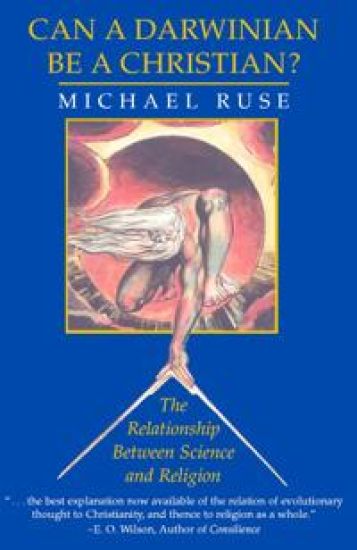
Can a Darwinian be a Christian?

Can a Darwinian be a Christian?

Michael Ruse

Cambridge University Press
2004
pokkari
Adopting a balanced perspective on the subject, Michael Ruse offers a serious examination of both Darwinism and Christianity. He covers a wide range of topics, from the Scopes Monkey Trial to claims about the religious significance of extraterrestrials. He deals with major figures in the current science/religion debate and considers in detail the claims of the new creationism, revealing some surprising parallels between Darwinian materialists and traditional thinkers such as St. Augustine. Michael Ruse argues that, although it is at times difficult for a Darwinian to embrace Christian belief, it is by no means inconceivable. At the same time he suggests ways in which a Christian believer should have no difficulty accepting evolution in general, and Darwinism in particular.
Agents Under Fire

Agents Under Fire

Angus J. L. Menuge; Michael Ruse

Rowman Littlefield Publishers
2004
sidottu
In the first study of its kind, Agents Under Fire defends a robust notion of agency and intentionality against eliminative and naturalistic alternatives, showing the interconnections between the philosophy of mind, theology, and Intelligent Design. Menuge argues that Behe's irreducible complexity is a challenge to reductionism not only in biology, but also in psychology, and shows the inability of the Darwinian psychology proposed by Dawkins, Dennett, and Steven Pinker to explain the integration, unity, direction, and reliability of rational thought. This fascinating defense against scientific materialism is the only book-length study relating Intelligent Design to contemporary issues in the philosophy of mind. Drawing on his experience as both a philosopher and a computer scientist, Menuge deftly shows the reader that the materialist's attempts to rid science of all commitment to teleology can only result in incoherence, and presents instead his own unique argument for the legitimacy of Intelligent Design.
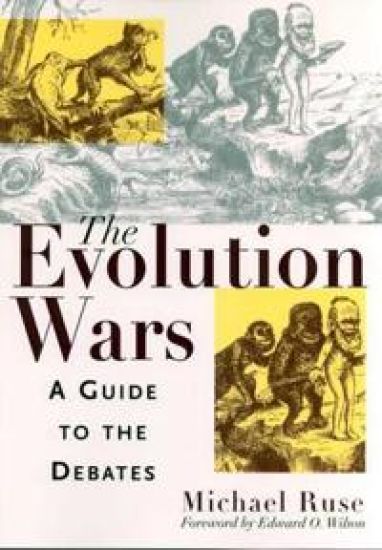
The Evolution Wars

The Evolution Wars

Michael Ruse

Rutgers University Press
2001
nidottu
The Evolution Wars draws on history, science, and philosophy to examine the development of evolutionary thought through the past two and a half centuries. It focuses on the debates that have engaged, divided, and ultimately provoked scientists to ponder the origins of organisms—including humankind—paying regard to the nineteenth-century clash over the nature of classification and debates about the fossil record, genetics, and human nature. Much attention is paid to external factors and the underlying motives of scientists. In these pages you will meet Charles Darwin’s ebullient grandfather Erasmus, the contentious Frenchmen Georges Cuvier and Etienne Geoffroy Stain-Hillaire, new creationist Phillip Johnson, the brilliant J. B. S. Haldane, outspoken Richard Dawkins, and many other stars of the debates. The Evolution Wars explores the ten greatest controversies surrounding evolution in world history, with emphasis on recent times, including the infamous Scopes trial of the 1920s: the search for human origins and speculation about the “missing link,” spurred by the discovery of “Lucy;” the debate surrounding the new theory of paleontology proposed by Stephen Jay Gould; and the rise of teaching “creation science” in public school as a subject on par with evolution. Although the author takes a strong stand on the side of evolution, he also shows respect for dissenting viewpoints. Thus, the book is intellectually rewarding not only for evolutionists but also for opponents of evolution theory, especially those who want to see how one of the great ideas of Western civilization resonates through time, both within and beyond the scientific community.
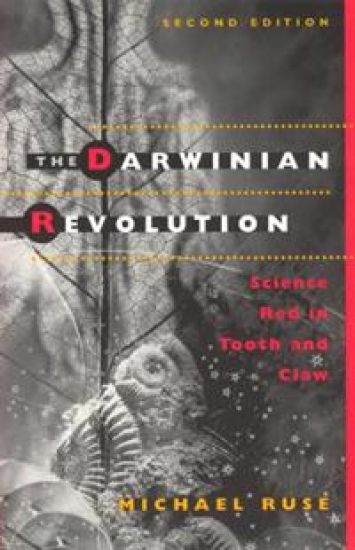
The Darwinian Revolution

The Darwinian Revolution

Michael Ruse

University of Chicago Press
1999
nidottu
Originally published in 1979, The Darwinian Revolution was the first comprehensive and readable synthesis of the history of evolutionary thought. Though the years since have seen an enormous flowering of research on Darwin and other nineteenth-century scientists concerned with evolution, as well as the larger social and cultural responses to their work, The Darwinian Revolution remains remarkably current and stimulating. For this edition Michael Ruse has written a new afterword that takes into account the research published since his book's first appearance." It is difficult to believe that yet another book on Darwin and the Darwinian Revolution could add anything new or contain any surprises. Ruse's book is an exception on all counts. Darwin scholars and the general reader alike can learn from it."—David L. Hull, Nature"No other account of the Darwinian Revolution provides so detailed and sympathetic an account of the framework within which the scientific debates took place."—Peter J. Bowler, Canadian Journal of History"A useful and highly readable synthesis. . .skillfully organized and written with verve, imagination, and welcome touches of humor."—John C. Greene, Science
The Darwinian Paradigm

The Darwinian Paradigm

Michael Ruse

Routledge
1989
sidottu
Charles Darwin's Origin of Species is now 130 years old, yet it continues to provoke fierce and impassioned debate. Michael Ruse, a distinguished champion of Darwin's theory of evolution, here presents a collection of essays - many previously unpublished - which look at Darwinism from both historical and contemporary perspectives. Written in a lively and accessible style, these essays cover philosophical and theological as well as scientific issues. Michael Ruse's claims are often highly controversial, particularly in discussions on the relations between science and religion, and they should provoke much comment.
Philosophy of Biology Today

Philosophy of Biology Today

Michael Ruse

State University of New York Press
1988
pokkari
This short and highly accessible volume opens up the subject of the philosophy of biology to professionals and to students in both disciplines. The text covers briefly and clearly all of the pertinent topics in the subject, dealing with both human and non-human issues, and quite uniquely surveying not only scholars in the English-speaking world but others elsewhere, including the Eastern block. As molecular biologists peer ever more deeply into life's mysteries, there are those who fear that such 'reductionism' conceals more than it reveals, and there are those who complain that the new techniques threaten the physical safety of us all. As students of evolution apply their new-found understanding to our own species, some people think that this is merely an excuse for racist and sexist propaganda, and others worry that the whole exercise blatantly violates the religious beliefs many of us hold dear. These controversies are the joint concern of biologists and philosophers-of those whose task it is to study the theoretical and moral foundations of knowledge. The comprehensive and fully up-to-date bibliography makes this an invaluable and indispensable guide.
Sociobiology: Sense or Nonsense?

Sociobiology: Sense or Nonsense?

Michael Ruse

Kluwer Academic Publishers
1979
nidottu
In June 1975, the distinguished Harvard entomologist Edward O. Wilson published a truly huge book entitled, Sociobiology: The New Synthesis. In this book, drawing on both fact and theory, Wilson tried to present a com­ prehensive overview of the rapidly growing subject of 'sociobiology', the study of the biological nature and foundations of animal behaviour, more precisely animal social behaviour. Although, as the title rather implies, Wilson was more surveying and synthesising than developing new material, he com­ pensated by giving the most thorough and inclusive treatment possible, beginning in the animal world with the most simple of forms, and progressing via insects, lower invertebrates, mammals and primates, right up to and in­ cluding our own species, Homo sapiens. Initial reaction to the book was very favourable, but before the year was out it came under withering attack from a group of radical scientists in the Boston area, who styled themselves 'The Science for the People Sociobiology Study Group'. Criticism, of course, is what every academic gets (and needs!); but, for two reasons, this attack was particularly unpleasant. First, not only were Wilson's ideas attacked, but he himself was smeared by being linked with the most reactionary of political thinkers, including the Nazis.