Kirjojen hintavertailu – 12 903 735 kirjaa ja 27 kauppaa

Kirjailija

Michael Siam-heng Heng

Kirjat ja teokset yhdessä paikassa: 3 kirjaa, julkaisuja vuosilta 2009–2012, suosituimpiin kuuluu Destructive Creativity Of Wall Street And The East Asian Response. Vertaile teosten hintoja ja tarkista saatavuus suomalaisista kirjakaupoista.

3 kirjaa

Kirjojen julkaisuvuodet: 2009–2012.

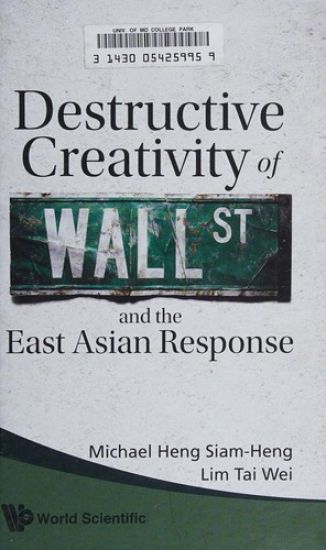
Destructive Creativity Of Wall Street And The East Asian Response

Destructive Creativity Of Wall Street And The East Asian Response

Michael Siam-heng Heng; Tai Wei Lim

World Scientific Publishing Co Pte Ltd
2009
sidottu
The current financial crisis provides a valuable occasion for the world to re-examine the grand statements of wisdom which dominate the financial world for a long time. The impact is extremely serious as a result of the convergence of a number of factors such as huge current account deficits of the United States, globalization, deregulation, loose monetary policy, and excessive liquidity. This book seeks to address the critical issues in deregulation, derivatives, leveraging, remuneration systems, and rating agencies. This book will also examine Asia's response and why Asian economies have been less affected by the global financial crisis. Are corporate governance, culture, management styles or even a state-led model the main reasons? Would the Asian sovereign funds help to be the last line of defense against the excesses of the crisis? Is the US$80 billion Asian crisis fund envisaged as the first instance of a coordinated East Asian response to the crisis and would this truly underpin the creation of an East Asian regional order? This book reaffims the need for banks and financial institutions to provide value-adding services, exercise prudence and due diligence and pay due regard for societal interest.
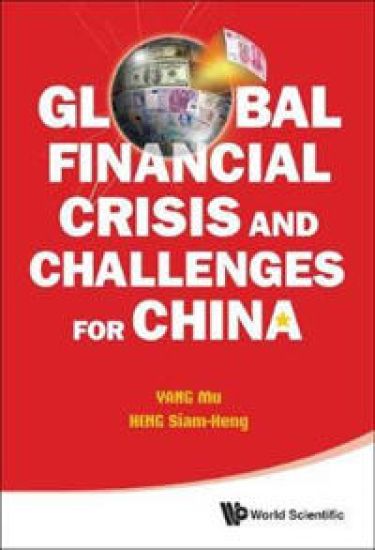
Global Financial Crisis And Challenges For China

Global Financial Crisis And Challenges For China

Mu Yang; Michael Siam-heng Heng

World Scientific Publishing Co Pte Ltd
2012
sidottu
The book analyzes the nature of Chinese economy which enables it to go through the financial tsunami pretty unscathed. It discusses the stimulus package designed by the Chinese government to keep the economy on course, as well as its results — both positive and negative aspects in the middle and long term. The 2008-09 financial crisis makes it very clear that we need a two-pronged approach to deal with the situation, namely governments need a) to take quick and decisive actions to stem any further deterioration in financial systems; b) to revamp their economies by refitting existing engines in the real economy. China, as the third largest economy in the world, and with its robust domestic consumption and a healthy financial system, is one of the most important drivers to pull the world out of recession. According to the Chinese leadership, China's main contribution is to keep its own economy running smoothly. In response to the crisis, the Beijing government has poured money into the following sectors: public housing, earthquake reconstruction, physical infrastructure, social security, education and healthcare. So far, the results have helped China to maintain the targeted high growth. Given the open nature of its economy, its high growth has also benefited other countries, thereby contributing to the global economy. The current crisis strengthens a trend that has emerged since the Asian financial crisis of 1997. And that is the enhanced economic integration of China with its East Asian neighbours and Southeast Asia. This augurs well for East Asian regionalism which may include the birth of Asian Monetary Fund. The global environment in the wake of the crisis poses new challenges to China, for example, in the form of shrinking size of its traditional export market in the USA and Europe. China needs to modify its strategy from previous export-oriented and investment-driven strategy into one with more emphasis on consumption. There is a lot of scope for China to embark on productive consumption such as cleaning up the environment, physical infrastructure, social security, education and healthcare. If done well, they will lay a firm basis for long-term economic development. It represents an occasion for China to embark on a nation-wide effort to upgrade its economy in the key sectors. At the same time, attention needs to be paid to improving economic-legal institutional framework to support China's role as a major global player.
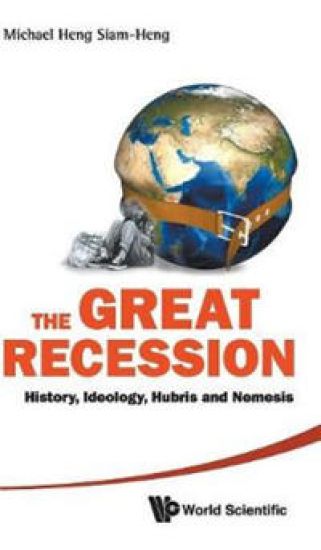
Great Recession, The: History, Ideology, Hubris And Nemesis

Great Recession, The: History, Ideology, Hubris And Nemesis

Michael Siam-heng Heng

World Scientific Publishing Co Pte Ltd
2010
sidottu
Many books on the 2008 financial crisis and the current recession focus on the financial sector. Unlike them, this book takes the real economy as the starting point and it situates the downturn within the societal context over the last several decades. Important elements of the story include global manufacturing overcapacity and declining profitability, failure of advanced industrial economies to make a quantum jump in discoveries and innovations across a broad range of technologies, ascent of neo-liberalism after the fall of the Berlin Wall, the Asian financial crisis, the Japanese “lost decade”, and the dot-com boom. This provides the backdrop of the birth of a market society, deregulation, easy credit, and financial excesses. The financial crisis reveals much that has gone astray in the business world over the last few decades — short term thinking, manipulation of figures and image management at the cost of the basics. The financial sector has become an arena for accounting shenanigans and corporate skullduggery. It is also a symptom of deeper social and cultural change. Crisis of a very serious nature functions as a cleansing exercise. Already we have seen debates which re-examine values and ideas, state policy and business practices. If the world could rise to the challenge, history will view the crisis as a blessing in disguise and thus render it in positive terms.