Kirjojen hintavertailu – 12 859 819 kirjaa ja 27 kauppaa

Kirjailija

Michael Singh

Kirjat ja teokset yhdessä paikassa: 8 kirjaa, julkaisuja vuosilta 2002–2021, suosituimpiin kuuluu Postmonolingual Critical Thinking. Vertaile teosten hintoja ja tarkista saatavuus suomalaisista kirjakaupoista.

8 kirjaa

Kirjojen julkaisuvuodet: 2002–2021.

Postmonolingual Critical Thinking

Postmonolingual Critical Thinking

Michael Singh; Si Yi Lu

TAYLOR FRANCIS LTD
2021
nidottu
Maintaining English as the sole language of knowledge production and dissemination in universities that enrol students who speak multiple languages, and those students learning other languages, is questionable. This groundbreaking work calls into question the exclusive use of academic English in internationalising higher education teaching and research. By interrogating the dominant assumptions informing the monolingual mindset, Postmonolingual Critical Thinking indicates that academically literate students can capably use their repertoires of languages and knowledge for educational purposes. The case for students’ languages and knowledge having a place in English-medium universities is made through evidence of the uses of Zhongwén, academic Chinese. Proposing to broaden the scope of languages used for knowledge production and dissemination, this book highlights the educational potential of multilingualism. Postmonolingual Critical Thinking makes a unique proposal: that universities which recruit doctoral students from Asia create education policy practices that enable them to extend their multilingual capabilities. Arguing that by drawing on intellectual resources from their various languages, students construct knowledge of critical thinking in complex, interesting and potentially innovative ways, this book guides higher education institutions in putting this into practice. It outlines a pragmatic approach for universities to explore the potential of multipolar, multilingual education, while being attentive to the tensions posed by assertions of a monolingual mindset. Postmonolingual Critical Thinking has the potential to create great change in a higher education sector which is mired by a monolingual approach to graduate training. This unique and thought-provoking book is essential reading for those in the fields of applied linguistics, comparative education, higher education, international studies, teacher education and translation studies.
Postmonolingual Critical Thinking

Postmonolingual Critical Thinking

Michael Singh; Si Yi Lu

Routledge
2020
sidottu
Maintaining English as the sole language of knowledge production and dissemination in universities that enrol students who speak multiple languages, and those students learning other languages, is questionable. This groundbreaking work calls into question the exclusive use of academic English in internationalising higher education teaching and research. By interrogating the dominant assumptions informing the monolingual mindset, Postmonolingual Critical Thinking indicates that academically literate students can capably use their repertoires of languages and knowledge for educational purposes. The case for students’ languages and knowledge having a place in English-medium universities is made through evidence of the uses of Zhongwén, academic Chinese. Proposing to broaden the scope of languages used for knowledge production and dissemination, this book highlights the educational potential of multilingualism. Postmonolingual Critical Thinking makes a unique proposal: that universities which recruit doctoral students from Asia create education policy practices that enable them to extend their multilingual capabilities. Arguing that by drawing on intellectual resources from their various languages, students construct knowledge of critical thinking in complex, interesting and potentially innovative ways, this book guides higher education institutions in putting this into practice. It outlines a pragmatic approach for universities to explore the potential of multipolar, multilingual education, while being attentive to the tensions posed by assertions of a monolingual mindset. Postmonolingual Critical Thinking has the potential to create great change in a higher education sector which is mired by a monolingual approach to graduate training. This unique and thought-provoking book is essential reading for those in the fields of applied linguistics, comparative education, higher education, international studies, teacher education and translation studies.
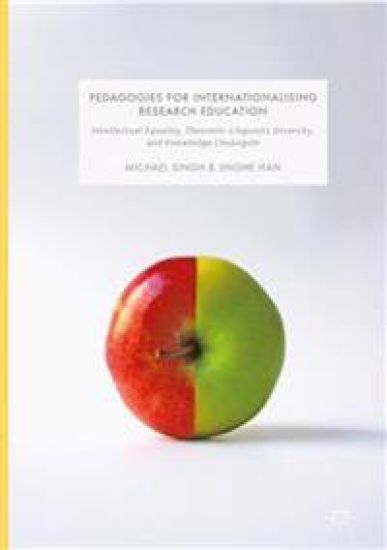
Pedagogies for Internationalising Research Education

Pedagogies for Internationalising Research Education

Michael Singh; Jinghe Han

Springer Verlag, Singapore
2018
nidottu
This book explores pedagogical concepts, metaphors and images of non-white, non-western researchers and research students on the inter/nationalization of education. Specifically, this book draws on the intellectual resources of China and India to explore the pedagogical dynamics and dimensions of the localization/globalization of education with non-Western characteristics. It introduces theoretic-linguistic non-Western concepts from the Tamil, Sanskrit and Chinese languages for use in Western, English-only education and redefines the intellectual basis for internationalising education. Debating whether ‘international education’ is Western-centric in terms of its privileging and promotion of Euro-American theoretical knowledge, this book contends that the internationalisation of Western-centric education can benefit from the intellectual power and powerfully relevant theorising performed by non-Western international students. It formulates a democratic vision for the internationalisation of education, with the potential to create transnational solidarity and constitute a forum for mobilising debates about global knowledge and power structures. It also provides key tools to use non-Western theoretic-linguistic tools and modes of critique in research undertaken in Anglophone Western universities.
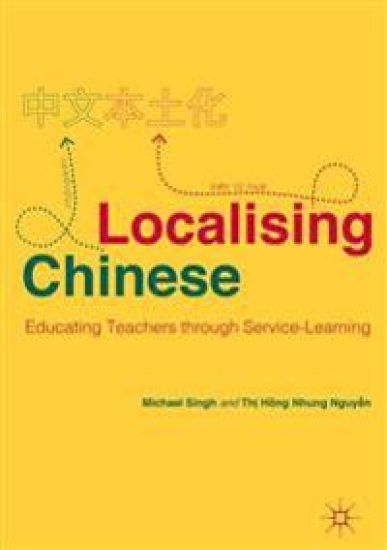
Localising Chinese

Localising Chinese

Michael Singh; Th? H?ng Nhung Nguy?n

Palgrave Macmillan
2018
sidottu
This book presents innovative strategies for teaching the Chinese language to English-speaking students around the world, using in-depth research arising from a long-running and successful Chinese language teaching programme in Sydney. Throughout the book its authors emphasise the importance of teaching methods which explore the relevance of Chinese to all aspects of students’ everyday lives; ‘Localising Chinese’ by folding it into students’ everyday sociolinguistic activities performed in English. The research presented here demonstrates how, through school-driven, research-oriented service-learning, university graduates from China learnt to use student-centred learning-focused language education as a basis for professional learning. In the context of China’s growing influence in the global academic community, this book addresses the urgent need to promote effective communication and partnerships. It provides a valuable resource for language teachers and teacher educators, as well aseducation researchers in the areas of international education, linguistics, the sociology of education and knowledge exchange.
Pedagogies for Internationalising Research Education

Pedagogies for Internationalising Research Education

Michael Singh; Jinghe Han

Springer Verlag, Singapore
2017
sidottu
This book explores pedagogical concepts, metaphors and images of non-white, non-western researchers and research students on the inter/nationalization of education. Specifically, this book draws on the intellectual resources of China and India to explore the pedagogical dynamics and dimensions of the localization/globalization of education with non-Western characteristics. It introduces theoretic-linguistic non-Western concepts from the Tamil, Sanskrit and Chinese languages for use in Western, English-only education and redefines the intellectual basis for internationalising education. Debating whether ‘international education’ is Western-centric in terms of its privileging and promotion of Euro-American theoretical knowledge, this book contends that the internationalisation of Western-centric education can benefit from the intellectual power and powerfully relevant theorising performed by non-Western international students. It formulates a democratic vision for the internationalisation of education, with the potential to create transnational solidarity and constitute a forum for mobilising debates about global knowledge and power structures. It also provides key tools to use non-Western theoretic-linguistic tools and modes of critique in research undertaken in Anglophone Western universities.
Global Teachers, Australian Perspectives

Global Teachers, Australian Perspectives

Carol Reid; Jock Collins; Michael Singh

Springer Verlag, Singapore
2016
nidottu
This is the first book on global teachers and the increasingly important phenomenon of ‘brain circulation’ in the global teaching profession. A teaching qualification is a passport to an international professional career: the global teacher is found in more and more classrooms around the world today. It is a two-way movement. This book looks at the growing importance of immigrant teachers in western countries today and at teachers who exit from western countries (emigrant teachers) seeking teaching experience in other countries. Drawing on the international literature in Europe, North America, Asia and elsewhere supplemented by rich insights derived from recent Australian research, the book outlines the personal, institutional and structural processes nationally and internationally underlying the increasing global circulation of teachers. It identifies the key drivers of global teacher mobility: a range of factors including family, lifestyle, classroom experience, travel, opportunities for advancement, discipline, linguistic skills, taxation rates, cultural factors and institutional frameworks and policy support. The book is the first detailed contemporary account of the experiences of Australian immigrant and emigrant teachers in the schools and communities where they teach and live. It makes an important and original theoretical and empirical contribution to the contemporary fields of sociology of education and immigration studies.
Global Teachers, Australian Perspectives

Global Teachers, Australian Perspectives

Carol Reid; Jock Collins; Michael Singh

Springer Verlag, Singapore
2013
sidottu
This is the first book on global teachers and the increasingly important phenomenon of ‘brain circulation’ in the global teaching profession. A teaching qualification is a passport to an international professional career: the global teacher is found in more and more classrooms around the world today. It is a two-way movement. This book looks at the growing importance of immigrant teachers in western countries today and at teachers who exit from western countries (emigrant teachers) seeking teaching experience in other countries. Drawing on the international literature in Europe, North America, Asia and elsewhere supplemented by rich insights derived from recent Australian research, the book outlines the personal, institutional and structural processes nationally and internationally underlying the increasing global circulation of teachers. It identifies the key drivers of global teacher mobility: a range of factors including family, lifestyle, classroom experience, travel, opportunities for advancement, discipline, linguistic skills, taxation rates, cultural factors and institutional frameworks and policy support. The book is the first detailed contemporary account of the experiences of Australian immigrant and emigrant teachers in the schools and communities where they teach and live. It makes an important and original theoretical and empirical contribution to the contemporary fields of sociology of education and immigration studies.
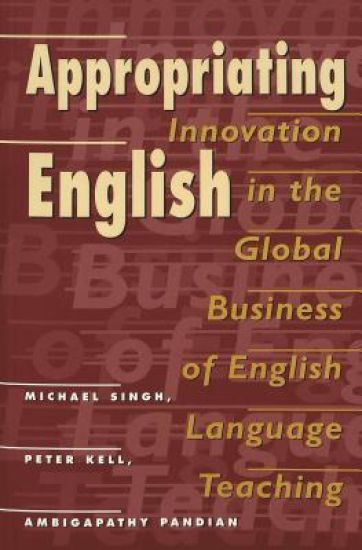
Appropriating English

Appropriating English

Michael Singh; Peter Kell; Ambigapathy Pandian

Peter Lang AG
2002
nidottu
English seems to be becoming the global language as a result of the massive socio-economic, cultural, and technological changes that have been struggled over since the 1950s. For teachers of English to speakers of other languages and for those involved in the education of such teachers, trying to understand the changes brought by the globalization, commodification, and technologization of English language teaching (ELT) is a major challenge in itself. Given the acceleration in language extinction and knowledge death, developing principled responses to these changes is ridden with significant complications and dangers. "Appropriating English" explores challenging possibilities for teachers and teacher educators in the transnational ELT market, providing a basis for informing and mobilizing innovations in the business of teaching English language and literacy to speakers of other languages. While the demand for English grows, its effects on other peoples, their languages, and their knowledge are not always positive. "Appropriating English" adds to the calls for a paradigmatic innovation in the ELT industry. Michael Singh, Peter Kell, and Ambigapathy Pandian offer a new perspective for reinventing the project of globalizing English that situates it within a framework of risk analysis and provides workpoints for making use of multivocal, hybridized Englishes and new digital technologies to help sustain the linguistic diversity of humanity.