Kirjojen hintavertailu – 12 903 725 kirjaa ja 27 kauppaa

Kirjailija

Michel Aglietta

Kirjat ja teokset yhdessä paikassa: 12 kirjaa, julkaisuja vuosilta 1998–2020, suosituimpiin kuuluu Currencies: Between Violence and Trust / La Monnaie: entre violence et confiance. Vertaile teosten hintoja ja tarkista saatavuus suomalaisista kirjakaupoista.

12 kirjaa

Kirjojen julkaisuvuodet: 1998–2020.

Money

Money

Michel Aglietta

Verso Books
2020
pokkari
As the financial crisis reached its climax in September 2008, the most important figure on the planet was Federal Reserve chairman Ben Bernanke. The whole financial system was collapsing, without anything to stop it. When a senator asked Bernanke what would happen if the central bank did not carry out its rescue package, he replied,"lf we don't do this, we may not have an economy on Monday." What saved finance, and the Western economy, was money. Yet it is a highly ambivalent phenomenon. It is deeply embedded in our societies, acting as a powerful link between the individual and the collective. But by no means is it neutral. Through its grip on finance and the debts system, money confers sovereign power on the economy. If confidence in money is not maintained, crises will follow.
The Reform of Europe

The Reform of Europe

Michel Aglietta

Verso Books
2019
sidottu
The Eurozone crisis since 2010 has instilled political disunity and generated a long period of economic stagnation. The cyclical recovery enjoyed in 2017 is no cause for complacency. It should act as an impetus to undertake long-overdue reforms, which require a change in perspective to develop a medium-term orientation for the next decade. There is no future for those incapable of investing. There is no stimulus for innovative investment in countries that have been converted to the hegemony of finance at the expense of productive investment. Europe must confront the challenges of the 21st century by recovering its ideological autonomy in the community spirit of its origins,which can be summed up as social progress. This book demonstrates the need for a long-term vision with two goals: reconstructing a social contract based on an entrepreneurial partnership and investing in the ecological transition. This political vision will restore to citizens of the member-states a sense of belonging to a wider community. To attain this, argues Michel Aglietta, one of the most important heterodox economists today, we must strengthen European institutions at the financial and fiscal levels. This involves making the euro a full currency, endowed with democratic legitimacy.
Money

Money

Michel Aglietta

Verso Books
2018
sidottu
As the financial crisis reached its climax in September 2008, the most important figure on the planet was Federal Reserve chairman Ben Bernanke. The whole financial system was collapsing, without anything to stop it. When a senator asked Bernanke what would happen if the central bank did not carry out its rescue package, he replied,"lf we don't do this, we may not have an economy on Monday." What saved finance, and the Western economy, was money. Yet it is a highly ambivalent phenomenon. It is deeply embedded in our societies, acting as a powerful link between the individual and the collective. But by no means is it neutral. Through its grip on finance and the debts system, money confers sovereign power on the economy. If confidence in money is not maintained, crises will follow. Looking over the last 5,000 years, this book explores the development of money and its close connection to sovereign power. Michel Aglietta mobilises the tools of anthropology, history and political economy in order to analyse how political structures and monetary systems have transformed one another. We can thus grasp the different eras of monetary regulation and the crises capitalism has endured throughout its history.
Money: Between Debt and Sovereignty / La Monnaie: Entre dettes et souveraineté
Michel Aglietta is the author of major works published by Odile Jacob, most recently "Un New Deal pour l'Europe" ("A New Deal for Europe"), co-written with Thomas Brand, and L"a voie chinoise. CapitalI'me et empire" ("The Chinese Way: CapitalI'm and Empire", co-written with Guo Bai. He is Professor Emeritus at the University of Paris X-Nanterre and scientific advisor to the CEPII and Groupama-AM. With this book, Michel Aglietta shows that it is not markets that are the main determinant of the economy, but money. Because money is not only the instrument that brings us everything we want, it is also the essential institution without which markets cannot exist. A true "political animal", money introduces policy - the "sovereign" - and, with it the entire history of society. Deeply multidisciplinary, this exceptional work opens with an exploration of the anthropological drivers that legitimize money: what gives us confidence in a money? It then examines its various historical forms, from the invention of writing to the present day, before questioning the ambivalence of money - at the same time liquidity and institution - and what makes it an agent of crisis. Finally, the comparison of monetary systems in the international order raises the issue of a truly supra-national money at a time when the dollar is the subject of many questions. Authoritative and highly respected, Michel Aglietta is France's leading money specialist. Exciting developments on the parallel inventions of money and writing (Sumer, Egypt), on the great financial crises of history, on today's currencies (the yuan, the dollar). Michel Aglietta is one of the leading "unorthodox" economists who, along with Andr Orleans and others, advocate the integration of economics into the social sciences.

A Theory of Capitalist Regulation

A Theory of Capitalist Regulation

Michel Aglietta

Verso Books
2015
nidottu
Aglietta's path-breaking book is the first attempt at a rigorous historical theory of the whole development of US capitalism, from the Civil War to the Carter presidency. A major document of the "Regulation School" of Marxist economics, it was received as the boldest book in its field since the classic studies of Paul Baran, Paul Sweezy and Harry Braverman. This edition includes a substantial new postface by Aglietta which brings regulation theory face to face with capitalism at the beginning of the new millennium.
China's Development

China's Development

Michel Aglietta; Guo Bai

Routledge
2015
nidottu
China is entering a phase where deep structural changes will arise throughout society. These multi-fold processes will be intertwined in a globalized world, impacted by the transformation of capitalism in the aftermath of the financial crisis and under the threat of severe environmental damage. Focussing on sustainability, this book explores the future of China in light of the successful reforms undertaken in the last thirty years. It combines Chinese economic history and up-to-date macroeconomic theory in order to show how economic transformations and institutional changes are intertwined in developing capitalism under state sovereignty. The book is divided into three parts: Part 1 analyses the structural changes ahead, drawing on the knowledge of the causes of the demise of imperial China and of the social disruptions due to political warfare in the 20th century. Part 2 examines the reasons why the last thirty years of reform were successful and why the present growth regime will undergo a dramatic mutation in future decades. Part 3 seeks to address the question: what type of political economy can support the purpose of achieving "harmonious society"? China's Development will be of interest to students and scholars of Chinese economics, politics, history and development.
A New Deal for Europe / Un New Deal pour l'Europe

A New Deal for Europe / Un New Deal pour l'Europe

Michel Aglietta; Thomas Brand

Odile Jacob
2013
nidottu
Michel Aglietta is an emeritus professor at the University of Paris X-Nanterre and a scientific adviser at the French Centre for Prospective Studies and International Information (CEPII) and Groupama-AM. He is the author of numerous works, many of them published by Editions Odile Jacob. Thomas Brand is project officer in the Economics and Financial Department of the French Centre for Strategic Analyses. A graduate of the Ecole Normale Sup rieure of Cachan, he is currently completing a thesis on European budgetary policies. This book poses a burning question: is European construction still a common goal, shared by all the E. U. states and legitimised by their citizens? Michel Aglietta and Thomas Brand propose a three-pronged reply. First, they examine the present crisis and offer a diagnosis that is both precise (they show that the euro remains a foreign currency, for cultural and institutional reasons) and original (they argue that public debt is not the cause of the European crisis). Secondly, they denounce a series of errors, committed since 2010, from austerity measures that pit citizens against one another to timorous efforts to strengthen bank balance sheets. Finally, they propose solutions closely linking reforms in European governance with a solid project for economic growth. A fI'm conviction underlies this book: the euro's sovereignty may depend on European federalI'm but without a new social and economic contract Europe's citizens will remain suspicious of all forms of federalI'm. Redefining the Central European Bank's mandate and setting up a banking union are both highly necessary but also completely insufficient measures. Europe must share its iedustrial policies and set up common regional projects. Only then will a real European Union come into existence.- A book that denounces many received opinions: about the causes of the European crisis, about budgetary policies, competitiveness.- A reflection that allies detailed analyses with an unusually all-embracing viewpoint.
China's Development

China's Development

Michel Aglietta; Guo Bai

Routledge
2012
sidottu
China is entering a phase where deep structural changes will arise throughout society. These multi-fold processes will be intertwined in a globalized world, impacted by the transformation of capitalism in the aftermath of the financial crisis and under the threat of severe environmental damage. Focussing on sustainability, this book explores the future of China in light of the successful reforms undertaken in the last thirty years. It combines Chinese economic history and up-to-date macroeconomic theory in order to show how economic transformations and institutional changes are intertwined in developing capitalism under state sovereignty. The book is divided into three parts: Part 1 analyses the structural changes ahead, drawing on the knowledge of the causes of the demise of imperial China and of the social disruptions due to political warfare in the 20th century. Part 2 examines the reasons why the last thirty years of reform were successful and why the present growth regime will undergo a dramatic mutation in future decades. Part 3 seeks to address the question: what type of political economy can support the purpose of achieving "harmonious society"? China's Development will be of interest to students and scholars of Chinese economics, politics, history and development.
Corporate Governance Adrift

Corporate Governance Adrift

Michel Aglietta; Antoine Rebérioux

Edward Elgar Publishing Ltd
2005
sidottu
Recent corporate governance scandals have brought to the fore the inherent contradictions of a capitalism dominated by financial markets. This challenging book by Michel Aglietta and Antoine Reberioux argues that capitalism's basic premise - that companies must be managed in the sole interest of their shareholders - is incongruent with the current environment of liquid markets, profit-hungry investors and chronic financial instability. The authors advocate rather that a company should be managed as an institution where common objectives are developed for all stakeholders, and that this democratic principle should be extended to the management of collective savings to reduce macro-financial instability. These two conditions, they contend, could make contemporary capitalism a vehicle for social progress. In this context, Corporate Governance Adrift also analyses the financial scandals of the Enron era, going beyond the malfunctioning of the gatekeepers to stress the failure of shareholder value and the inadequacy of measures intended to prevent such scandals. This provocative and unique volume will be required reading for all scholars and researchers of industrial organization and strategy of the firm, finance and corporate governance. Policymakers, financial commentators and those involved in business will also find this book of great interest and value.
Corporate Governance Adrift

Corporate Governance Adrift

Michel Aglietta; Antoine Rebérioux

Edward Elgar Publishing Ltd
2005
nidottu
Recent corporate governance scandals have brought to the fore the inherent contradictions of a capitalism dominated by financial markets. This challenging book by Michel Aglietta and Antoine Reberioux argues that capitalism's basic premise - that companies must be managed in the sole interest of their shareholders - is incongruent with the current environment of liquid markets, profit-hungry investors and chronic financial instability. The authors advocate rather that a company should be managed as an institution where common objectives are developed for all stakeholders, and that this democratic principle should be extended to the management of collective savings to reduce macro-financial instability. These two conditions, they contend, could make contemporary capitalism a vehicle for social progress. In this context, Corporate Governance Adrift also analyses the financial scandals of the Enron era, going beyond the malfunctioning of the gatekeepers to stress the failure of shareholder value and the inadequacy of measures intended to prevent such scandals. This provocative and unique volume will be required reading for all scholars and researchers of industrial organization and strategy of the firm, finance and corporate governance. Policymakers, financial commentators and those involved in business will also find this book of great interest and value.
Currencies: Between Violence and Trust / La Monnaie: entre violence et confiance
Europeans'infatuation with their new currency is in sharp contrast with the despair experienced by Argentineans who have been ruined as a consequence of parity between their currency and the U. S. dollar. Orthodox economic theory does not take currency into account. It either ignores it, in order to carry out investigations in real terms, or treats it as though it were a neutral factor and implements policies that maintain it in this role. In the present book, Michel Aglietta and Andr Orl an, leaders of the heterodox economic school known as 'regulatory', set out to show how, on the contrary, currencies are at the heart of most economic relations, from the simplest (exchanges between two agents) to the most complex (international financial relations). Combining Marx and Girard, they analyse currency and its numerous properties. Currency acts as an intermediary in exchanges, it serves as a means of conserving wealth and helps to socialise economic behaviour through imitation. Not content with abstract analysis ' which would not explain the economic phenomena presented by history and day-to-day life ' the authors have applied their analytical tools in an effort to understand modern and contemporary monetary crises. They have also applied these tools to explaining the innovation represented by the euro. Michel Aglietta teaches at the University of Paris X-Nanterre. He is a member of the Institut de France and of the French Prime Minister's Economic Council. Andr Orl an is a head of research at the Centre National de la Recherche Scientifique.
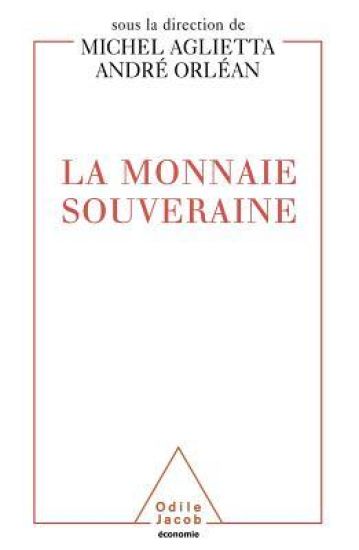
A Sovereign Currency / La Monnaie souveraine

A Sovereign Currency / La Monnaie souveraine

Michel Aglietta; André Orléan

Odile Jacob
1998
nidottu
The result of many years of work between economists, historians, anthropologists and psychoanalysts, this book shows how money is the cement of societies--the most archaic as well as the most contemporary. Money reigns not only over horizontal relationships between iedividuals, but also over the vertical relationships between iedividuals and the State. This analysis entirely changes our conception of money, and makes us better understand the outpouring of emotion at the passage of the Euro, which opened questions of national sovereignty and of the legitimacy of new financial institutions. Michel Aglietta is an economics professor at Nanterre, and member of the Prime Minister's Council on Economic Analysis. Andr ; Orl an is the Research Director at the CNRS.