Kirjailija
Michel Leiris
Kirjat ja teokset yhdessä paikassa: 13 kirjaa, julkaisuja vuosilta 1992–2024, suosituimpiin kuuluu Mannesalter. Vertaile teosten hintoja ja tarkista saatavuus suomalaisista kirjakaupoista.
13 kirjaa
Kirjojen julkaisuvuodet: 1992–2024.
The fourth and final volume of Michel Leiris’s renowned autobiography, now available in English for the first time, translated by Richard Sieburth “Reading Frail Riffs, appearing in English nearly fifty years after its initial French publication, I realize how much our attraction to autobiography owes to Leiris . . . a quiet virtuoso of French prose.”—Alice Kaplan, New York Review of Books Ex-surrealist and maverick anthropologist Michel Leiris (1901–1990) crafted his multivolume autobiography over the course of thirty-five years, profoundly influencing generations of French writers, from Sartre and Beauvoir to Modiano and Ernaux. In this fourth and final volume, Richard Sieburth completes the project of bringing Leiris’s monumental experiment in self-portraiture into English. With wit and playfulness, Leiris assembled a scrapbook of fragments—journal extracts, travel notes, transcriptions of dreams, poems—to document the vagaries of a life committed to the difficult marriage of poetry and revolutionary politics, which he witnessed firsthand in Mao’s China, Castro’s Cuba, and on the Paris streets in May ’68. Frail Riffs is a jazz improvisation on the twilight of a life, at once a painstaking self-examination and a chronicle of a century. As Leiris wrote, it is “neither a private diary nor a formal work, neither an autobiographical narrative nor a work of the imagination, neither prose nor poetry, but all this at the same time. . . . A perpetual work in progress.”
Correspondence – Georges Bataille and Michel Leiris
Georges Bataille; Michel Leiris; Liz Heron
SEAGULL BOOKS LONDON LTD
2023
nidottu
Halvin toimitettuna 30,80 €
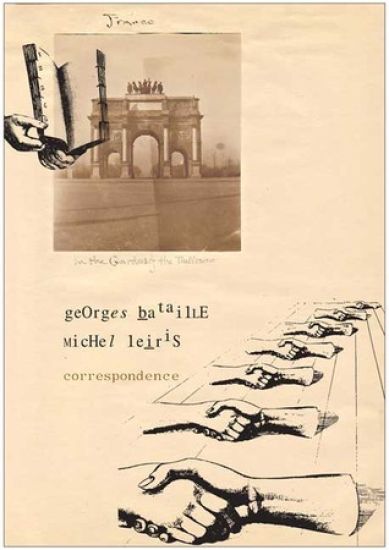
Including a number of short essays by Bataille and Leiris on aspects of the other's work as well as excerpts on Bataille from Leiris' diaries, this collection of correspondence throws new light on two of Surrealism's most radical dissidents. In the autumn of 1924, just before André Breton published the Manifeste du surréalisme, two young men met in Paris for the first time. Georges Bataille, 27, starting work at the Bibliothèque Nationale; Michel Leiris, 23, beginning his studies in ethnology. Within a few months, they were both members of the Surrealist group, although their adherence to Surrealism (unlike their affinities with it) would not last long: in 1930 they were among the signatories of "Un cadavre," the famous tract against Breton, the "Machiavelli of Montmartre," as Leiris put it. But their friendship would endure for more than 30 years, and their correspondence, assembled here for the first time in English, would continue until the death of Bataille in 1962.
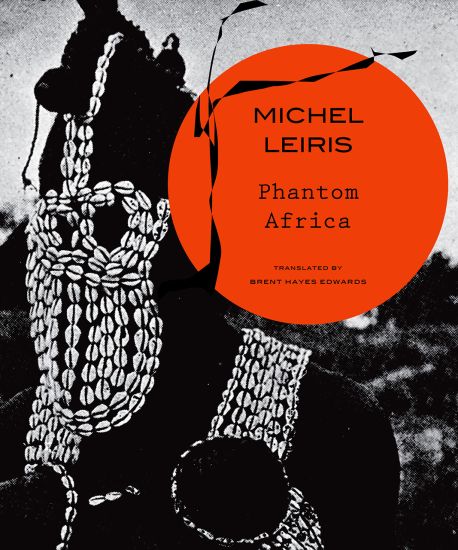
One of the towering classics of twentieth century French literature, Phantom Africa is a singular and ultimately unclassifiable work: a book composed of one man's compulsive and constantly mutating daily travel journal--by turns melodramatic, self-deprecating, ecstatic, and morose--as well as an exhaustively detailed account of the first French state-sponsored anthropological expedition to visit sub-Saharan Africa. In 1930, Michel Leiris was an aspiring poet drifting away from the orbit of the Surrealist movement in Paris when the anthropologist Marcel Griaule invited him on an ethnographic journey that traversed the African continent from 1931 to 1933. Leiris, while maintaining the official records of the Mission, also kept a diary where he noted not only a given day's activities and events but also his impressions, his states of mind, his anxieties, his dreams, and even his erotic fantasies. Upon returning to France, rather than compiling a more conventional report or ethnographic study, Leiris decided simply to publish his diary. The result is an extraordinary book: a day-by-day record of one European writer's experiences in an Africa inexorably shaded by his own exotic delusions and expectations, on the one hand, and an unparalleled depiction of the paradoxes and hypocrisies of conducting anthropological field research at the height of the colonial era on the other. First published in English by Seagull Books in 2017, Phantom Africa is an invaluable document. Now available in paperback, this important book bears witness to the full range of social and political forces reshaping the African continent in the period between the World Wars.
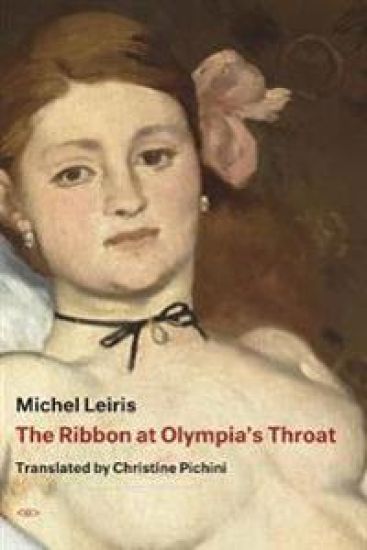
Short fragments and essays that explore how a seemingly irrelevant aesthetic detail may cause the eruption of sublimity within the mundane. That the nude painted by Manet (in a painting so conceptually new that it created a scandal in its day) achieves so much truth through such a minor detail, that ribbon that modernizes Olympia and, even more than a beauty mark or a patch of freckles would, renders her more precise and more immediately visible, making her a woman with ties to a particular milieu and era: that is what lends itself to reflection, if not divagation!—from The Ribbon at Olympia's ThroatIn The Ribbon at Olympia's Throat, Michel Leiris investigates what Lydia Davis has called the “expressive power of fetishism”: how a seemingly irrelevant aesthetic detail may cause the eruption of sublimity within the mundane. Written in 1981, toward the end of Leiris's life, The Ribbon at Olympia's Throat serves as a coda to his autobiographical masterwork, The Rules of the Game, taking the form of both shorter fragments (poems, memory scraps, notes) that are as formally disarming as the fetishistic experiences they describe, and longer essays, more exhaustive critical meditations on writing, apprehension, and the nature of the modern. Rooted in remembrance, devoted to the kaleidoscopic intricacies of wordplay, Leiris draws from his own aesthetic experiences as writer and spectator to explore the fetish that “exposes and disarms the sinister passage of time,” conferring “an undeniable realness upon the whole by essentially causing it to crystallize in a reality it would never have possessed if that sturdy fragment hadn't acted as bait.”
The The Sacred Conspiracy
Georges Bataille; Roger Caillois; Michel Leiris
Atlas Press
2018
sidottu
Halvin toimitettuna 36,20 €
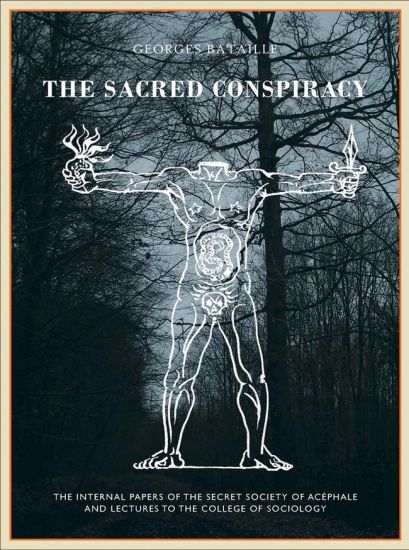
Georges Bataille's secret society, long the stuff of legend, is now revealed in its texts, meditations, rules and prohibitions This book recounts what must be one of the most unusual intellectual journeys of modern times, in which the influential philosopher, cultural theorist and occasional pornographer Georges Bataille (1897-1962), having spent the early 1930s in far-left groups opposing the rise of fascism, abandoned that approach in order to transfer the struggle onto "the mythological plane." In 1937, Bataille founded two groups in order to explore the combinations of power and the "sacred" at work in society. The first group, the College of Sociology, gave lectures that were intended to reveal the hidden undercurrents within a society on the verge of catastrophe. The second group was Ac phale, a genuine secret society and anti-religion whose emblem was a headless figure that, in part, represented the death of God. Until the discovery a few years ago of the group's internal papers (which include theoretical texts, meditations, minutes of meetings, rules and prohibitions and even a membership list), almost nothing was known of its activities. This book is the first to collect a representative selection of the writings of Bataille, and of those close to him, in the years leading up to World War II. The texts published here comprise lectures given to the College of Sociology by Bataille, Roger Caillois and Michel Leiris, essays from the Ac phale journal and a large cache of the internal papers from the secret society. A desperate narrative unfolds, wherein Bataille risked all in a wholly unreasonable quest--with a few fellow travelers, he undertook what he later described as a "journey out of this world."
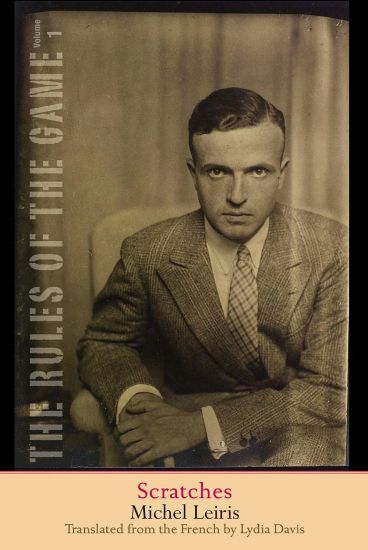
A dazzling translation by Lydia Davis of the first volume of Michel Leiris’s masterwork, perhaps the most important French autobiographical enterprise of the twentieth century Michel Leiris, a French intellectual whose literary works inspired high praise from the likes of Simone de Beauvoir and Claude Lévi-Strauss, began the first volume of his autobiographical project at the age of 40. It was the beginning of an endeavor that ultimately required 35 years and three additional volumes. In Volume 1, Scratches, Leiris proposes to discover a savoir vivre, a mode of living that would have a place for both his poetics and his personal morality. “I can scarcely see the literary use of speech as anything but a means of sharpening one’s consciousness in order to be more—and in a better way—alive," he declares. He begins the project of uncovering memories, returning to moments and images of childhood—his father’s recording machine, the letters of the alphabet coming to life—and then of his later life—Paris under the Occupation, a journey to Africa, and a troubling fear of death.
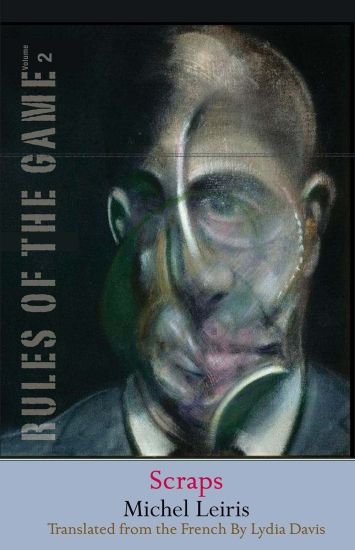
The second volume of Michel Leiris’s hugely influential four-volume autobiographical essay, available to English-language readers in a brilliant and sensitive translation by Lydia Davis One of the most versatile and beloved French intellectuals of the twentieth century, Michel Leiris reconceives the autobiography as a literary experiment that sheds light on the mechanisms of memory and on the way the unconnected events of a life become connected through invented narrative. In this volume, the second in his four-volume epic autobiographical enterprise, Leiris merges quotidian events with profound philosophical self-exploration. He also wrangles with the disillusionment that accompanies his own self-reflection. In the midst of struggling with his own motives for writing an autobiographical essay, he comes to the revelation that life, after all, has aspects worth remembering even if moments of beauty are bookended by misery. Yet what can be said of human life, of his own life, when his memory is unreliable, his eyesight is failing, and his mood is despairing?
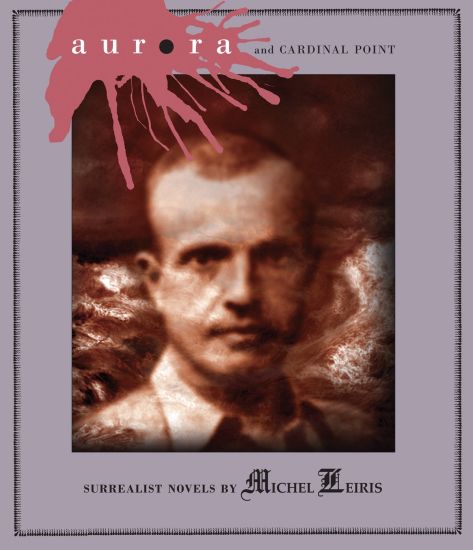
This volume collects two classics of Surrealist fiction, both long out of print, by the writer and ethnographer Michel Leiris (1901-1990). Close to Georges Bataille, Picasso, Jean-Paul Sartre and Francis Bacon, and a director of the Mus e de l'Homme in Paris, Leiris was a pivotal figure in postwar France. He wrote important works in the fields of ethnology and anthropology, as well as a sequence of autobiographical works regarded as classics of modern French literature (most famously Manhood 1939]). "There is scarcely a literary opus today that can compare in authenticity and stature to that of Michel Leiris," Maurice Nadeau wrote of him. In Aurora, Leiris pursues his eponymous heroine through a visionary landscape shot through with catastrophe. His lucid yet baroque language, with its rich descriptions and ever more extravagant metaphors, is only just able to keep pace. Looking back on this novel, Leiris described its tone: "despite the 'black' or 'frenetic' style of its blustering prose, what I like about this work is the appetite it expresses for an unattainable purity, the faith it places in the untamed imagination, the horror it manifests with regard to any kind of fixity." Cardinal Point is Leiris' first prose work. Written in 1925, soon after he had joined the Surrealist movement, it employs "automatic writing" to excavate the hidden meanings of ordinary words, a procedure that was to underpin his most vital future works.
Correspondence – Georges Bataille and Michel Leiris
Georges Bataille; Michel Leiris; Liz Heron
Seagull Books London Ltd
2008
sidottu
In the autumn of 1924, two young men met in Paris for the first time. Georges Bataille was just 27 and had recently started working at the Bibliotheque nationale. Michel Leiris, 23, was beginning his studies in ethnology. They discussed the idea of founding a movement which would displace Dada and of launching a magazine based in a brothel. Instead, within a few months, they both became members of the surrealist group. But their adherence to surrealism would not last long. In 1930 they were signatories to the infamous tract against Breton, the 'Machiavelli of Montmartre', as Leiris put it. But their own friendship would endure for more than thirty years and their correspondence, assembled here for the first time, would continue until the death of Bataille in 1962. As these letters show, their intellectual affinities were extensive and although they followed different trajectories - Leiris spending more and more time in Africa as an ethnologist, whilst Bataille remained in Paris developing the ideas on the sacred, sacrifice and eroticism for which he is best known - they continued to have a profound influence on each other. Including a number of short essays by each of them on aspects of the other's work, and excerpts on Bataille from Leiris' diaries, this collection of their correspondence throws new light on two of surrealism's most radical dissidents.
The Burial of the Count of Orgaz & Other Poems
Pablo Picasso; Michel Leiris
Exact Change,U.S.
2004
pokkari
Protean, erotic, scatological and experimental, Picasso's poetry is finally compiled in this essential anthology Pablo Picasso is arguably the most famous and influential artist of the 20th century. What few in the English-speaking world know is that in 1935, at age 54, an emotional crisis caused Picasso to halt all painting and devote himself entirely to poetry. Even after resuming his visual work, Picasso continued to write, in a characteristic torrent, until 1959, leaving a body of prose poems that André Breton praised as “an intimate journal, both of the feelings and the senses, such as has never been kept before.” Similarly struck by the poems' originality, Michel Leiris wrote, “If we must compare him, despite his fierce singularity, in order to try and situate him on the literary map, I see only James Joyce.” Near the end of his life, Picasso himself was quoted as having “told a friend that long after his death his writing would gain recognition and encyclopedias would say: 'Picasso, Pablo Ruiz—Spanish poet who dabbled in painting, drawing and sculpture.'“ For the past five years, poets Jerome Rothenberg and Pierre Joris have overseen a project to translate the majority of this writing into English for the first time. Working from Picasso's original Spanish and French (he wrote in both languages), they enlisted the help of over a dozen contemporary poets in order to mark, as they note in their introduction, “Picasso's entry into our own time.” This is indeed a new Picasso for most of us, or rather, a renewed Picasso: the poems are as protean, erotic, scatological and experimental in form as his visual art has always been described. But amid the ubiquitous posters, t-shirts and tchotchkes, how many of us have truly felt the impact of Picasso's visual work as powerfully as it was perceived in the first half of the 20th century? The poems give us a 21st-century Picasso, free of cliché. Perhaps they will even spark a revival of interest in his “dabblings.”
"Not only one of the frankest of autobiographies, but also a brilliantly written book, Leiris' Manhood mingles memories, philosophic reflections, sexual revelation, meditations on bullfighting, and the life-long progress of self-discovery."—Washington Post Book World "Leiris writes to appall, and thereby to receive from his readers the gift of a strong emotion—the emotion needed to defend himself against the indignation and disgust he expects to arouse in his readers."—Susan Sontag, New York Review of Books