Kirjojen hintavertailu – 12 859 819 kirjaa ja 27 kauppaa

Kirjailija

Michel Wedel

Kirjat ja teokset yhdessä paikassa: 5 kirjaa, julkaisuja vuosilta 1999–2012, suosituimpiin kuuluu Eye Tracking for Visual Marketing. Vertaile teosten hintoja ja tarkista saatavuus suomalaisista kirjakaupoista.

5 kirjaa

Kirjojen julkaisuvuodet: 1999–2012.

Market Segmentation

Market Segmentation

Michel Wedel; Wagner A. Kamakura

Springer-Verlag New York Inc.
2012
nidottu
Modern marketing techniques in industrialized countries cannot be implemented without segmentation of the potential market. Goods are no longer produced and sold without a significant consideration of customer needs combined with a recognition that these needs are heterogeneous. Since first emerging in the late 1950s, the concept of segmentation has been one of the most researched topics in the marketing literature. Segmentation has become a central topic to both the theory and practice of marketing, particularly in the recent development of finite mixture models to better identify market segments. This second edition of Market Segmentation updates and extends the integrated examination of segmentation theory and methodology begun in the first edition. A chapter on mixture model analysis of paired comparison data has been added, together with a new chapter on the pros and cons of the mixture model. The book starts with a framework for considering the various bases and methods available for conducting segmentation studies. The second section contains a more detailed discussion of the methodology for market segmentation, from traditional clustering algorithms to more recent developments in finite mixtures and latent class models. Three types of finite mixture models are discussed in this second section: simple mixtures, mixtures of regressions and mixtures of unfolding models. The third main section is devoted to special topics in market segmentation such as joint segmentation, segmentation using tailored interviewing and segmentation with structural equation models. The fourth part covers four major approaches to applied market segmentation: geo-demographic, lifestyle, response-based, and conjoint analysis. The final concluding section discusses directions for further research.

Eye Tracking for Visual Marketing

Eye Tracking for Visual Marketing

Michel Wedel; Rik Pieters

now publishers Inc
2008
nidottu
In the last decade there has been a rapid growth in commercial applications of eye-tracking technology to assess the effectiveness of visual marketing efforts. Eye-movements are tightly coupled with visual attention which makes them eminent indicators of the covert visual attention process. Now a sizable and growing body of literature exists on attention to visual marketing stimuli. Eye-Tracking for Visual Marketing provides:1. The foundations of visual attention and eye-tracking.2. A conceptual framework for eyetracking research in marketing.3. A review of the marketing literature within this conceptual framework. Motivated from its rising importance in marketing practice and its potential for theoretical contribution, Eye-Tracking for Visual Marketing examines the structure of the eye, the visual brain, eye-movements, and methods for recording and analyzing them. Next, it describes the authors' theory and reviews eye-tracking applications in marketing based on this theory. It conclude with an outlook on future theory and method development and recommendations for practice.
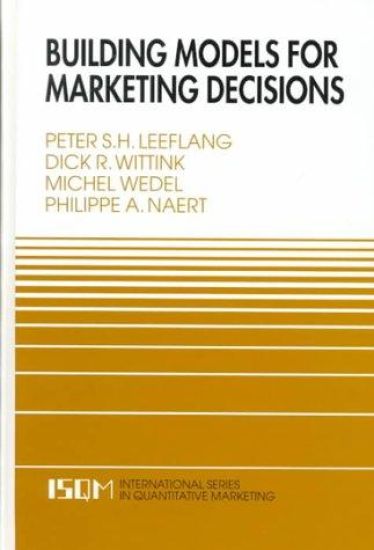
Building Models for Marketing Decisions

Building Models for Marketing Decisions

Peter S.H. Leeflang; Dick R. Wittink; Michel Wedel; Philippe A. Naert

Kluwer Academic Publishers
2000
sidottu
The market environment is changing rapidly. Prior to scanner data, ACNielsen, the major supplier of information on brand performances, said its business was to provide the score but not to explain or predict it. Now, model-based insights are not only demanded by managers, but can also be meaningfully provided. It is common for managers in many countries to receive market feedback frequently, quickly and in great detail due to the use of scanners and computers. With advances in information technology and expertise in modeling, IRI introduced model-based services in the US that explain and predict essential parts of the marketplace. ACNielsen followed, and marketing researchers have been developing increasingly valid, useful and relevant models of marketplace behavior ever since. Models that provide information about the sensitivity of market behavior to marketing activities such as advertising, pricing, promotions and distribution are now routinely used by managers for the identification of changes in marketing programs that can improve brand performances. Building Models for Marketing Decisions describes marketing models that managers can use as an aid in decision making. It has long been known that even simple models outperform judgments in predicting outcomes in a wide variety of contexts. More complex models potentially provide insights about structural relations not available from casual observations. Although marketing models are now widely accepted, the quality of the marketing decisions is critically dependent upon the quality of the models on which those decisions are based. In this book, which is a revision and expansion of Naert and Leeflang's Building Implementable Marketing Models (1978), the authors discuss in detail the model-building process. They distinguish four parts in this process: specification, estimation, validation and use of models. Throughout the book, the authors provide examples and illustrations. This book will be of interest to researchers, analysts, managers and students who want to understand, develop or use models of marketing phenomena.
Building Models for Marketing Decisions

Building Models for Marketing Decisions

Peter S.H. Leeflang; Dick R. Wittink; Michel Wedel; Philippe A. Naert

Springer
2000
nidottu
This book is about marketing models and the process of model building. Our primary focus is on models that can be used by managers to support marketing decisions. It has long been known that simple models usually outperform judgments in predicting outcomes in a wide variety of contexts. For example, models of judgments tend to provide better forecasts of the outcomes than the judgments themselves (because the model eliminates the noise in judgments). And since judgments never fully reflect the complexities of the many forces that influence outcomes, it is easy to see why models of actual outcomes should be very attractive to (marketing) decision makers. Thus, appropriately constructed models can provide insights about structural relations between marketing variables. Since models explicate the relations, both the process of model building and the model that ultimately results can improve the quality of marketing decisions. Managers often use rules of thumb for decisions. For example, a brand manager will have defined a specific set of alternative brands as the competitive set within a product category. Usually this set is based on perceived similarities in brand characteristics, advertising messages, etc. If a new marketing initiative occurs for one of the other brands, the brand manager will have a strong inclination to react. The reaction is partly based on the manager's desire to maintain some competitive parity in the mar­ keting variables.
Market Segmentation

Market Segmentation

Michel Wedel; Wagner A. Kamakura

Springer
1999
sidottu
Modern marketing techniques in industrialized countries cannot be implemented without segmentation of the potential market. Goods are no longer produced and sold without a significant consideration of customer needs combined with a recognition that these needs are heterogeneous. Since first emerging in the late 1950s, the concept of segmentation has been one of the most researched topics in the marketing literature. Segmentation has become a central topic to both the theory and practice of marketing, particularly in the recent development of finite mixture models to better identify market segments. This second edition of Market Segmentation updates and extends the integrated examination of segmentation theory and methodology begun in the first edition. A chapter on mixture model analysis of paired comparison data has been added, together with a new chapter on the pros and cons of the mixture model. The book starts with a framework for considering the various bases and methods available for conducting segmentation studies. The second section contains a more detailed discussion of the methodology for market segmentation, from traditional clustering algorithms to more recent developments in finite mixtures and latent class models. Three types of finite mixture models are discussed in this second section: simple mixtures, mixtures of regressions and mixtures of unfolding models. The third main section is devoted to special topics in market segmentation such as joint segmentation, segmentation using tailored interviewing and segmentation with structural equation models. The fourth part covers four major approaches to applied market segmentation: geo-demographic, lifestyle, response-based, and conjoint analysis. The final concluding section discusses directions for further research.