Kirjojen hintavertailu – 12 859 818 kirjaa ja 27 kauppaa

Kirjailija

Michele Fratianni

Kirjat ja teokset yhdessä paikassa: 15 kirjaa, julkaisuja vuosilta 1978–2026, suosituimpiin kuuluu Currencies And The Foreign Exchange Market: International Finance For Business, Economics, And Accounting. Vertaile teosten hintoja ja tarkista saatavuus suomalaisista kirjakaupoista.

15 kirjaa

Kirjojen julkaisuvuodet: 1978–2026.

Currencies And The Foreign Exchange Market: International Finance For Business, Economics, And Accounting

Currencies And The Foreign Exchange Market: International Finance For Business, Economics, And Accounting

Francesco Marchionne; Michele Fratianni

World Scientific Publishing Co Pte
2026
Sidottu
Currencies and the Foreign Exchange Marketis a comprehensive and accessible introduction to how money functions in modern economies and how currencies interact in the global financial system. Drawing from rich historical context, the book explains the evolution of money — from early barter and commodity exchange to metal coinage, bank notes, fiat currency, and emerging digital and cryptocurrency forms. It shows how the exchange rate serves as the price linking two distinct national monies and demonstrates why currency markets became central to international trade and finance. The book explores the structure and astonishing scale of the foreign exchange market, now the world's largest financial market with over $7 trillion traded daily. Readers gain a clear understanding of spot transactions, forwards, swaps, futures, and options, along with how currency dealers, brokers, and exchanges operate to provide liquidity and price discovery. The text also demystifies key analytical concepts such as direct and indirect quotations, cross rates, bid-ask spreads, and real exchange rates, explaining their significance in practical trading and economic competitiveness. Written with clarity and supported by real market data and historical examples, this book serves as an ideal foundation for students, professionals, and anyone seeking a deeper understanding of how currencies shape global commerce and financial markets.

International Money And Finance

International Money And Finance

Michele Fratianni; Andreas Hauskrecht; Catalin Stefanescu

World Scientific Publishing Co Pte Ltd
2025
sidottu
This textbook explores important recent topics in international money and finance, including those on exchange rate regimes, the foreign exchange market, balance of payments, parity conditions, international capital flow, financial crises, and regulatory responses. Each chapter covering these topics is written like an academic paper with up-to-date sources and references. Country-specific boxes, short cases and applications are presented for readers to appreciate theories and apply them in the real world. International Money and Finance is a recommended text for MBA students and those taking advanced undergraduate, Master's and PhD courses in Economics and Finance.
The European Monetary System And European Monetary Union

The European Monetary System And European Monetary Union

Michele Fratianni; Jurgen Von Hagen

Routledge
2021
nidottu
When the European Monetary System (EMS) was created in 1978, economists on both sides of the Atlantic predicted its early failure. Today, EMS is alive and well, continuing to defy conventional economic wisdom. The authors address three major questions about the European Monetary System (EMS): how it came into being, how it works and how it may evolve into a fully-fledged monetary union.
Governing Global Finance

Governing Global Finance

Michele Fratianni; Paolo Savona

Routledge
2019
nidottu
This title was first published in 2002: As the twenty-first century began, it was easy to assume that the reforms to the international financial system undertaken in the last half of the 1990s were adequate to the core tasks of ensuring stability, sustained growth and broadly shared benefits in the world economy. That comfortable consensus has now been shattered. This volume critically assesses fundamental issues including: -the elements and adequacy of recent G7-led efforts at international financial reform -current causes of and prospects for growth in the new global economy -the challenges of crisis prevention -private sector participation and IFI responsibilities -the world’s monetary supply and sovereignty in the face of market forces. These key topics are examined by leading economists and scholars of political economy from both academic and policy communities in G7 countries, making it an essential addition to the collections of all those concerned with the challenges facing the world economy in the coming years.
The European Monetary System And European Monetary Union

The European Monetary System And European Monetary Union

Michele Fratianni; Jurgen Von Hagen

Routledge
2019
sidottu
When the European Monetary System (EMS) was created in 1978, economists on both sides of the Atlantic predicted its early failure. Today, EMS is alive and well, continuing to defy conventional economic wisdom. The authors address three major questions about the European Monetary System (EMS): how it came into being, how it works and how it may evolve into a fully-fledged monetary union.
Governing Global Finance

Governing Global Finance

Michele Fratianni; Paolo Savona

Routledge
2017
sidottu
This title was first published in 2002: As the twenty-first century began, it was easy to assume that the reforms to the international financial system undertaken in the last half of the 1990s were adequate to the core tasks of ensuring stability, sustained growth and broadly shared benefits in the world economy. That comfortable consensus has now been shattered. This volume critically assesses fundamental issues including: -the elements and adequacy of recent G7-led efforts at international financial reform -current causes of and prospects for growth in the new global economy -the challenges of crisis prevention -private sector participation and IFI responsibilities -the world’s monetary supply and sovereignty in the face of market forces. These key topics are examined by leading economists and scholars of political economy from both academic and policy communities in G7 countries, making it an essential addition to the collections of all those concerned with the challenges facing the world economy in the coming years.
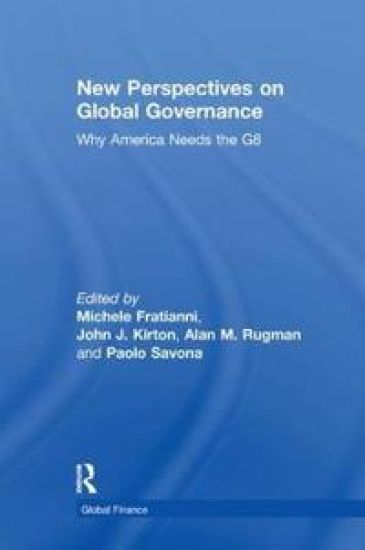
New Perspectives on Global Governance

New Perspectives on Global Governance

Michele Fratianni; Paolo Savona

Routledge
2017
nidottu
On its 30th anniversary in 2004 responsibility for hosting the G8 Summit fell into the hands of an allegedly unilateralist America. An America still reeling from the shock of the September 11th terrorist attacks, the resulting economic recession, bitter divisions with its NATO allies and disappointment with the United Nations Institutions over the 2003 Iraq war. So why does America still need the G8? New Perspectives on Global Governance offers new insight into the role of the Group of Eight's major market democracies and challenges the assumption that the G8 is simply a forum for binding a unilateralist hegemonic America. In contrast to seeing the G8 as a means of imposing an American world order this unique collection of new writings suggests that a now vulnerable America must rely on the G8 as a central instrument of foreign policy. America needs the G8 to achieve its security, economic and political interests in the world and to shape the twenty-first central global order it so desperately wants.
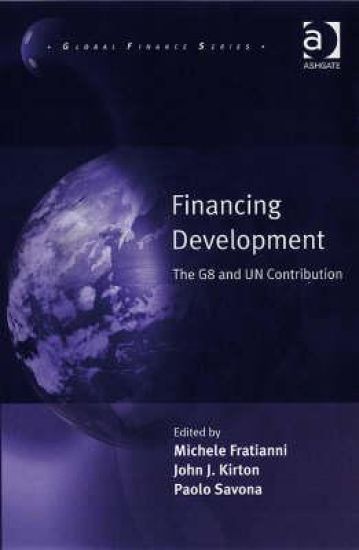
Financing Development

Financing Development

Michele Fratianni

Ashgate Publishing Limited
2007
sidottu
The critical challenge of financing development and sustainability is a key focus for the world's international financial institutions, led by the International Monetary Fund, the World Bank, and, above all, the G8. This volume assesses the current practice and perspectives of the major developed world countries that dominate the boards of the IMF and the World Bank and comprise the G8. It looks at the prospects for meeting the Millennium Development Goals in the most impoverished region of Africa, the way trade and finance instruments can help, and how the challenges of energy security and climate change control will affect the results. This volume offers in-depth analysis of: * how the Millennium Development Goals are to be met * North-to-South resource transfers * the challenges of controlling climate control beyond Kyoto In sum, this volume provides a critical and creative examination of what the G8 governments, especially at and after the 2005 Gleneagles summit, have done and what they should do to promote development and sustainability.
Corporate, Public and Global Governance

Corporate, Public and Global Governance

Michele Fratianni; Paolo Savona

Ashgate Publishing Limited
2007
sidottu
The intensifying pace of globalization has led to a questioning of the traditional approaches to governance at the corporate, national and international levels. The crash of the dot-com bubble and the outbreak of corporate accounting scandals in the United States, along with the debt burden of financial institutions in Japan and Europe, have led to demands for major reforms. Consequently, national governments are confronting stronger demands for new ways to regulate corporations to fulfil their social responsibilities and generate growth in a competitive world. This volume explores three central questions: what forms of corporate governance are most desirable for the globalizing world of the twenty-first century? What forms of public governance are most appropriate in this new age? And how well are the world's leading national governments pioneering the needed policies and practices? The book offers an analysis of the G8's role in assisting governments and corporations to work together to design and deliver a superior approach.
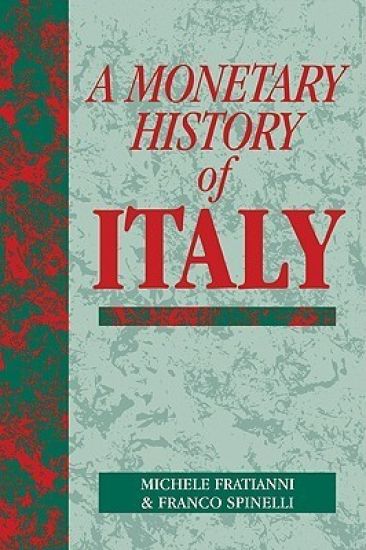
A Monetary History of Italy

A Monetary History of Italy

Michele Fratianni; Franco Spinelli

Cambridge University Press
2005
pokkari
This volume deals with the monetary history of Italy from its independence in 1861 to 1992. It provides the first complete analysis of a country which has experienced diverse and often dramatic monetary conditions. The authors interpret Italian monetary history through the looking glass of a model which, while monetarist in flavour, is open to other interpretations. A key theme is that public finance is at the root of the (relatively) high Italian inflation rates. The authors argue that there is a strong relationship between the government budget deficit and monetary policy, and that the monetary authorities are too dependent on government. The book contributes in a novel way not only to the monetary debate, but also to fiscal and institutional questions. It combines economic theory, statistical data and history in an accessible way which should prove useful to both economic historians and monetary economists.
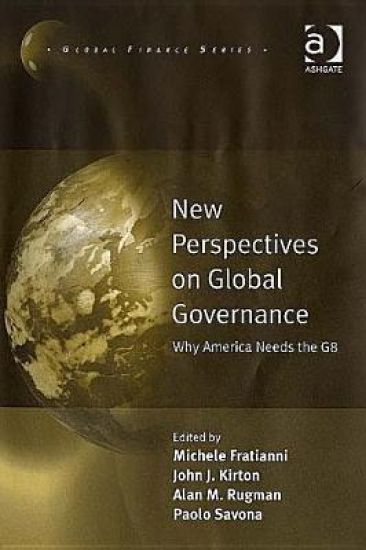
New Perspectives on Global Governance

New Perspectives on Global Governance

Michele Fratianni; Paolo Savona

Ashgate Publishing Limited
2005
sidottu
On its 30th anniversary in 2004 responsibility for hosting the G8 Summit fell into the hands of an allegedly unilateralist America. An America still reeling from the shock of the September 11th terrorist attacks, the resulting economic recession, bitter divisions with its NATO allies and disappointment with the United Nations Institutions over the 2003 Iraq war. So why does America still need the G8? New Perspectives on Global Governance offers new insight into the role of the Group of Eight's major market democracies and challenges the assumption that the G8 is simply a forum for binding a unilateralist hegemonic America. In contrast to seeing the G8 as a means of imposing an American world order this unique collection of new writings suggests that a now vulnerable America must rely on the G8 as a central instrument of foreign policy. America needs the G8 to achieve its security, economic and political interests in the world and to shape the twenty-first central global order it so desperately wants.
A Monetary History of Italy

A Monetary History of Italy

Michele Fratianni; Franco Spinelli

Cambridge University Press
1997
sidottu
This volume deals with the monetary history of Italy from its independence in 1861 to 1992. It provides the first complete analysis of a country which has experienced diverse and often dramatic monetary conditions. The authors interpret Italian monetary history through the looking glass of a model which, while monetarist in flavour, is open to other interpretations. A key theme is that public finance is at the root of the (relatively) high Italian inflation rates. The authors argue that there is a strong relationship between the government budget deficit and monetary policy, and that the monetary authorities are too dependent on government. The book contributes in a novel way not only to the monetary debate, but also to fiscal and institutional questions. It combines economic theory, statistical data and history in an accessible way which should prove useful to both economic historians and monetary economists.